operating
Mandatory driver assistance systems: the four dates in Annex II
Regulation (EU) 2019/2144 phases seven advanced systems onto trucks and buses on four separate timetables. Which apply to M2, M3, N2 and N3, from when, and what a registration date proves.
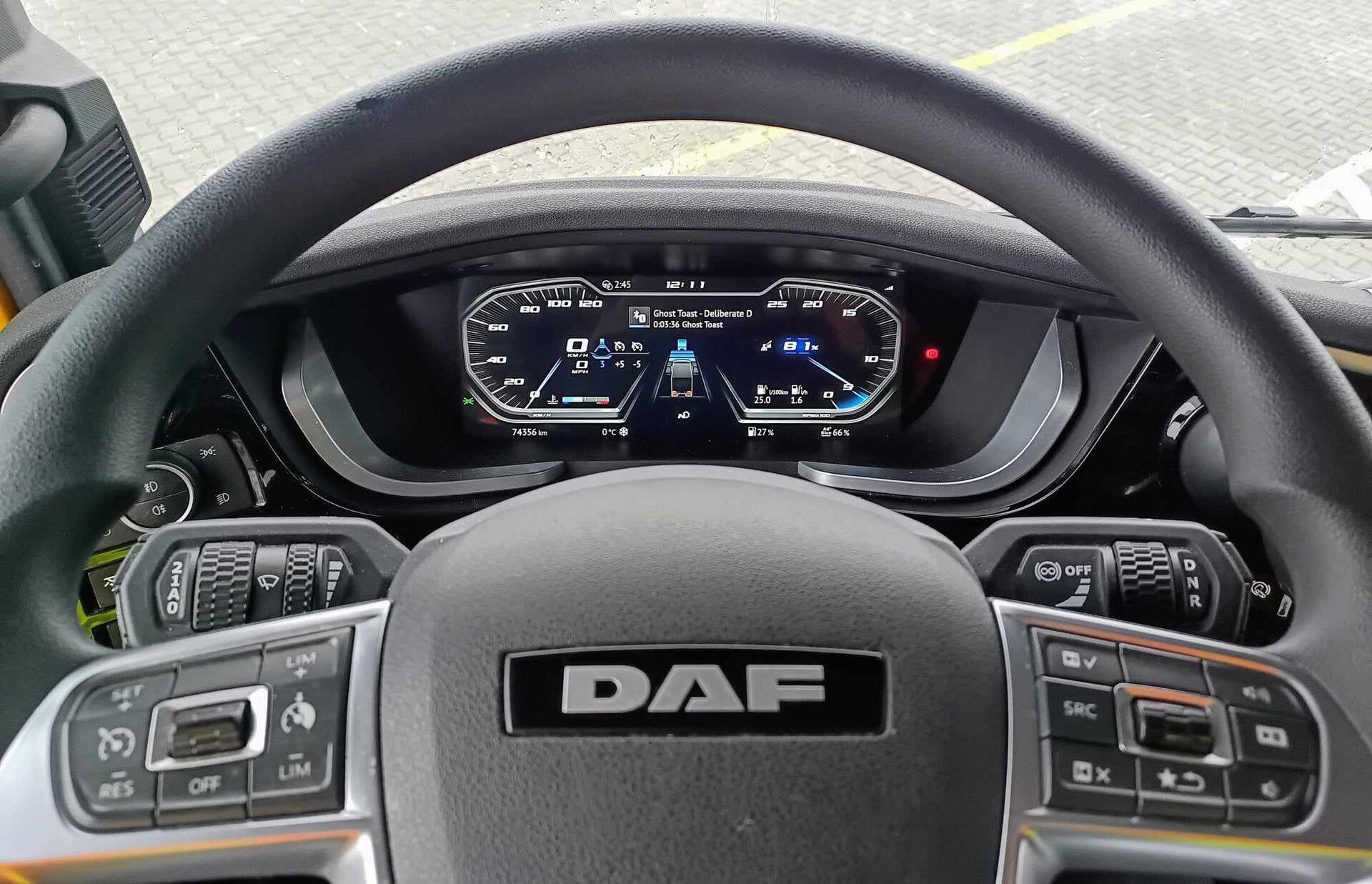
Put a 2022 tractor unit and a 2025 one side by side on a used lot and neither specification sheet will say which safety systems each is legally obliged to carry. Regulation (EU) 2019/2144, the EU General Safety Regulation, is usually described as if it switched on in July 2022. Article 19 does say it applies from 6 July 2022, with a list of empowerment provisions applying from 5 January 2020, but that is when the framework began to work, not when any particular system became compulsory. Those dates are in Annex II, and there are four different sets of them.
One regulation, four calendars
Annex II is a table of requirements against vehicle categories; each filled cell carries a letter — A, B, C, D, X or IF — pointing to a note at the foot of it, and only the first four of those are dates. Article 16 says what the dates in those notes do: point (a) makes national authorities refuse EU or national type-approval to a new type that does not comply; point (b) makes them treat certificates of conformity for new vehicles as no longer valid and prohibit registration; point (c) prohibits the placing on the market of non-compliant components and separate technical units.
| Note | EU type-approval refused for a new type from | Registration prohibited, and components no longer placed on the market, from |
|---|---|---|
| A | no separate date given | 6 July 2022 |
| B | 6 July 2022 | 7 July 2024 |
| C | 7 July 2024 | 7 July 2026 |
| D | 7 January 2026 | 7 January 2029 |
Two things follow. Note A prints one date only, the registration prohibition, and no type-approval date at all; rows C2 and C8 below show why, because the requirements carrying it were already binding before this regulation replaced its predecessor and there was no new approval cut to make. Reading note A that way is ours. And the gap in the other three notes is the whole point: notes B and C leave two years between the two cuts and note D leaves three, that subtraction being ours too. Inside the gap a manufacturer may keep registering vehicles of a type approved before the first cut, so a system is compulsory on new types long before it is compulsory on new vehicles.
The seven systems every motor vehicle must carry
Article 6(1) is the list that applies across the categories: intelligent speed assistance, alcohol interlock installation facilitation, driver drowsiness and attention warning, advanced driver distraction warning, emergency stop signal, reversing detection, and event data recorder. Read against the M2, M3, N2 and N3 columns of Annex II, those seven do not share a timetable.
| Code | Requirement | Regulatory act named in Annex II | Note |
|---|---|---|---|
| B7 | Reversing detection | UN Regulation No 158 | B |
| D8 | Intelligent speed assistance | Delegated Regulation (EU) 2021/1958 | B |
| D16 | Emergency stop signal | UN Regulation No 48 | B |
| E1 | Alcohol interlock installation facilitation | Delegated Regulation (EU) 2021/1243 | B |
| E2 | Driver drowsiness and attention warning | Delegated Regulation (EU) 2021/1341 | B |
| E3 | Advanced driver distraction warning | Delegated Regulation (EU) 2023/2590 | C |
| E5 | Event data recorder | Delegated Regulation (EU) 2024/2220, UN Regulation No 169 | D |
Five of the seven carry note B, one note C and one note D. That count is ours; Annex II prints no total. It answers the used-lot question. A vehicle registered in June 2024 could lawfully lack all seven. One registered in August 2024 must have the five under note B. The two later rows have to be read against the approval, not the year. A 2025 truck or coach built to a type approved before 7 July 2024 need not carry advanced driver distraction warning, because note C stops registration only from 7 July 2026; one built to a type approved on or after 7 July 2024 does, because Article 16(a) closes new-type approvals first. Neither needs an event data recorder: note D refuses approval to a new type from 7 January 2026 and prohibits registration from 7 January 2029, both of them after the vehicle was built.
The event data recorder is the row that splits
E5 is the only one of the seven whose note letter changes with the vehicle category. In the M1 and N1 columns it is note B, under Delegated Regulation (EU) 2022/545 and UN Regulation No 160. In the M2, M3, N2 and N3 columns it is note D, and until 2024 the regulatory act cell for those categories was empty. Delegated Regulation (EU) 2024/2220 filled it: Article 1 confines it to M2, M3, N2 and N3, Article 2 makes the system comply with UN Regulation No 169 plus its own Articles 3 to 5, and Article 7 applies it from 7 January 2026.
What the recorder must do is prescribed tightly. Under Article 6(4)(b) and 6(5) of the parent regulation it cannot be deactivated, and it must not be capable of storing the last four digits of the vehicle indicator section of the VIN or anything else identifying the vehicle, its owner or its holder. Article 4 of Delegated Regulation (EU) 2024/2220 requires the data to be retrievable through the serial data port on the standardised data link connector, by direct connection where a collision has killed that port, in a machine-readable format, and specifically not over wireless interfaces or any interface reachable without unlocking the vehicle or using tools.
Intelligent speed assistance is not a speed limiter
D8 is the row most often misdescribed. Article 6(2)(d) is explicit that intelligent speed assistance “shall not affect the possibility, for the drivers, of exceeding the system’s prompted vehicle speed”, and Article 6(2)(b) requires that it be possible to switch off. Delegated Regulation (EU) 2021/1958 sets out how. Under point 2.1 of its Annex I the system comprises a speed limit information function together with either a speed limit warning function or a speed control function. That is a floor rather than an exclusive election: point 3.6.5 allows a system built on the warning function to have speed-control-like characteristics as well, as long as the override and positive action requirements of point 3.6.1.4 are observed. Where the manufacturer chooses the speed control function, point 3.6.1.1 restricts how it may intervene on a heavy vehicle: it acts by reducing propulsion power and driveline torque, it shall not actuate the service braking system except on M1 and N1, an endurance brake such as a retarder may be incorporated only once propulsion power has already been restricted to a minimum, and the deceleration rate must be no more than 3.0 m/s². Point 3.6.1.4 requires that the driver can override the intervention by a positive action, and forbids a design in which the only way to do so is accelerator kick-down.
Deactivation is equally prescribed. Point 3.2.1 allows the driver to switch the system off fully or partially; point 3.2.1.1 makes it reinstate itself in normal operation mode on each activation of the vehicle master control switch, optionally conditional on the driver’s door having been opened. One clause belongs in a cost calculation rather than a safety one. Point 3.4.2.5.5.2 attaches wherever electronic data is used to achieve the required performance, not to map data alone: updates must then be made available to vehicle owners until seven years after the date of manufacture, at least on an annual basis where the data is map-based, and free of charge — except, the point says, for the possible cost of common storage media, use of a personal computer, an operating system, private or mobile internet charges, and travel to an authorised dealer, repairer, distributor or independent repairer. Subsequent updates may be subject to the payment of a reasonable fee. Point 3.4.2.5.5.1 reaches further out, requiring the manufacturer to ensure that the reliability of speed limit determination is maintained for at least 14 years after the date of manufacture. The excepted costs and the fee after year seven are what land on a used vehicle before anything mechanical does, alongside the checks that already come first when buying a used truck.
Alcohol interlock facilitation is wiring, not a breathalyser
Article 3(4) defines alcohol interlock installation facilitation as “a standardised interface that facilitates the fitting of aftermarket alcohol interlock devices in motor vehicles”. No interlock is supplied with the vehicle. Delegated Regulation (EU) 2021/1243 requires, at point 1 of Annex I, that the facilitation allow the fitting or retrofitting of a device complying with EN 50436-1:2014 or EN 50436-2:2014+A1:2015, and at point 2 that each vehicle conform to an installation document to EN 50436-7:2016. Point 3.4 limits what a fitted device may do: it may intervene only in the starting process or in allowing the vehicle to move under its own power upon activation of the master control switch, and it “shall not influence a running engine or a moving vehicle”.
What only buses and trucks carry
Article 9 adds requirements for M2, M3, N2 and N3 on top of Article 6. Paragraph 2 requires a lane departure warning system and an advanced emergency braking system. Paragraph 3 is a separate obligation on a separate system: advanced systems capable of detecting pedestrians and cyclists in close proximity to the front or nearside of the vehicle and of providing a warning or avoiding collision. Paragraph 5 requires the vehicle to be designed to enhance direct visibility of vulnerable road users from the driver seat by reducing blind spots in front of and to the side of the driver. Paragraph 6 applies only to M2 and M3 with a capacity exceeding 22 passengers in addition to the driver and constructed with areas for standing passengers to allow frequent passenger movement; those must be designed and constructed to be accessible by persons with reduced mobility, including wheelchair users. The purpose clause is doing the work — an incidental standing area is not an area built for frequent movement — and it puts the threshold closer to the passenger classes used in bus type-approval than to the vehicle’s size.
| Code | Requirement | Regulatory act named in Annex II | Note |
|---|---|---|---|
| C2 | Lane departure warning system | UN Regulation No 130 | A, with note (4) |
| C8 | Advanced emergency braking on heavy-duty vehicles | UN Regulation No 131 | A, with note (4) |
| B5 | Pedestrian and cyclist collision warning | UN Regulation No 159 | B |
| B6 | Blind spot information system | UN Regulation No 151 | B |
| C14 | Tyre pressure monitoring for heavy-duty vehicles | UN Regulation No 141 | B |
| B9 | Heavy-duty vehicles direct vision | UN Regulation No 167 | D |
C14 reaches beyond the motor vehicle: heavy-duty tyre pressure monitoring carries note B in the O3 and O4 columns too, so it lands on heavy trailers as well.
The two note A rows are the ones that were not new. Regulation (EC) No 661/2009 already required an advanced emergency braking system and a lane departure warning system on M2, M3, N2 and N3 under its Article 10(1) and 10(2), with type-approval refused from 1 November 2013 by Article 13(12) and registration prohibited from 1 November 2015 by Article 13(13). Neither obligation was unconditional: both paragraphs of Article 10 opened “Subject to exemptions established in accordance with Article 14(3)(a)”, and the exemptions were duly made. Article 1 of Commission Regulation (EU) No 347/2012 for braking and Article 1 of Commission Regulation (EU) No 351/2012 for lane departure each excluded the same six groups of vehicle that Annex II note (4) now lists, the first of them semi-trailer towing vehicles of category N2 over 3.5 and up to 8 tonnes. The braking regulation held its own dates back further: Article 3(2) applied the 1 November 2015 registration prohibition without the approval level 2 requirements and with the exception of vehicles not equipped with pneumatic rear axle suspension, and Article 3(4) prohibited registration on the full obligation only with effect from 1 November 2018.
EUR-Lex records Regulation (EC) No 661/2009 as no longer in force, end of validity 5 July 2022; Article 18(1) of Regulation (EU) 2019/2144 repealed it together with both implementing regulations, and Article 9(2) re-enacted the pair. A tractor unit outside those six groups and on pneumatic rear axle suspension, registered new in 2016, therefore already had both, and a seller presenting them as a recent upgrade is describing a decade-old requirement. A 3.5 to 8 tonne N2 semi-trailer towing vehicle of the same year lawfully had neither, and a steel-sprung one above that weight lawfully had no emergency braking system.
At the other end, B9 is the newest row in the table. Direct vision had no regulatory act attached until Delegated Regulation (EU) 2025/1122 added UN Regulation No 167 for M2, M3, N2 and N3. It carries note D, so approvals for new types close on 7 January 2026 and registrations on 7 January 2029 — the compliance clock running behind current truck cab design.
Note (4) is where frames get widened by accident
Rows C2 and C8 carry a footnote exempting six groups of vehicle: semi-trailer towing vehicles of category N2 with a maximum mass exceeding 3.5 but not exceeding 8 tonnes; vehicles of categories M2 and M3 of Class A, Class I and Class II as defined in paragraph 2.1 of UN Regulation No 107; articulated buses of category M3 of those same three classes; off-road vehicles of categories M2, M3, N2 and N3; special purpose vehicles of those categories; and vehicles of those categories with more than three axles. Only two of the six turn on passenger class, so an exemption argued from class alone is incomplete in both directions — which matters when buying a used coach built around one of the other four groups.
Read the approval, not the model year
Article 16(b) hangs the registration prohibition on the certificate of conformity, and Article 15(1) preserves EU type-approvals granted under Regulations (EC) No 78/2009, (EC) No 79/2009 or (EC) No 661/2009 by 5 July 2022 unless this regulation modified the relevant requirements or added new ones. Together they mean the timetable runs on the approval a vehicle was built to, not on its build year or its marketing generation.
For a purchase specification, that makes the Annex II code and the UN Regulation number the useful reference. “Blind spot detection” is a sales phrase; requirement B6 under UN Regulation No 151 is something an approval authority can confirm. The categories come from Article 4 of Regulation (EU) 2018/858 — N2 over 3.5 and up to 12 tonnes, N3 over 12 tonnes, M2 and M3 the passenger split at 5 tonnes — and a specification naming the category, the code and the UN Regulation is checkable against a certificate of conformity. A brand name for the same function is not. Some makers do print the acronyms: the current Iveco Eurocargo brochure lists AEBS, LDWS, BSIS, MOIS, ADDW, ISA, ESS and TPMS by name on a 7.5-tonne chassis, though a brochure is still not a certificate of conformity.
Quick answers
- When did driver assistance systems become mandatory on new trucks?
- There is no single date. Regulation (EU) 2019/2144 applies from 6 July 2022 under Article 19, but the dates sit in the letters Annex II puts in each cell. Note A gives one date only, the prohibition of registration on 6 July 2022. Notes B, C and D each give a date for refusing EU type-approval to a new type and a later date for prohibiting registration, the last of them 7 January 2029. Cells marked X or IF carry no date at all.
- Does a 2025 truck have to have an event data recorder?
- Not necessarily. The event data recorder row carries note D for M2, M3, N2 and N3, so EU type-approval is refused for a new type from 7 January 2026 and registration is prohibited from 7 January 2029. On cars and vans the same row carries note B, which bit on 6 July 2022 and 7 July 2024.
- Can the driver switch off intelligent speed assistance?
- Yes. Article 6(2)(b) of Regulation (EU) 2019/2144 requires that it be possible to switch the system off, and point 3.2.1.1 of Annex I to Delegated Regulation (EU) 2021/1958 requires it to be reinstated in normal operation mode upon each activation of the vehicle master control switch. Article 6(2)(d) says the system shall not affect the possibility, for drivers, of exceeding its prompted speed.
- Is an alcohol interlock fitted to new trucks and buses?
- No. Article 3(4) defines alcohol interlock installation facilitation as a standardised interface that facilitates the fitting of aftermarket alcohol interlock devices. Delegated Regulation (EU) 2021/1243 requires the vehicle to allow the fitting or retrofitting of a device to EN 50436-1:2014 or EN 50436-2:2014+A1:2015, and an installation document to EN 50436-7:2016. The device itself is not supplied.
- Which trucks and buses are exempt from lane departure warning and heavy-duty AEBS?
- Annex II note (4) lifts requirements C2 and C8 for six groups: N2 semi-trailer towing vehicles over 3.5 and up to 8 tonnes; M2 and M3 vehicles of Class A, Class I and Class II; articulated M3 buses of those classes; off-road vehicles of M2, M3, N2 and N3; special purpose vehicles of the same categories; and vehicles of those categories with more than three axles.
Sources
- Regulation (EU) 2019/2144 on general safety type-approval requirements — consolidated text of 2 August 2026 (Articles 3, 6, 9, 15, 16 and 19, and Annex II with its notes) — EUR-Lex, European Union
- Regulation (EU) 2019/2144 — original text as published in OJ L 325, 16 December 2019 — EUR-Lex, European Union
- Commission Delegated Regulation (EU) 2021/1958 on intelligent speed assistance systems — EUR-Lex, European Union
- Commission Delegated Regulation (EU) 2021/1243 on alcohol interlock installation facilitation — EUR-Lex, European Union
- Commission Delegated Regulation (EU) 2024/2220 on event data recorders for heavy-duty motor vehicles — EUR-Lex, European Union
- Commission Delegated Regulation (EU) 2025/1122 adding UN Regulations Nos 167, 169 and 171 to Regulation (EU) 2019/2144 — EUR-Lex, European Union
- Regulation (EC) No 661/2009 on general safety type-approval requirements — document information (status: no longer in force, end of validity 5 July 2022, repealed by 32019R2144) — EUR-Lex, European Union
- Regulation (EU) 2018/858 on the approval and market surveillance of motor vehicles — Article 4, vehicle categories — EUR-Lex, European Union
- Commission Regulation (EU) No 347/2012 implementing Regulation (EC) No 661/2009 as regards advanced emergency braking systems — Articles 1 and 3 (status: no longer in force, end of validity 5 July 2022, repealed by 32019R2144) — EUR-Lex, European Union
- Commission Regulation (EU) No 351/2012 implementing Regulation (EC) No 661/2009 as regards lane departure warning systems — Article 1 (status: no longer in force, end of validity 5 July 2022, repealed by 32019R2144) — EUR-Lex, European Union