Kögel
Kögel Cargo
Ten named variants on one deck. What the Kögel Cargo's tare, bogie rating and fifth-wheel load each mean, what Kögel does not publish, and what to establish before buying used.
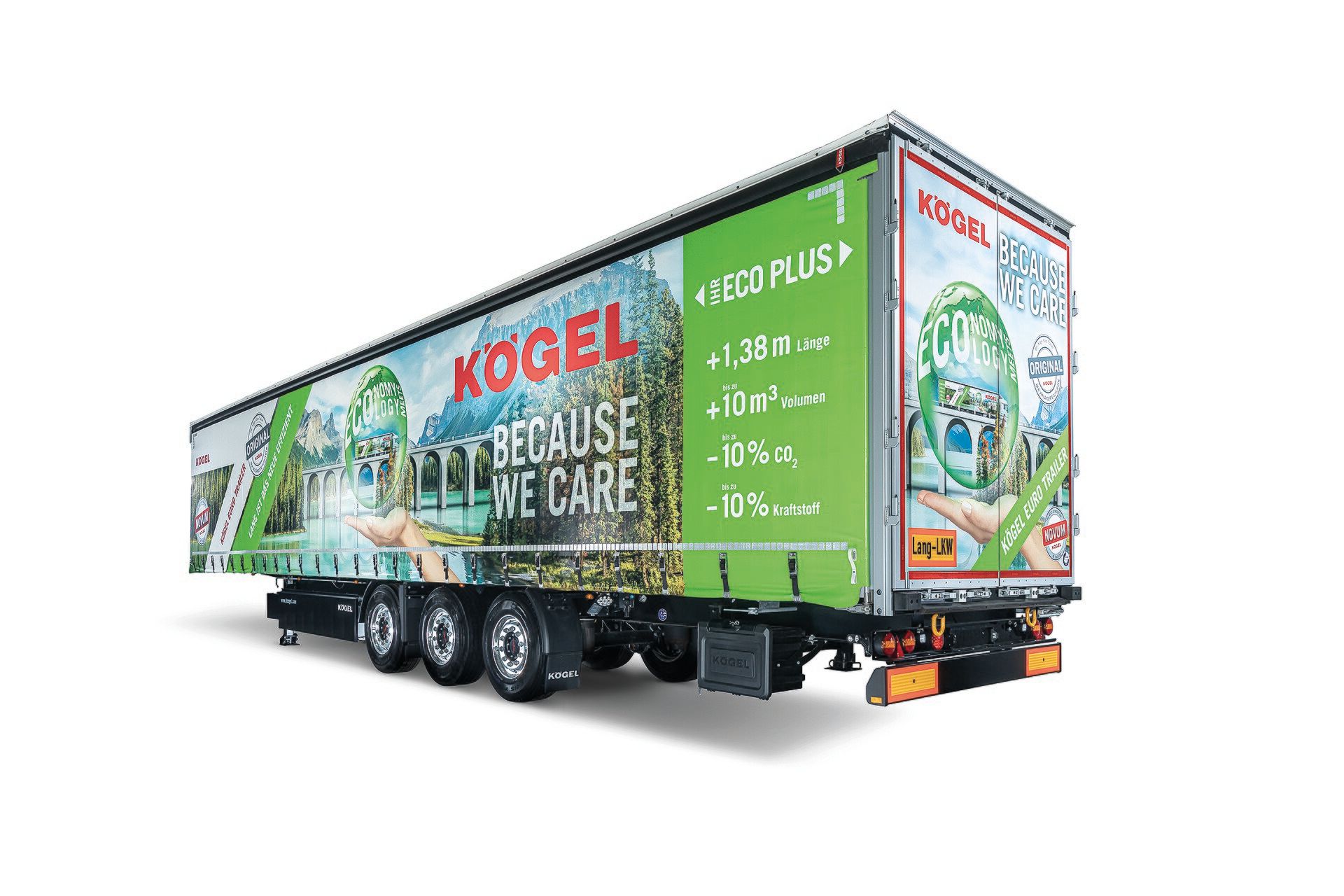

Model overview
Axle variants: tri-axle · two-axle
The figures shown are the CARGO P90, the base three-axle curtainsider, and the tare is Kögel's own "in basic configuration". Kögel lists ten named Cargo variants against the same 13,620 mm deck and the ladder is worth reading as one. The 120 mm frame neck of the P120 raises the technically feasible fifth-wheel load to 15,000 kg and the permissible total to 42,000 kg; the reinforced 120 mm neck of the Nordic P120 reaches 18,000 kg and 45,000 kg on an extended wheelbase at a 6,060 kg tare; the two-axle Cargo drops to an 18,000 kg bogie and a 30,000 kg total at 5,400 kg. The bogie rating stays at 27,000 kg across every three-axle variant, so it is the fifth-wheel load that moves the permissible total. Bodywork is paid for in tare rather than in capacity: 6,650 kg for the Coil with its 7.2 m or 9 m coil trough, 6,900 kg for the Coil Rail, 6,520 kg for the EuroTrailer, whose 15,000 mm deck Kögel describes as 1.38 m longer than the standard semi-trailer. The wooden floor is rated for a 7,200 kg forklift axle load as standard, optionally 8,000, 9,000 or 9,500 kg, and the optional Strong & Go body meets Daimler Guideline 9.5 without insert slats.
The Cargo is the standard curtainsider in Kögel’s tarpaulin range, and an unusually legible trailer to read a specification on. Most makers publish one data block per model; Kögel publishes ten, giving each named Cargo variant a technically feasible fifth-wheel load, an axle-unit load, a permissible total weight, a tare weight in basic configuration and a clear loading length. Set the ten side by side and the vehicle explains itself. The record here is the CARGO P90, the base three-axle version.
The deck is the one thing that does not move
Every Cargo except the two EuroTrailer variants has the same clear loading length, 13,620 mm, and that is not a Kögel decision. Krone and Schmitz Cargobull publish the same deck for their standard curtainsiders, as semi-trailer dimensions sets out from their data sheets. All three land there because the envelope is drawn at the kingpin rather than at either end of the trailer, and a third independent maker arriving at the same figure turns a two-maker coincidence into a convergence.
The exception shows where the constraint sits. Kögel’s two EuroTrailer variants carry a 15,000 mm deck, 1.38 m longer than the standard semi-trailer in the company’s own words, registrable in EU countries under a derogation regulation — a different legal animal, not a longer version of the same one.
What changes is the front of the frame
The ordering axis on a Cargo is the frame neck, offered at 90 mm and at 120 mm. The number is a height rather than a strength grade: Kögel says the shallower neck allows a higher body and a larger load volume, the deeper one a reinforced front section of the frame.
The ladder starts there. The P90’s 90 mm neck is rated at a technically feasible fifth-wheel load of 12,000 kg, stated for two-axle tractors, against a 39,000 kg permissible total weight. The P120’s 120 mm neck takes 15,000 kg, stated for three-axle tractors, and 42,000 kg total. The Nordic P120 has a reinforced 120 mm neck, 18,000 kg of fifth-wheel load and 45,000 kg total, on an extended wheelbase Kögel describes as optimised for three-axle tractors.
Now look at what does not change across those three: the axle-unit rating stays at 27,000 kg throughout, so the permissible total rises only because the load the trailer imposes on the tractor rises. That is the clearest worked example this site has of what the kingpin and fifth wheel argues in the abstract — the imposed vertical load is a property of the pairing, not of either vehicle — and it is why “which tractor” comes before “which trailer”. Whether a tractor can take 15,000 or 18,000 kg through its fifth wheel without breaching a drive-axle limit is a question about axle configuration.
The two-axle Cargo runs the same ladder downwards: an 18,000 kg axle unit, a 30,000 kg permissible total and a 5,400 kg tare, on the identical 13,620 mm deck.
Three weights, and why they are three
The three weights in the overview above are not versions of one number. The tare, 5,920 kg, is what the trailer weighs empty and the only one a buyer cannot change after it is built; Kögel qualifies it “in basic configuration”, and that qualifier is Kögel’s own. The permissible total, 39,000 kg, is what the loaded trailer may weigh. The axle load, 27,000 kg, is the rating of the three-axle unit underneath, less than the total because the fifth wheel carries the rest.
Subtract the first from the second and the answer is 33,080 kg. That subtraction is ours: Kögel publishes no payload figure for any Cargo variant. It is also a statement about the trailer’s own structure, not about what may be run on a road, because the road limit applies to the whole combination and that contains a tractor too. A five- or six-axle articulated vehicle is held to 40 tonnes in the European rules described in gross vehicle and gross combination weight, and no trailer rating lifts it. Reading a trailer’s plate as a payload is the most expensive misreading on a specification sheet.
The tare is also the figure that never goes away: it comes off the payload laden and is carried empty, which puts it beside fuel and tyres in tractor unit running costs rather than in the purchase price.
The body is a certificate
Kögel sells the Cargo with a CO body — sliding tarpaulin tensioned against the external frame — and a CS body with drop sides and tarpaulin cords or tensioners. Both carry, in Kögel’s words, an EN 12642 XL certificate without slats.
That phrase is worth not paraphrasing. The certification is a statement about the strength of the body structure; “without slats” is a statement about what an operator does not have to insert before it applies. Kögel goes further with the optional Strong & Go body, which it says complies with Daimler Guideline 9.5 without insert slats and offers for beverage transport. None of that replaces the work of load securing; it changes what that work consists of.
One floor figure belongs here rather than in that article: the wooden floor is rated for a forklift axle load of 7,200 kg as standard, with 8,000, 9,000 and 9,500 kg as options — a limit on the machine that drives onto the deck, not on the freight.
What we could not confirm
Kögel publishes no interior height for the Cargo. The only such statement on the product page is an optional FlexiUse body that increases or reduces it by 200 mm — a difference with no baseline to apply it to. Kögel does publish a 3 m interior height, but for the MEGA, a different model, and that figure is not carried across here. No pallet capacity is published either: the brochure’s only pallet figure, 37 Euro pallets, is stated for the EuroTrailer’s 15,000 mm deck and says nothing about a 13,620 mm one.
No coupling height is published as a coupling height. Kögel’s internal type codes carry a suggestive number after a slash — S24P90/1100, S24P120/1070 — which behaves the way a coupling height would. But the legend in Kögel’s NOVUM brochure defines only the frame neck height and never the figure after the slash, in the German edition or the English one, so filling that row would be a decode rather than a citation. No internal width is published either, and the 2,480 mm other makers give belongs to their trailers, not this one.
There is no per-model data sheet at all. Kögel’s technical-information download page loads, and holds guide times, a maintenance checklist, a tank-chassis works standard and a parts catalogue — no dimension drawing for any Cargo. Nothing was published about the model’s braking on any page opened for this record either, so nothing is said about it here beyond the general subject of trailer braking systems.
Where two Kögel documents disagree, follow the German. The English tarpaulin brochure renders Aggregatlast — the load on the axle unit — as “axle load” in one legend entry and as “gross vehicle weight” in another, turning the Nordic’s 18,000 kg fifth-wheel load into an axle load and the 10-tonne two-axle variant’s 20,000 kg axle-unit rating into a gross weight. The German brochure and both product pages agree with each other; the English legend is the outlier.
Finally the production date. 2018 dates the NOVUM generation, not the Cargo nameplate, which is older. Kögel’s launch announcement for the NOVUM-generation Cargo is dated 20 August 2018 and now returns 404 on koegel.com in both languages; it was read for this record in an Internet Archive capture, and the company brochure’s history timeline carries the same event in the same part of its 2010 to 2020 spread.
Who the Cargo is for
A general-haulage operator moving palletised freight on a standard-height deck and buying on tare rather than volume. The P90 is the plain answer: the lightest published Cargo on a three-axle chassis, with a fifth-wheel load a two-axle tractor can take, on the same deck as everything else in the market.
The variants then sort themselves by industry rather than size. Coil work takes the Coil at 6,650 kg against the P90’s 5,920 kg, the difference being what a recess in the frame and a 7.2 m or 9 m trough cost in tare — our subtraction from Kögel’s two figures. Road-rail work takes a Rail variant, built to be loaded by crane. A market that plates higher takes the Nordic P120. Volume work does not take a Cargo at all; it takes the Mega, a separate model and a separate record.
Where it sits against its rivals
On paper the base Cargo and its two German rivals are the same trailer. The figures trailer types explained sets out for Krone’s Profi Liner are the same four — 13,620 mm of deck, 27,000 kg of axle load, 12,000 kg of fifth-wheel load, 39,000 kg permissible total — and Schmitz Cargobull’s curtainsider lands on the same body length.
Published tares sit within a few tens of kilograms of each other and the temptation is to rank them, which should be resisted: the three are differently qualified. Kögel’s is stated in basic configuration, Krone’s is a flat dead weight against a fully specified model code, Schmitz Cargobull’s an open-ended “from”. A gap smaller than the qualifiers’ own looseness is not a ranking.
What distinguishes Kögel is the breadth of what it publishes. Ten named variants with five figures each — a 45,000 kg Nordic and a 30,000 kg two-axle at opposite ends of the same deck — is more of the range published than either rival gives, and to a buyer specifying an unusual duty that is worth more than a 20 kg difference in tare.
Buying used
Establish which of the ten variants the trailer is before anything else: the differences are structural and none can be changed afterwards. The frame neck decides which tractors it can work behind, so a P90 bought for work that needs 15,000 kg through the coupling is the wrong trailer, and a Nordic outside the market it was built for is extra tare with no return.
Read the tare against the specification rather than the brochure. The 5,920 kg is a basic-configuration figure and a used trailer rarely is: RoRo equipment, stanchion pockets for steel, a heavier floor rating and a Strong & Go body have all been paid for in kilograms. The plate on the trailer is what matters.
The XL certificate is paperwork as much as structure: Kögel states it for the CO and the CS body as built, and what a given trailer still carries after a working life is a question for its documents. The rest of the sequence is the same as for buying a used tractor — specification and papers first, mechanical inspection second — because no workshop can change what the trailer already is.
Compared with
- Krone Profi Liner
- Schmitz Cargobull S.CS
- Schwarzmüller curtainsider
Sources
- KÖGEL CARGO — product detail, vehicle variants — Kögel Trailer GmbH
- KÖGEL CARGO — Produktdetail, Fahrzeugvarianten — Kögel Trailer GmbH
- Tarpaulin vehicles — product brochure — Kögel Trailer GmbH
- Planenfahrzeuge — Prospekt — Kögel Trailer GmbH
- Kögel company brochure — company history 2010 to 2020 — Kögel Trailer GmbH
- Kögel presents Kögel Cargo NOVUM at the Transport Compleet Hardenberg 2022 — Kögel Trailer GmbH, 2 Jun 2022
- Kögel NOVUM Generation — Bestseller Cargo Now Even More Flexible and Robust (archived capture, live URL now 404) — Kögel Trailer GmbH via the Internet Archive, 20 Aug 2018