segments
Bus Doors and Emergency Exits Under UN Regulation 107
How UN Regulation No. 107 fixes the number, position and size of a bus's service doors and emergency exits, and what opens a power-operated door when the supply fails.
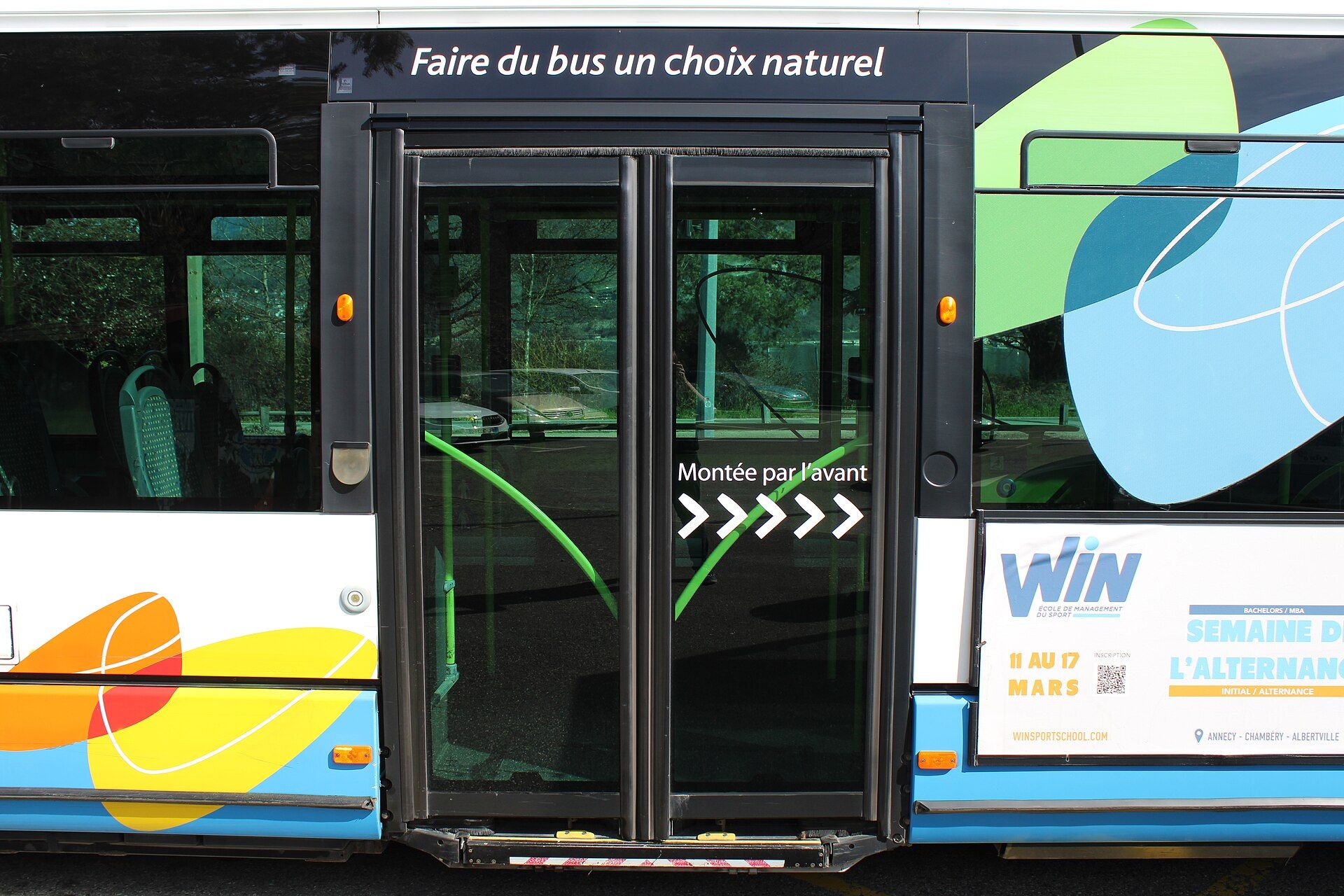
A bus is counted twice for exits, by two tables that do not talk to each other, and the second count is the one that surprises people. The first table asks how many service doors the vehicle needs. The second asks how many exits of every kind it needs in total. A Class III coach can satisfy the first with a single door and still owe five more openings under the second.
Which rulebook, and which of them is still in force
The instrument is UN Regulation No. 107. Paragraph 1.1 applies it to every single-deck, double-deck, rigid or articulated vehicle of category M2 or M3, and paragraph 1.2 lifts four kinds out again: vehicles for the secure transport of persons, for example prisoners; vehicles specially designed for the carriage of injured or sick persons; off-road vehicles; and vehicles specially designed for the carriage of school children. Article 4(1)(a) of Regulation (EU) 2018/858 fixes the categories — M2 and M3 both carry more than eight seating positions in addition to the driver, divided at a maximum mass of 5 tonnes.
The European Union once wrote its own bus construction rules and no longer does. EUR-Lex records Directive 2001/85/EC as no longer in force, end of validity 31 October 2014, repealed by Regulation (EC) No 661/2009; that regulation is itself no longer in force, end of validity 5 July 2022, repealed by Article 18 of Regulation (EU) 2019/2144, which applies from 6 July 2022 under Article 19. Which version of R107 the Union points at is a separate question from which one you read. Annex II to 2019/2144 lists UN Regulation No. 107 as requirement F14, “General bus construction”, marked A for M2 and M3, but it names no series of amendments. The annex that pins the version is Annex I, the list of UN Regulations referred to in Article 4(2), and in the consolidation to 2 August 2026 that still gives R107 at the 07 series of amendments, published in OJ L 52 of 23 February 2018, for M2 and M3 — the notes to that table then accept compliance with a series adopted after the one listed as an alternative. Paragraph numbers throughout this article are those of the 11-series text, republished in the Official Journal on 29 January 2026 and incorporating all valid text up to the 10 series of amendments, in force 8 October 2022, and the 11 series, in force May 2026.
Two counts, and they are independent
Paragraph 2.5 defines a service door as one intended for use by passengers in normal circumstances with the driver seated, and 2.8 an emergency door as one used as an exit only exceptionally and in particular in an emergency. Paragraph 2.11 makes an escape hatch an opening in the roof or the floor; 2.12 gathers emergency door, emergency window and escape hatch into “emergency exit”; 2.13 defines “exit” to take in the service doors, intercommunication staircases and half-staircases as well.
Paragraph 7.6.1.1 opens with a floor that has nothing to do with capacity: a vehicle shall have at least two doors, either two service doors or one service door and one emergency door, and every double-deck vehicle shall have two doors on the lower deck. Above that floor the service doors scale by class, and the classes are set out in bus classes under R107, which works from that 07-series consolidation.
| Number of passengers | Classes I & A | Class II | Classes III & B |
|---|---|---|---|
| 9 – 45 | 1 | 1 | 1 |
| 46 – 70 | 2 | 1 | 1 |
| 71 – 100 | 3 (2 in the case of a double-deck vehicle) | 2 | 1 |
| > 100 | 4 | 3 | 1 |
The second table, in paragraph 7.6.1.4, works on a different population: passengers and crew, per compartment or per deck.
| People per compartment or deck | Exits | People per compartment or deck | Exits |
|---|---|---|---|
| 1 – 8 | 2 | 61 – 75 | 7 |
| 9 – 16 | 3 | 76 – 90 | 8 |
| 17 – 30 | 4 | 91 – 110 | 9 |
| 31 – 45 | 5 | 111 – 130 | 10 |
| 46 – 60 | 6 | > 130 | 11 |
Two worked readings, both ours rather than the Regulation’s. A Class III coach seating 53 passengers with a driver and a courier takes one service door from the first table and, at 55 people in the saloon, six exits from the second — five emergency exits beyond the door. A Class I city bus rated at 95 passengers takes three service doors and, with the driver, nine exits. Neither total appears in the text.
What a maker offers above those floors is a configuration choice, and one manufacturer prints it as a tick matrix: MAN’s Lion’s City data sheets offer the 12 m bodies in two or three doors, the 18 and 19 variants in three or four, and the low-entry 12 E LE in two only.
What counts, and what does not
Paragraph 7.6.1.4 carries the counting rules too, and they cut in both directions. Each deck of a double-deck vehicle and each separate compartment is determined separately, but toilet compartments and galleys are not separate compartments for this purpose, so a coach washroom does not open a second count. Escape hatches can only count as one of the emergency exits in the table. Paragraph 7.6.1.6 is the generous one: a double service door counts as two doors, a double or multiple window as two emergency windows. Paragraph 7.6.1.3 is the strict one — a service door with a power-operated control system is not deemed an emergency door unless it can be readily opened by hand once the emergency control of paragraph 7.6.5.1 has been actuated, if necessary.
Articulated vehicles are treated as several vehicles. Paragraph 7.6.1.2 requires at least one service door in each rigid section, and two in the front section of a Class I articulated vehicle; paragraph 7.6.1.5 then treats each rigid section as a separate vehicle for the number and position of exits, counts passengers per section, and states that the connecting passage between sections is not an exit. On a double-decker each intercommunication staircase is an exit from the upper deck under paragraph 7.6.1.13, and paragraph 7.6.1.14 requires everyone on the lower deck to reach the outside without entering the upper deck.
Escape hatches are not universal either. Paragraph 7.6.1.11 requires them on Classes II, III and B in addition to the emergency doors and windows — one up to 30 passengers, two above — and in the upper deck roof only on a double-decker. Classes I and A may have them but are not required to, and no escape hatch may be fitted in the roof of a trolleybus.
Where they have to be
For Classes I, II and III, paragraph 7.6.2.1.1 puts the service doors on the traffic side declared by the manufacturer on the communication form, with at least one of them in the forward half of the vehicle. Classes A and B answer paragraph 7.6.2.2 instead: at least one exit on each side, and at least one in each of the forward and rearward halves of the passenger compartment.
Separation is prescribed rather than left to styling, and the figure turns on how many decks the vehicle has. The gate is in paragraph 7.6.2.3: where the passenger compartment has an area S0 equal to or greater than 10 m², two of the doors of paragraph 7.6.1.1 must be separated, the distance measured between transverse vertical planes through their centres of area. On a single-deck vehicle paragraph 7.6.2.3.1 sets that distance at 40 per cent of the overall length of the passenger compartment, measured parallel to the longitudinal axis; on an articulated vehicle the same paragraph is met if two doors of different sections are 40 per cent of the overall length of the combined passenger compartment apart, all sections counted. A double-decker is governed by paragraph 7.6.2.3.2, which measures on a different basis: either 25 per cent of the overall length of the vehicle or 40 per cent of the overall length of the passenger compartment on the lower deck — and the requirement does not apply at all if the two doors are on different sides.
Paragraph 7.6.2.4 wants the exits, on each deck in the case of a double-decker, split substantially evenly between the two sides. Paragraph 7.6.2.5 requires at least one exit in the front or rear face, which paragraph 7.6.2.5.2 confines to the upper deck on a double-deck vehicle. Class I and A vehicles have two ways to satisfy it under paragraph 7.6.2.5.1: fitting an escape hatch, or, where paragraph 7.6.1.12 applies — no hatch may be fitted where technical components presenting possible danger to the passengers using it are installed, high-voltage systems among the examples given — fitting an additional exit on each side of the vehicle.
How big the aperture has to be
| Exit | Classes I, II, III | Annex 7 alternative for Classes A and B |
|---|---|---|
| Service door | Aperture must pass the access gauge of paragraph 7.7.1 | Entry height 1,650 mm (Class A) or 1,500 mm (Class B); width 650 mm single, 1,200 mm double |
| Emergency door | 1,450 mm high × 600 mm wide | 1,250 mm high × 550 mm wide |
| Emergency window | 400,000 mm², taking a 500 × 700 mm rectangle | 400,000 mm², taking a 500 × 700 mm rectangle |
| Escape hatch | 450,000 mm², taking a 600 × 700 mm rectangle | 450,000 mm², taking a 600 × 700 mm rectangle |
The aperture is only half the test. Paragraph 7.7.2.1 requires the route from the gangway to an emergency door to pass a dual cylinder — 300 mm diameter and 700 mm tall from the floor, carrying a second cylinder of 550 mm diameter, 1,400 mm in total. Paragraph 7.7.3.3 gauges an emergency window with a thin plate of 600 × 400 mm, corners radiused by 200 mm, or 1,400 × 350 mm with 175 mm corners at the rear face. A window of the right area behind a seat that blocks the plate is not an emergency window. Where the first step rather than the aperture is the constraint, the step heights are in bus accessibility under Annex 8.
What opens the door when the power fails
Paragraph 7.6.5.1 answers the question, and it is a requirement about the control rather than about the door. Every power-operated service door shall be capable, with the vehicle stationary or at 3 km/h or less, of being opened from inside — and from outside when not locked — by controls that work whether or not the power supply is operating, overriding all other door controls. Interior ones sit on the door or within 300 mm of it, at least 1,000 mm above the first step, and are deactivated above 3 km/h.
Paragraph 7.6.5.1.6 sets the outcome and offers a choice of two: within eight seconds of the control being operated, either the door opens to a width the access gauge can pass, or it can easily be opened by hand to that width. The control may sit behind a cover that can be broken or removed, but paragraph 7.6.5.1.7 requires operating the control, or removing the cover, to be signalled to the driver both audibly and visually. Where the driver has locked out the exterior emergency controls under paragraph 7.6.5.2, they come back automatically either when the engine starts or before the vehicle reaches 20 km/h, and any further lock-out needs a fresh deliberate action.
Emergency doors follow the same logic from the other end. Paragraph 7.6.7.2 forbids a power-operated emergency door unless, once the control has been actuated and returned to its normal position, the door will not close again until the driver operates a closing control — again within a maximum of eight seconds, by power or by hand.
Glass is timed rather than specified. Under paragraph 7.6.8.2.2 a toughened-glass emergency window needs a device that lets one person break and remove each pane from inside within 20 seconds, verified by the technical service against a stopwatch. The device is marked in red, fixed in the upper third of the window and protected so that releasing it takes one extra action — and if it is electronic, paragraph 7.6.8.2.2.3 requires it to remain operational in the event of a failure of the vehicle’s power supply. Closing force is the mirror image: paragraph 7.6.5.6.1.1 requires a door meeting resistance of no more than 150 N at the measuring points of Annex 6 to reopen automatically to its fullest extent, with a short-lived peak permitted provided it does not exceed 300 N.
What a used buyer can actually check
Marking is part of the construction, not a sticker. Paragraph 7.6.11.5 requires every emergency exit, and any other exit meeting the prescriptions for one, to carry a pictogram from Table 3 of ISO 7010:2011 legible from inside and outside; 7.6.11.3 requires signs visible from inside to be photo-luminescent to at least sub-classification C in Table 2 of ISO 17398:2004.
Both tables are driven by the declared passenger number, so any change to seating changes what the vehicle owes. Refitting a saloon, removing a toilet or reclassifying a vehicle moves it between rows and sometimes between columns, and paragraph 2.1.1.4 allows a vehicle to belong to more than one class and be approved for each. The approval is granted to a series of amendments: paragraphs 10.35 to 10.41 provide that contracting parties need not accept type approvals to earlier series first issued after 1 September 2027, and from 1 September 2030 need not accept earlier approvals at all, except for vehicles unaffected by the 11 series changes.
On the vehicle itself, three checks need no tools. Count the exits against the compartment population rather than against the seat count. Try the emergency control at every power-operated door and confirm the audible and visual signal reaches the driver. Look for the pictogram on both faces of each emergency exit, and for the breaking device still fixed where the approval assumed it. What the registration certificate says about class and seat count is the other half of that exercise, covered in buying a used coach and in how to read a coach specification sheet.
Quick answers
- How many doors does a bus have to have?
- At least two, and paragraph 7.6.1.1 of Annex 3 to UN Regulation No. 107 allows that to be two service doors or one service door and one emergency door. The number of service doors specifically runs from one to four depending on passenger count and class, and every double-deck vehicle must have two doors on the lower deck.
- How many emergency exits must a bus have?
- Paragraph 7.6.1.4 sets a total exit count per compartment or deck, from two exits for 1 to 8 people up to eleven above 130, and the emergency exits are whatever is needed to reach that total once the service doors are counted.
- How big does a bus emergency door have to be?
- In Classes I, II and III the aperture must be at least 1,450 mm high and 600 mm wide, under paragraph 7.6.3.1.2. Classes A and B may instead use the Annex 7 figures of 1,250 mm by 550 mm.
- What opens a bus door when the electrics fail?
- Paragraph 7.6.5.1 requires every power-operated service door to be openable from inside — and from outside when unlocked — by emergency controls that work whether or not the power supply is operating, with the vehicle stationary or below 3 km/h.
- Does a toilet cubicle count as a separate compartment for exit purposes?
- No. Paragraph 7.6.1.4 states that toilet compartments and galleys are not separate compartments for the purpose of defining the number of emergency exits, so they do not trigger a second exit count.
Sources
- UN Regulation No. 107 — Uniform provisions concerning the approval of category M2 or M3 vehicles with regard to their general construction [2026/139]; Annex 3 paragraphs 7.6 and 7.7, Annex 7, paragraphs 1.1, 1.2, 2.1 and 2.5 to 2.28, transitional provisions 10.35 to 10.41 — Official Journal of the European Union, L series, 2026/139, 29 January 2026 (UNECE text)
- Regulation (EU) 2019/2144 on type-approval requirements for motor vehicles, consolidated text of 2 August 2026 — Annex I and its notes, Annex II item F14, Article 18 and Article 19 — Official Journal of the European Union
- Regulation (EC) No 661/2009 concerning type-approval requirements for the general safety of motor vehicles — EUR-Lex record of validity — Official Journal of the European Union
- Directive 2001/85/EC relating to special provisions for vehicles used for the carriage of passengers comprising more than eight seats in addition to the driver's seat — EUR-Lex record of validity — Official Journal of the European Union
- Regulation (EU) 2018/858 on the approval and market surveillance of motor vehicles — Article 4, vehicle categories — Official Journal of the European Union