MAN
MAN TGS
Every axle configuration MAN builds, three engine families and a top engine you cannot order on a tipper — what the TGS is, how MAN plates it, and what to check used.
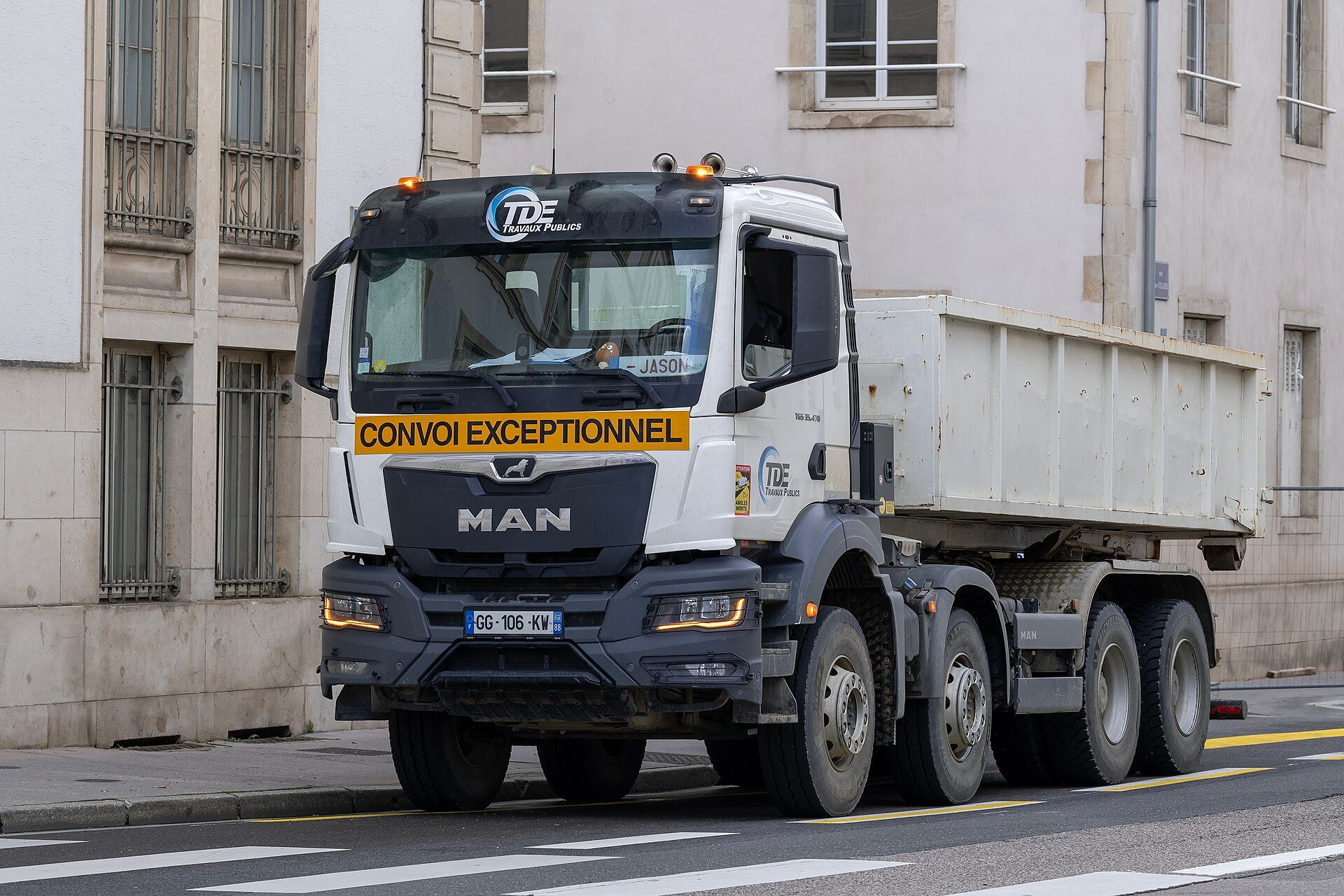
.jpg)
Model overview
Axle configurations: 4x2 · 4x4 · 6x2- · 6x2 · 6x4 · 6x4- · 6x6 · 8x2- · 8x4 · 8x4/8x4- · 8x6/8x8
Engine families
- Power
- 243–294 kW
- Power
- 324–397 kW
- Power
- 279–412 kW
- Torque
- 2100–2800 Nm
MAN restricts the D3066 to one variant. Its row in the TGS specification table carries a footnote that the page footer resolves as "Only 4x2 semitrailer tractors in standard or low-height configuration", so the D30's 279–412 kW and 2,100–2,800 Nm above describe a 4x2 semitrailer tractor and cannot be ordered on a tipper, a mixer or any all-wheel-drive TGS. Both weights above belong to one named vehicle: the TGS 8x4-4 tridem of MAN UK sheet TGS 8x4TRI/01, plated at 32,000 kg gross vehicle and 44,000 kg gross train, design and UK legal alike, on design axle loads of 9,000 kg front and 27,000 kg rear. Every other configuration differs. The 4x2 tractor and 4x2 rigid are plated 18,000 kg gross vehicle against 40,000 kg gross train; the 6x2 rigid, 6x4 rigid and 6x4 tractor 26,000 kg against 44,000 kg. The two 8x4 tipper sheets publish no gross train weight at all and are the clearest example of design capacity diverging from what a member state licences: the normal-height tipper reads 34,000 kg design against 32,000 kg UK legal, with a rear bogie of 21,000 kg design against 19,000 kg legal, and the medium-height tipper 35,000 kg design against the same 32,000 kg legal with a 23,000 kg design bogie. Both plate the front axle pair at 14,200 kg and offer a 15,000 kg front-axle upgrade, and both warn that tyre changes can affect legal weights. Across the whole range the February 2020 launch release quotes gross vehicle weight as 18 to 41 tonnes. Engine braking on the D3066: a Compression Release Brake rated to 355 kW, with a retarder to 4,700 Nm offered alongside it. The 2022 MAN UK sheets specify a 12-speed TipMatic and an 89 km/h road speed limiter on all ten TGS variants they cover, but publish two ratio sets: the three four-axle sheets and the 6x4 rigid give an overdrive twelve, 12.92 down to 0.77 with reverse gears of 12.03 and 9.92, while the 4x2 and 6x2 rigids and the four tractor sheets give a direct-drive twelve, 16.69 down to 1.00 with reverse gears of 15.54 and 12.03. Final drives diverge with them — 3.70:1 on the two tippers and the tridem, 3.08:1 on both 6x4 sheets, 2.53:1 on the 4x2 and 6x2 rigids and 2.31:1 on the 4x2 and 6x2 tractor sheets, of which the 4x2 tractor sheet shows 2.53:1 as well. All ten mark an exhaust brake, selective catalytic reduction and OBD-E as standard, and mark the chassis "Suitable for EN15940". The tridem carries a 60-litre AdBlue tank against 35 litres on both tippers, runs 385/65R22.5 steer tyres with 315/80R22.5 on the drive axles, and has a bolted and riveted S500MC frame of 270 x 85 x 8 mm section, waisted from 942 to 762 mm. Its unladen weight is published as 9,858 to 9,960 kg depending on wheelbase, to a stated tolerance of 2.5 per cent. Hub-reduction rear axles are a priced option on the sheets that offer them; cross-axle and inter-axle differential locks are standard on the tridem. MAN HydroDrive, the hydrostatic front-wheel drive, is offered on two-, three- and four-axle TGS according to the 2020 launch release. The narrow cabs are the model's defining feature: MAN gives the TM and TN an external width of 2,240 mm, and the NN — which the launch release calls the most frequently chosen TGS cab, typically for tippers and mixers — an external length of 1,880 mm. On both 8x4 tipper sheets the D1556LF17 at 400 PS is the standard engine and the D2676 is listed under optional equipment as a change that adds 230 kg. Only the medium-height tipper sheet records N3G certification; its chassis designations are TGS 35.400, 35.430 and 35.470. Note MAN's own inconsistency on that sheet: its chassis specification list names a "TGS 32.510 8x4 BB CH" where the technical table beside it reads "TGS 35.510 8x4 BB CH". The number before the dot cannot be read as a weight without opening the sheet: it is the design gross weight on the medium-height tipper (35,000 kg), the UK legal weight on the normal-height tipper (TGS 32.400 to 32.510 against 34,000 kg design and 32,000 kg legal) and neither on the tridem (TGS 36.430 to 36.510 against 32,000 kg design and legal; its 9,000 kg and 27,000 kg design axle loads add to 36,000 kg, which is this site's arithmetic and not a rule MAN states).
The TGS is the working member of the MAN Truck Generation the company introduced on 10 February 2020. Where the TGX is the long-haul flagship, MAN’s launch release aims the TGS at “the heavy-duty construction vehicle, distribution and municipal services sectors” and says it is characterised by narrow cabs, because in its typical applications low unladen weight and good visibility are what matter. That sentence is the specification brief, and it explains why the most important thing on this page is not a power figure but a footnote.
The chassis table is the headline
MAN’s chassis table has eleven rows: 4x2, 4x4, 6x2-, 6x2, 6x4, 6x4-, 6x6, 8x2-, 8x4, one headed “8x4/ 8x4-” and one headed “8x6 / 8x8”. The last two name two wheel formulae apiece in a single cell against a single set of marks, so eleven rows cover thirteen formulae — and both of those counts are ours, because MAN publishes no count at all. Each row is marked against three body types — semitrailer tractor, chassis and tipper — and the marks do not all line up. The 8x2- is a chassis only, the 8x6 / 8x8 row is a tipper only, and the 6x4- is a chassis or a tipper but not a tractor.
That grid matters more than any count: it is MAN saying which layouts it will build for which work, and it makes this a better worked example than a tractor unit for axle configurations, which this page will not re-teach. The all-wheel-drive end — 4x4, 6x6, 8x6 and 8x8 — has no equivalent in a long-haul range, and where traction is wanted occasionally rather than constantly the launch release offers MAN HydroDrive, a hydrostatic front-wheel drive, on two-, three- and four-axle TGS.
Three engine families, and the biggest one is not for this truck
MAN lists three engine series for the TGS, where the TGX table lists four. The D15, at 9 litres, runs 243–294 kW. The D26, at 12.4 litres, runs 324–397 kW. The D30, at 12.7 litres, runs 279–412 kW with 2,100–2,800 Nm.
Read that last line and stop, because it is a trap. The D3066 row in MAN’s specification table carries a footnote, and the footnote resolves in the page footer as: only 4x2 semitrailer tractors in standard or low-height configuration. The same restriction sits under the same table on the global, German, Austrian and Spanish MAN sites — the Spanish wording reads medium rather than standard height — and again under the same footnote marker on the TGS equipment page. A tipper, a mixer, an 8x4 or any all-wheel-drive TGS cannot be ordered with the D30 at all.
So the 412 kW and the 2,100–2,800 Nm above are real MAN figures for a TGS describing a road-going 4x2 tractor that happens to wear the badge. They are not construction figures. What a four-axle rigid may be ordered with is a question the range table does not answer either: that footnote is the only engine-by-configuration statement MAN publishes, and the only MAN documents that pair an engine step with an 8x4 chassis are the May 2022 UK tipper and tridem sheets, which stop at 510 PS — a rating MAN has since replaced. The engine a maker will sell you in the configuration you intend to order is the one worth comparing, which is the argument of how truck power figures are measured.
The D15 is the payload engine, and MAN says so plainly on the equipment page: less engine weight and consequently more payload. On a four-axle tipper plated at 32,000 kg that is a direct gain in what the vehicle carries. Power figures here also need a date attached — the D26’s steps are 440, 480, 520 and 540 PS today, where the 2022 MAN UK sheets describe the same engine at 430, 470 and 510 PS.
The gearbox depends on which document you read
The 2022 MAN UK chassis sheets specify a 12-speed TipMatic on every TGS variant they cover, and a road speed limiter at 89 km/h on every one of them — but they publish two different ratio sets. The two 8x4 tippers, the 8x4 tridem and the 6x4 rigid give an overdrive twelve, 12.92 down to 0.77 with reverse gears of 12.03 and 9.92; the 4x2 and 6x2 rigids and the four tractor sheets give a direct-drive twelve, 16.69 down to 1.00 with reverse gears of 15.54 and 12.03. Final drives diverge with them: 3.70:1 on the two tippers and the tridem, 3.08:1 on both 6x4 sheets, 2.53:1 on the 4x2 and 6x2 rigids, and 2.31:1 on the 6x2 midlift tractors, with the 4x2 tractor sheet showing 2.53:1 and 2.31:1 both. That is the gearbox behind the construction TGS as MAN UK documented it, and no one of those ratio sets is the range’s.
MAN’s press release of 19 September 2024 then announced the TipMatic 14, with 14 forward and 2 reverse gears plus six further reverse gears activated over the air, around 60 kg lighter than the TipMatic 12 it replaces. But read the scope: that release says the new box replaces the TipMatic 12 in MAN’s standard semitrailer tractors in the heavy series, and it is always paired with the D30 — the engine restricted to 4x2 tractors. Nothing MAN publishes says it has reached a tipper chassis, so the two boxes are recorded here as two documents of different dates rather than reconciled, and the automated gearbox in any used TGS is a question for its build record.
Braking splits the same way. The UK sheets list an exhaust brake as standard on the construction chassis; the compression release brake rated to 355 kW and the retarder to 4,700 Nm are published for the D30 driveline, which is to say for the tractor. On a loaded descent out of a quarry that gap matters more than a power step — the subject of retarders and engine braking.
Weights, and which vehicle they belong to
The two weights in the table above belong to one named vehicle: the 8x4-4 tridem of MAN UK sheet TGS 8x4TRI/01, plated at 32,000 kg gross vehicle and 44,000 kg gross train, design and UK legal alike. Change the configuration and they change. The 4x2 tractor and rigid are plated at 18,000 kg gross vehicle against 40,000 kg gross train; the 6x2 rigid, 6x4 rigid and 6x4 tractor at 26,000 kg against 44,000 kg. Across the range the launch release quotes gross vehicle weight as 18 to 41 tonnes — a range, not a figure.
The two tipper sheets separate what the chassis is built for from what a member state will licence. The normal-height 8x4 tipper reads 34,000 kg design against 32,000 kg UK legal, on a rear bogie of 21,000 kg design against 19,000 kg legal; the medium-height tipper reads 35,000 kg design against the same 32,000 kg legal, on a 23,000 kg design bogie. Neither publishes a gross train weight at all. Both plate the front axle pair at 14,200 kg with an upgrade to 15,000 kg — an option that changes the plating, not just the hardware — and both warn that tyre changes can affect legal weights, the practical end of tyre labelling and load indices. It is this site’s cleanest illustration of why gross vehicle and gross combination weight are separate questions from what the driveline is approved to pull.
What we could not confirm
Rated speed. Every 2022 MAN UK sheet gives 1,800 rpm for all D2676 and D1556 steps — but that is ten sheets from one publisher in one issue month, repetition rather than corroboration, and no current MAN page publishes a rated speed for any TGS engine. The TGX record dropped the same figure from the same document family, so the row is blank here too.
Torque for the D26 and the D15. The UK sheets publish peaks — 2,200 Nm at 430 PS, 2,400 at 470 and 2,600 at 510 for the D26, and 1,700 at 360 PS with 1,800 at 400 for the D15 — but those attach to power steps MAN has since replaced, and the D15’s 330 PS step has no published torque at all. Printing them beside the current kilowatt ranges would pair documents that do not describe the same ratings.
The Euro 6 sub-step. All four MAN model pages head the column “Euro 6 emission standard (met by all)” and name no step. Euro 6e appears on the D30 engine page for the D3066 and in one line of the equipment page for the D2676, but no page describing the TGS range names a step, so neither does this record; what the step means is set out in Euro 6 and Euro 7. The UK sheets do confirm selective catalytic reduction and OBD-E as standard, and the D30 page describes a double SCR arrangement — the source of the AdBlue consumption an operator pays for, at a 60-litre tank on the tridem against 35 litres on both tippers.
How many D30 power steps there are. The TGS specification table publishes five — 279, 324, 353, 382 and 412 kW. The TGS equipment page, the MAN D30 PowerLion page and the TGX specification table each publish six, adding a 302 kW (410 hp) step the TGS table omits: three MAN documents against one. A second disagreement runs between the same documents but concerns the D26, not the D30 — the TGS specification table gives its 520 PS step as 383 kW where the equipment page and the TGX table both give 382 kW. Neither moves the ranges in the table above, 279 to 412 kW for the D30 and 324 to 397 kW for the D26, and saying so is the honest close.
Vehicle dimensions. MAN publishes cab dimensions — 2,240 mm external width, 1,880 mm external length for the NN cab — and no overall length, width or height for any TGS on a page that opens. The ten UK sheets give wheelbases, but across them they run from 2,600 mm on the 6x2 midlift tractor to 6,700 mm on the 4x2 rigid, with wall-to-wall turning circles from 14.8 metres on the 3,600 mm 4x2 tractor to 24.2 metres on the 5,900 mm 6x2 rigid. A single value in a field labelled “wheelbase” would read as the model’s, so those fields are empty.
Who this truck is right for
Tipper, mixer, hook-loader, crane and municipal fleets, and buyers who want a specific layout rather than a specific engine. The narrow cab is the reason to be here: MAN gives the NN an external length of 1,880 mm and the launch release calls it the most frequently chosen TGS cab, typically for tippers and mixers. Every millimetre it gives up behind the seats is body length or payload, which inverts the usual cab logic for this class.
It is the wrong truck for anyone whose priority is the driveline in MAN’s current advertising. If you want the D30 and the TipMatic 14 you want a 4x2 semitrailer tractor, and at that point you are choosing between a TGS and a TGX on cab and price rather than on capability.
Where it sits against its rivals
The Volvo FMX, the Arocs and Scania’s XT range are the direct answers, each the construction derivative of a long-haul family as the TGS is. Against the FMX the comparison is unusually legible, because both makers publish enough to make it: Volvo sells two diesel families and publishes a kilowatt and a newton-metre figure for every step, while MAN lists three families and publishes torque for one. Volvo lists ten axle configurations; MAN’s table runs to eleven rows, two of which name two formulae each.
This site has not verified the Arocs or the XT against manufacturer documents, so no scored comparison is offered — only what to compare. Ask each maker which engines are available in the configuration you intend to order, not which appear in the range table; the D30 footnote is why that is not a pedantic question. Then ask for the design and plated figures separately, on that configuration, in the market you will register it in. MAN Truck & Bus is among the makers profiled in who builds trucks in Europe.
Buying used
Start with the chassis designation rather than the badge — and do not read a weight off it. On every sheet here the number after the dot tracks the power step — TGS 35.470 stands against a 470 PS engine — but the number before it means something different from sheet to sheet. On the medium-height tipper it is the design gross weight: TGS 35.400 to 35.470 against 35,000 kg design. On the normal-height tipper it is the UK legal weight instead: TGS 32.400 to 32.510 against 34,000 kg design and 32,000 kg legal. On the tridem it is neither: TGS 36.430 to 36.510 against 32,000 kg gross vehicle weight, design and legal alike, on design axle loads of 9,000 kg front and 27,000 kg rear. Those two do add to 36,000 kg, but the addition is ours and MAN states no rule that would make it the source of the designation. MAN is not even consistent within one sheet: the medium-height tipper’s chassis list names a TGS 32.510 where the technical table beside it reads TGS 35.510. Ask what the vehicle is plated at, and read the two columns the tipper sheets keep apart.
Then read the engine designation, which survives where a door badge does not. The UK sheets name D1556LF17, D1556LF18, D2676LFAJ, D2676LFAI and D26LFAF against specific power steps, so the code identifies which step a chassis carries after a repaint or a re-body. A D15 under a heavy tipper body is not the mismatch it looks: on both 8x4 tipper sheets the D1556LF17 at 400 PS is the standard engine, and the D2676 sits under optional equipment as a change that adds 230 kg. The code tells you which step is fitted; the sheet tells you whether that step was the base specification or the upgrade.
Ask which rear axle and which differential locks are fitted. Cross-axle and inter-axle locks are standard on the tridem and hub-reduction rear axles are a priced option on the sheets that offer them, so two visually identical four-axle TGS can be geared for very different work — the reasoning is in axle ratios and final drive.
Duty cycle matters more than the odometer: a quarry vehicle at moderate distance has had a harder life than a road-going tipper at twice the reading, and the standard used-truck checks need reading against that. Confirm the cab generation too — the current cab dates from 2020, and the TGS sold before it looks similar enough at a distance to catch a hurried buyer. Ask for the service record on the air dryer and the compressor rather than reading their history off the odometer.
Quick answers
- Which engines are available in the MAN TGS?
- The record for the MAN TGS covers these engine families: MAN D15 (D1556) (9 l), MAN D26 (D2676) (12.4 l), MAN D30 (D3066) — 4x2 semitrailer tractors only (12.7 l). Output spans 243–412 kW.
- What axle configurations does the MAN TGS come in?
- 4x2, 4x4, 6x2-, 6x2, 6x4, 6x4-, 6x6, 8x2-, 8x4, 8x4/8x4-, 8x6/8x8.
- What emission standard does the MAN TGS meet?
- Euro 6.
Compared with
- Volvo FMX
- Mercedes-Benz Arocs
- Scania XT
Sources
- MAN TGS — specifications — MAN Truck & Bus
- MAN TGS — Spezifikationen — MAN Truck & Bus
- MAN TGS — Spezifikationen (Austria) — MAN Truck & Bus
- MAN TGS — especificaciones — MAN Truck & Bus
- MAN TGX — specifications — MAN Truck & Bus
- MAN TGS — equipment — MAN Truck & Bus
- MAN D30 PowerLion driveline — MAN Truck & Bus
- Climate-friendly and economical: MAN Lions with new PowerLion driveline — MAN Truck & Bus Press
- MAN Truck & Bus introduces new MAN Truck Generation — MAN Truck & Bus Press
- Chassis specification — TGS 8x4 Tridem (TGS 8x4TRI/01, May 2022) — MAN Truck & Bus UK Ltd
- Chassis specification — TGS 8x4 Normal Height Tipper (TGS 8X4RIGTIP/10, May 2022) — MAN Truck & Bus UK Ltd
- Chassis specification — TGS 8x4 Medium Height Tipper (TGS 8X4TIP/10, May 2022) — MAN Truck & Bus UK Ltd
- Chassis specification — TGS 4x2 Rigid (TGS 4X2DB/08, May 2022) — MAN Truck & Bus UK Ltd
- Chassis specification — TGS 4x2 Tractor (TGS 4X2TRC/09, May 2022) — MAN Truck & Bus UK Ltd
- Chassis specification — TGS 6x2 Rigid (TGS 6X2DB/08, May 2022) — MAN Truck & Bus UK Ltd
- Chassis specification — TGS 6x2 Midlift Tractor (TGS 6X2MID/09, May 2022) — MAN Truck & Bus UK Ltd
- Chassis specification — TGS 6x4 Rigid (TGS 6X4RIG/08, May 2022) — MAN Truck & Bus UK Ltd
- Chassis specification — TGS 6x4 Tractor (TGS 6x4TRAC/09, May 2022) — MAN Truck & Bus UK Ltd
- MAN bodybuilder chassis specification sheets — MAN Truck & Bus UK Ltd
- Chassis specification — TGS 6x2 Midlift Lite Tractor (TGS 6X2MIDLIT/09, May 2022) — MAN Truck & Bus UK Ltd