segments
Retarders and engine braking: what UN R13 asks a heavy vehicle to prove
Exhaust brake, decompression brake and hydrodynamic retarder sit under one legal heading. What an endurance braking system is, which vehicles must prove one, and what the plate records.
A used coach advertised with a retarder and a used coach advertised with an engine brake are not the same vehicle, and the gap between them is not a trim level. UN Regulation No. 13 gathers every device of this kind under one heading, calls it an endurance braking system, and then asks certain vehicles to demonstrate a performance rather than to carry a named part. Which vehicles those are, and what the demonstration consists of, is the whole of the subject.
One heading, several devices
Paragraph 2.15 is the definition: an endurance braking system is “an additional braking system having the capability to provide and to maintain a braking effect over a long period of time without a significant reduction in performance”, and the term “covers the complete system including the control device”. Paragraph 2.15.1 adds that it may comprise a single device or a combination of several devices, each of which may have its own control. So the stalk is part of the system, and a truck with both an engine brake and a retarder has one endurance braking system, not two.
The Regulation names hardware only where it has to hold the engine apart from everything else: Annex 11, paragraph 1.3 excuses repeat testing for a system “other than the engine brake” identical to one already tested; Annex 5, paragraph 2.2.1.4 says that where the system “is constituted by its engine”, the gear ratios are to be considered its stages of effectiveness; and 5.2.1.30.4 keeps the stop lamps dark when retardation comes from the natural braking effect of the engine alone. Beyond that the text is indifferent to how the braking effect is made.
The version quoted here was published in the Official Journal on 13 April 2026 and incorporates all valid text up to Supplement 1 to the 15 series of amendments, in force 11 January 2026. Annex I of Regulation (EU) 2019/2144 lists the Regulation at the 11 series, and the notes to that table accept compliance with a later series as an alternative.
Three ways the driver is given hold of it
Paragraph 2.15.2 sets out the control configurations, and this is the part a buyer can inspect from the driving seat. Volvo’s description of its auxiliary-brake stalk shows what they look like in a cab: positions 1 to 3 are brake level settings acting when the accelerator is released, position A is an automatic mode blending braking force between the ordinary and the auxiliary brakes when the brake pedal is depressed, and position 0 turns all auxiliary brakes off.
| Configuration | Definition |
|---|---|
| Independent | Control device separated from that of the service and other braking systems. |
| Integrated | Control device integrated with that of the service braking system, so that both are applied simultaneously or suitably phased by operation of the combined control device. |
| Combined | An integrated system that in addition has a cut-out device, allowing the combined control to apply the service braking system alone. |
What the three devices actually are
An exhaust brake works on the gas leaving the engine. Volvo’s exhaust pressure governor is a pneumatic-controlled valve in the exhaust outlet of the turbo that chokes the flow; when the brake is activated the valve is almost shut, giving a high backpressure on the pistons on their way up. Makers do sometimes publish what that is worth: on the Volvo FL the exhaust braking effect is quoted at 80 kW with the five-litre engine and 120 kW with the eight-litre, both at 2800 r/min, against 170 kW for the optional compression brake.
A compression release brake — the decompression brake — works inside the cylinder. Cummins describes the Jacobs mechanism as opening the exhaust valves near the top of the compression stroke, so that the highly compressed air is released through the exhaust system and little energy is returned to the piston; the engine becomes a power-absorbing air compressor. Volvo’s engine brake combines a compression brake integrated in the valve system with the exhaust pressure governor, and its VEB+ variant adds a special camshaft profile and two exhaust rocker arms per cylinder. Some makers now offer this class of device as a replacement for the retarder rather than as a companion to it: Iveco’s 2023 release describes the High Performance Engine Brake on the Iveco S-Way as 30% more effective and “capable of substituting the Retarder in most mission scenarios”, which is a claim about missions rather than about the Type-IIA test below.
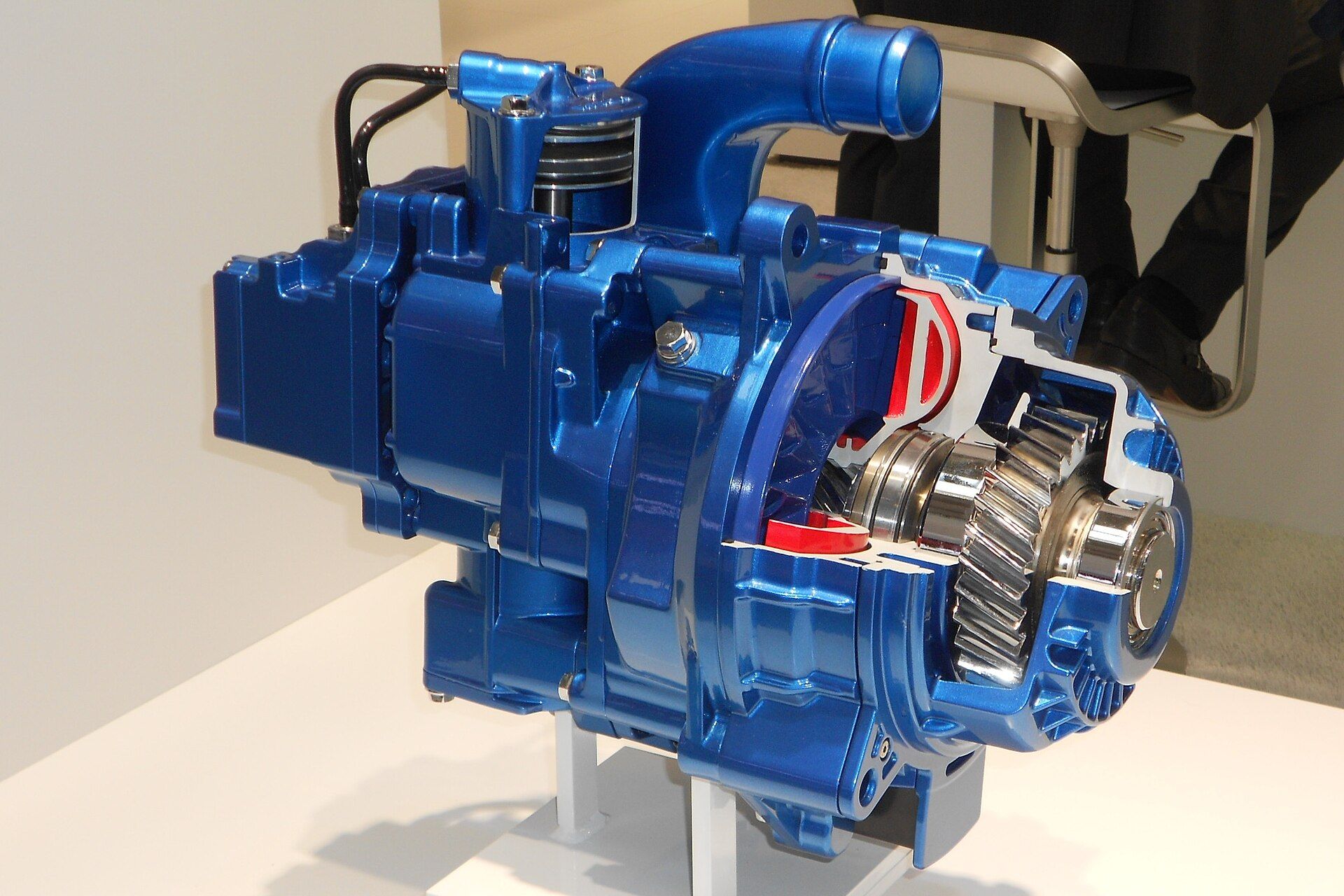
A hydrodynamic retarder does not involve the engine at all. Volvo’s RET-TH fact sheet describes a closed unit of two impellers — a fixed stator and a rotor on the gearbox output shaft — whose angled blades make oil forced from rotor towards stator resist the rotor’s movement and brake the propeller shaft, with a control module regulating the oil volume and pressure that set the brake force. The published specification for that unit, made by Voith, is a maximum brake torque of 3,250 Nm on the propeller shaft, 3,000 Nm at 750 rpm and 1,800 Nm at 500 rpm, at an installation weight including oil of 105 kg. Two lines matter more than the numbers: the retarder is coordinated with the engine’s exhaust brake, and it must be factory mounted because it cannot be retrofitted. On the passenger side the same architecture appears as a coolant unit — the Mercedes-Benz Tourismo RHD data sheet names a Secondary Water Retarder (SWR) as the retarder for all four variants, Tourismo, M/2, M/3 and L.
A hydrodynamic unit can also sit at the other end of the driveline: the turbo retarder clutch offered on the Mercedes-Benz Arocs combines a wear-free moving-off element with a primary retarder that brakes continuously at walking pace, which is manoeuvring control rather than descent control.
Because it hangs off the gearbox output, the retarder is a transmission decision as much as a brake decision, and belongs with the questions raised in automated manual transmissions.
Which vehicles have to prove it
The braking tests in Annex 4 are assigned by category: the table at paragraph 2.1.1 puts categories M2, N1 and N2 through Type-0 and Type-I only, category M3 through “0-I-II or IIA”, and category N3 through Type-0, Type-I and Type-II. Under Regulation (EU) 2018/858, Article 4, N3 is a goods vehicle over 12 tonnes maximum mass and O4 a trailer over 10 tonnes.
Paragraph 1.8.1 lists the vehicles that take the Type-IIA test in place of the Type-II test, a substitution made explicit at 1.6.4: vehicles of category M3 belonging to Classes II, III or B as defined in the Consolidated Resolution on the Construction of Vehicles (R.E.3); vehicles of category N3 authorized to tow a trailer of category O4; and certain vehicles subject to ADR. Those passenger classes are the ones set out in bus classes under UN R107, and Class I — the class constructed with areas for standing passengers — is not among them. Nor does the N3 entry ask whether a trailer is coupled: it catches the vehicle authorized to tow one, a plating question of the kind set out in truck weights, GVW and GCW.
The performance itself is in paragraph 5.1.2.4: the system shall make it possible to maintain a constant downhill speed over a long period of time without the use of the friction brakes. Paragraph 5.1.2.4.1 treats at least 12 minutes as the equivalent of a long period, and 5.1.2.4.2 requires an average speed of 30 km/h on a seven per cent down-gradient over that time, at the maximum mass of the vehicle or, for a motor vehicle authorized to tow an O4 trailer, at the maximum mass of the combination, but not exceeding 44 tonnes. Annex 4, paragraph 1.8.2.2 puts that on the road as an energy input equivalent to 30 km/h down a 7 per cent gradient for 6 km, with the service, secondary and parking braking systems not engaged.
The Regulation does not demand a retarder anywhere in this. Paragraph 1.8.2.3 provides for vehicles in which the energy is absorbed by the braking action of the engine alone, allowing a tolerance of ±5 km/h on the average speed and accepting a mean deceleration of at least 0.6 m/s². An engine brake can carry a coach through Type-IIA on its own. An earlier text capped the mass: at the 11 series of amendments, paragraph 1.8.1.2 limited the test mass to 26 tonnes where an N3 vehicle’s maximum mass exceeded that figure, or, where the unladen mass exceeded 26 tonnes, required that mass to be taken into account by calculation. The 15 series drops the sentence and, at 1.8.2.1, ties the test mass to whatever is needed to demonstrate 5.1.2.4 instead. The cap is not a spent provision: the 11 series is the one Annex I of Regulation (EU) 2019/2144 lists, later series being accepted as an alternative rather than demanded, and paragraph 12.9.6 lets a Contracting Party grant approvals to any preceding series of amendments.
The one place the hardware itself is compulsory
Annex 5 applies to vehicles subject to section 9.2.3 of Annex B to the ADR agreement, and its paragraph 2.2.1 is the only place the Regulation orders an endurance braking system to be fitted rather than a performance to be demonstrated: power-driven vehicles having a maximum mass exceeding 16 tonnes, or authorized to tow a trailer of category O4, shall be fitted with an endurance braking system according to paragraph 2.15. The conditions are specific. The control configuration must be one of the three at 2.15.2.1 to 2.15.2.3. On an electrical failure of the anti-lock system, integrated or combined systems shall be switched off automatically. The anti-lock system shall control the endurance braking system’s effectiveness so that the axles it brakes cannot be locked above 15 km/h — a requirement that expressly does not reach the part constituted by natural engine braking. And the system shall have several stages of effectiveness including a low stage for the unladen condition, and meet the Type-IIA test at the laden mass of the motor vehicle plus its authorized maximum towed mass, not exceeding 44 tonnes in total. The mandate falls on the tractor, not the tank; the trailer side is in ADR trailers.
What fitting one changes elsewhere
Anti-lock is pulled in by the control configuration rather than by weight: Annex 13, paragraph 4.6 requires vehicles with an integrated endurance braking system to have an anti-lock system acting at least on the service brakes of the endurance braking system’s controlled axle and on the endurance braking system itself. The stop lamps follow the deceleration rather than the device, but only on one specification of vehicle. Paragraph 5.2.1.30.2 addresses vehicles that use electronic signalling to control initial application of the service braking system and are equipped with an endurance braking and/or regenerative braking system of category A — category A being, at paragraph 2.21.2, an electric regenerative braking system that is not part of the service braking system. On those, deceleration by the endurance braking and/or regenerative braking system of 1.3 m/s² or less may generate the stop-lamp signal, and deceleration above 1.3 m/s² shall generate it. On a vehicle whose braking system is of a different specification, 5.2.1.30.3 lets the operation of those systems generate the signal irrespective of the deceleration produced.
The trailer is left to look after itself. Paragraph 5.2.1.28.6 states that coupling forces resulting from the performance of endurance braking systems shall not be compensated by the service braking system of either vehicle, and that endurance braking systems are considered not part of the service braking systems — worth reading next to trailer brakes and EBS, because the retarder on the tractor is pushing a trailer that no coupling force control will balance for.
Battery-electric vehicles have their own branch, and it is narrower than it first looks. Paragraph 5.1.2.4.3.1 deems the requirements of 5.1.2.4.1 and 5.1.2.4.2 — the twelve minutes and the 30 km/h down-gradient run — met where a vehicle whose endurance braking system incorporates electric regenerative braking is able to store and/or dissipate, the Regulation’s own example being an extra-endurance brake, the energy of the maximum negative vertical height difference the vehicle can reach. Two limits ride with that. The energy is capped at the level those two paragraphs require, not at the whole of the height difference, and the current electric state of charge is to be taken into account. The demonstration is by methods such as a global navigation satellite system combined with a topography model and an intelligent battery management system, and it is made to the satisfaction of the Technical Service, including through the test at Annex 4, paragraph 1.8.2.5(a). Where the system is solely regenerative, 5.1.2.4.3.3 requires the driver to be told before the braking force can no longer be provided.
What is checkable on a used vehicle
For a bus or coach the approval mark carries the answer. Paragraph 4.5 provides that where a vehicle of category M2 or M3 has been approved under Annex 4, paragraph 1.8, the Regulation number is followed by the letter M, and Annex 3 confirms that for those categories the mark means the type has undergone the Type-IIA test. Paragraph 4.8 puts the mark close to or on the vehicle data plate, beside the rest of the identity described in buying a used coach. Behind the mark stands the Annex 2 communication, the form an administration issues when it grants the approval, and its item 14.6 records the braking system or systems used during the Type-II/IIA test. The numerical mass ceiling on that form belongs to a different vehicle: item 14.11 asks whether the vehicle is subject to the requirements of Annex 5 (ADR), and only under that heading does 14.11.1 record the total maximum mass in tonnes up to which the Type-IIA endurance braking performance requirements are met. On a coach outside ADR the answer at 14.11 is No, and 14.11.1 says nothing.
What the mark itself does not say is which device produced the result, and with the communication in an approval authority’s file rather than the seller’s folder, that is for a chassis inspection to settle, alongside the other figures gathered in coach specifications. A gearbox-mounted retarder is a physical unit between gearbox and propeller shaft with its own oil volume and cooling connection; an exhaust brake is a valve at the turbo outlet. The distinction survives the sale, because the maker’s own fact sheet says the retarder cannot be retrofitted: a vehicle built without one cannot be given one later.
Quick answers
- What is the difference between an engine brake and a retarder?
- UN Regulation No. 13 does not distinguish them by name: paragraph 2.15 defines a single category, the endurance braking system, as an additional braking system able to provide and maintain a braking effect over a long period without a significant reduction in performance. The difference is in the hardware. An exhaust brake and a compression release brake act through the engine; a hydrodynamic retarder is a separate oil-filled unit on the driveline.
- Which vehicles have to have an endurance braking system by law?
- Only ADR vehicles, and only some of them. Annex 5, paragraph 2.2.1 of UN Regulation No. 13 requires power-driven vehicles within its scope having a maximum mass exceeding 16 tonnes, or authorized to tow a trailer of category O4, to be fitted with one. Elsewhere the Regulation asks for a test result rather than a named part.
- What is the Type-IIA test?
- The endurance braking performance test in Annex 4, paragraph 1.8. The vehicle is tested so that the energy input matches a laden vehicle driven at an average speed of 30 km/h down a 7 per cent gradient for 6 km, with the service, secondary and parking braking systems not engaged. Paragraph 5.1.2.4.1 treats at least 12 minutes as a long period of time.
- Does a city bus need a retarder?
- Not under the endurance braking rules. Annex 4, paragraph 1.8.1.1 of UN Regulation No. 13 puts vehicles of category M3 belonging to Classes II, III or B into the Type-IIA test, and Class I — the class UN Regulation No. 107 defines as constructed with areas for standing passengers — is not on that list.
- Does the retarder switch on the brake lights?
- It depends on the specification of the vehicle. Paragraph 5.2.1.30.2 covers vehicles that use electronic signalling to control initial application of the service braking system and are equipped with an endurance braking and/or regenerative braking system of category A: deceleration by the endurance braking and/or regenerative braking system of 1.3 m/s² or less may generate the signal, and deceleration above 1.3 m/s² shall generate it. On a vehicle of a different specification, 5.2.1.30.3 lets the operation of those systems generate the signal irrespective of the deceleration produced. Paragraph 5.2.1.30.4 forbids the signal wherever the retardation comes from the natural braking effect of the engine alone.
Sources
- UN Regulation No. 13 — Uniform provisions concerning the approval of vehicles of categories M, N and O with regard to braking [2026/746], incorporating all valid text up to Supplement 1 to the 15 series of amendments — Official Journal of the European Union, L series 2026/746 of 13 April 2026
- Regulation No. 13 — consolidated text at the 11 series of amendments, part 2 of the file set, covering Annexes 1 to 4 (Annex 4, paragraph 1.8.1.2) — Ministry of Land, Infrastructure, Transport and Tourism, Japan
- Regulation (EU) 2019/2144 on type-approval requirements for motor vehicles and their trailers — consolidated text of 2 August 2026, Article 4 and Annex I with its notes to the table — EUR-Lex, Publications Office of the European Union
- Regulation (EU) 2018/858 on the approval and market surveillance of motor vehicles and their trailers — Article 4, vehicle categories — EUR-Lex, Publications Office of the European Union
- UN Regulation No. 107 — Uniform provisions concerning the approval of category M2 or M3 vehicles with regard to their general construction [2026/139], paragraphs 2.1.1 and 2.1.2 — Official Journal of the European Union, L series 2026/139 of 29 January 2026
- Fact sheet: Engine brake — EBR-VEB+, EBR-VEB, EBR-EPGC, EBR-EPG (ENG Version 02, 17 June 2024) — Volvo Trucks
- Fact sheet: Retarder RET-TH, gearbox-mounted hydrodynamic oil retarder (ENG Version 09, 16 June 2025) — Volvo Trucks
- Compression Release Engine Brake — Jacobs engine braking and valvetrain — Cummins Inc.
- Facts — Tourismo RHD: technical data and standard equipment — Mercedes-Benz (Daimler Buses)
- New IVECO Way Range is born and built around you — Iveco S.p.A.