Iveco
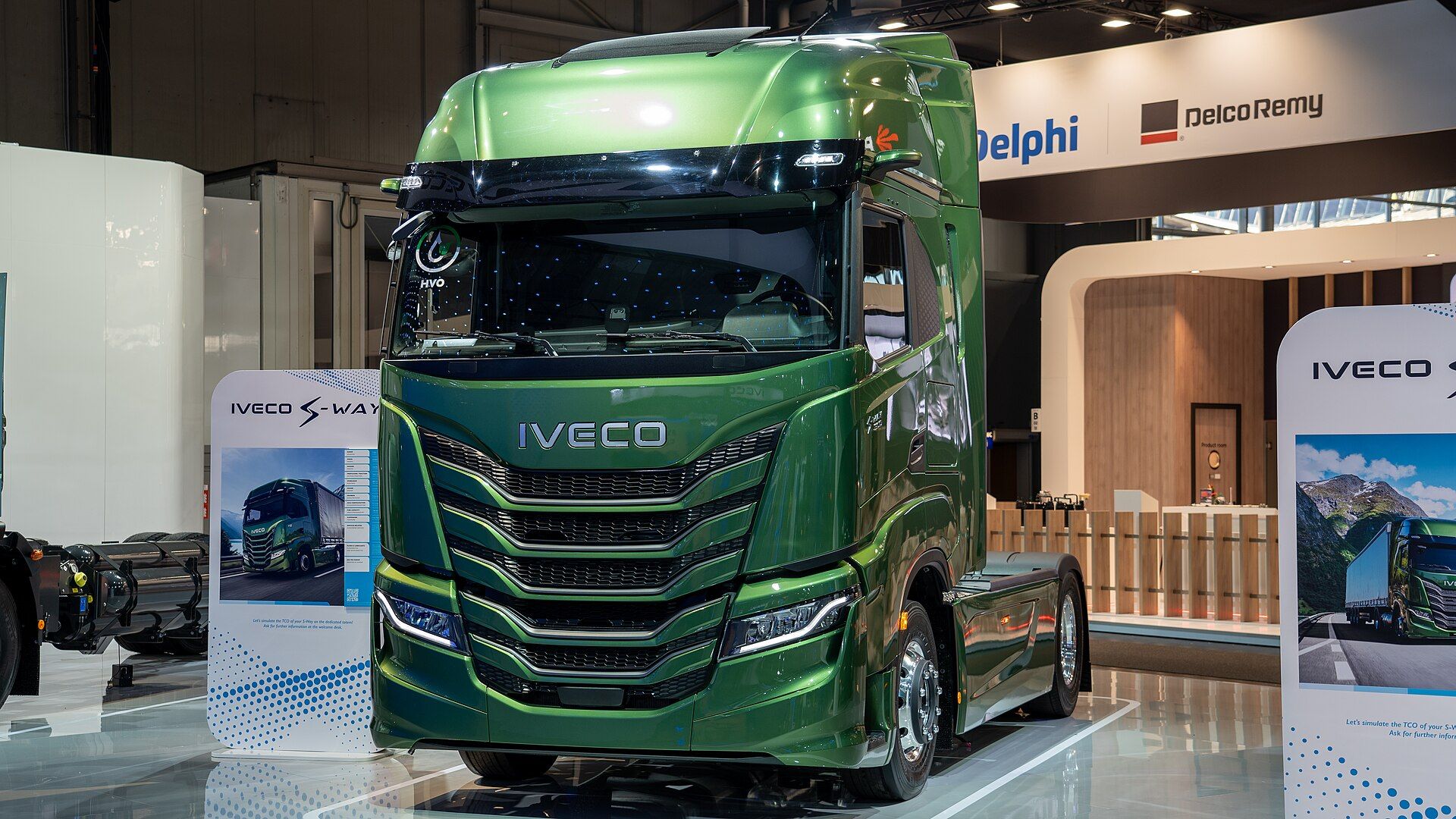
Iveco S-Way
Two diesel families, two natural-gas engines and no gross combination weight in any Iveco document we could open — what the S-Way is, and what to check on a used one.
.jpg)
Model overview
Axle configurations: 4x2 · 6x2C · 6x2P
Engine families
- Power
- 251–294 kW
- Torque
- 1400–1700 Nm
- Power
- 338–426 kW
- Torque
- 2500–2800 Nm
- Power
- 251–294 kW
- Torque
- 1500–1700 Nm
- Power
- 368 kW
- Torque
- 2200 Nm
Weights. The only weight Iveco publishes for the S-Way is a range, 18 - 26 t, labelled MTT on the Swiss-Italian tractor page and GVW on the UK product pages, and it covers both long-distance and regional missions. Those same mission cards split the line-up by power in words: Long distance 460 - 580 hp with the AS cab and Regional Delivery 360 - 540 hp with the AT and AD cabs on the UK Artic and Swiss-Italian tractor pages (da 460 a 580 CV, da 360 a 540 CV), and 340 - 540 hp on both the Regional Delivery and the Municipality and Specialities cards of the UK Rigid page. The regional band therefore spans both diesel families rather than the C9 alone. No gross combination figure appears in any Iveco document this record opened. The 2023 press release's 60 t is the rating of a new 18x single-reduction rear axle, which it says "can withstand up to 60t GCW"; the same release gives a reinforced front air suspension with 9.0 t GAW and a reinforced 9.0 t tag axle on 6x2 rigids, and names the 17xHE Meritor rear axle. Steps and bands, from the MY24 brochure tables. Diesel C9, 8.7 l: 340 hp / 251 kW at 1,710-2,200 rpm with 1,400 Nm at 1,100-1,710 rpm (WG turbo); 360 hp / 265 kW at 1,530-2,200 rpm with 1,650 Nm at 1,200-1,530 rpm (WG); 400 hp / 294 kW at 1,655-2,200 rpm with 1,700 Nm at 1,200-1,655 rpm (eVGT). Diesel XC13, 12.9 l, all eVGT: 460 hp / 338 kW at 1,600-1,650 rpm with 2,500 Nm at 820-1,100 rpm; 500 hp / 368 kW at 1,600-1,650 rpm with 2,600 Nm at 843-1,100 rpm; 540 hp / 397 kW at 1,500-1,650 rpm with 2,700 Nm at 950-1,200 rpm; 580 hp / 426 kW at 1,450-1,850 rpm with 2,800 Nm at 980-1,450 rpm. Natural gas C9G, 8.7 l, WG: 340 hp / 251 kW at 1,600-2,000 rpm with 1,500 Nm at 1,100-1,600 rpm; 400 hp / 294 kW at 1,575-2,000 rpm with 1,700 Nm at 1,200-1,575 rpm. Natural gas XC13G, 12.9 l, eWG: 500 hp / 368 kW at 1,600-1,700 rpm with 2,200 Nm at 1,000-1,500 rpm. Cab availability, from the same tables and repeated on the Italian page: the three C9 diesel steps and both C9G steps are marked for the AT and AD cabs and not the AS; the 540 hp diesel likewise; the 580 hp diesel and the 500 hp XC13G are marked for the AS cab only. FPT's own datasheets for the four XC13 ratings the S-Way uses give a single peak-power speed of 1,650 rpm and single torque speeds of 820, 843, 956 and 978 rpm, a bore and stroke of 135 x 150 mm, ECR 2500 bar injection, an EVGT BB turbocharger, an aftertreatment train of DOC + DPF + SCR + CUC, Euro VI E certification and a dry weight of 1,018 kg for the 426 kW rating. FPT states 426 kW as 579 HP where Iveco's table says 580 hp. FPT's XCURSOR 13 page ranges the engine from 460 hp / 2,300 Nm to 600 hp / 2,850 Nm, quotes braking power of up to 530 kW, a lifetime of up to 1,600,000 km, oil change intervals of up to 150,000 km and DPF change intervals of up to 600,000 km; the ninth datasheet, 442 kW / 601 HP at 1,900 rpm with 2,850 Nm at 1,100 rpm, is a rating the S-Way does not use. FPT's Cursor 9 truck page states power ratings from 300 to 400 HP, a no-EGR architecture, a regeneration-free HI-eSCR system and DPF maintenance at up to 450,000 km. Line-up and wheelbases, MY24 brochure page 16. Articulated: 4x2 at 3,650-3,800 mm, 6x2C at 3,800-4,000 mm, 6x2P (Twin) at 3,200-3,300 mm. Rigid: 4x2 at 3,800-6,700 mm, 6x2P at 3,120-6,050 mm, 6x2C at 4,200-4,500 mm. Rear axle suspension is pneumatic or full pneumatic throughout. The natural-gas line-up is narrower: an articulated 4x2 at 3,800 mm and rigids at 4x2 and 6x2P, with the rigid wheelbases given as 3,800-6,300 and 5,700 mm on the 4x2 and 3,120-6,050 and 4,200-6,050 mm on the 6x2P. Gas tanks and range, brochure pages 14, 15 and 17. CNG steel type-1 cylinders of 70, 80, 115 and 148 litres; new CNG tanks of 2 x 135 and 2 x 175 litres each side, 190 kg of methane giving a range of up to 800 km; a double CNG pack on the right side for rigids from 5,500 mm wheelbase for more than 1,500 litres overall. The line-up table gives CNG up to 800 km on the articulated 4x2 and up to 1,000 km on the rigids, and LNG up to 1,700 km on all three. LNG tanks are stainless steel in a 26 inch, 660 mm section at 250, 410 and 540 litres and a 24 inch, 610 mm section at 400 litres; Iveco claims a best-in-class 1,080 litres on a 4x2 articulated vehicle, and the four tank arrangements it illustrates are quoted at up to 1,700, 1,500, 1,250 and 850 km. The gas vehicle is PIEK Quiet Truck Test certified at less than 72 dB. Iveco's brochure says that thanks to an EU derogation, 18 t and 26 t natural-gas vehicles can have a bonus mass to match the increase in tare weight; it names neither a figure nor an instrument. Axle ratios: the 1 June 2021 release gives longer ratios down to 2.31:1 with standard profile tyres, the MY24 brochure adds new rear axle ratios of 2.17 and 2.06. Braking and efficiency claims: a High Performance Engine Brake described in the brochure as capable of substituting the Intarder in most missions and in the 2023 release as 30% more effective and capable of substituting the Retarder in most mission scenarios; up to 10% better fuel consumption on the diesel and a further 4% from services; up to 11% on the XC13G gas; engine weight reduced by 10% and durability up to 1.6 million kilometres, 33% greater than its predecessor; mirrorless cameras worth up to 1.5% against a standard mirror. Two official documents disagree on biomethane: the MY24 brochure says up to 90% reduction in CO2 when run on biomethane, the 15 November 2023 release says up to 95%. Naming: the 1 July 2019 launch release calls the gearbox Hi-Tronix and states ECE R29.03 cab crash compliance; the 2023 release names a 12-speed TRAXON Gen2 by ZF and does not use the Hi-Tronix name, and no document that opens states whether the two names describe the same unit. The 3 July 2026 Model Year 26 release quotes up to 11% fuel savings, a 450 mm steering wheel, a 10 inch touchscreen and up to 32,000 configurations, and says the vehicle builds on the Model Year 24 with the same xCursor 13 engine; the figures in this record are the Model Year 24 tables that Iveco's product pages still carry. The S-Way is also sold as a rigid on the same engines; the segment above follows Iveco's own Artic line-up. The battery-electric truck is the S-eWay, a separate model, and none of its figures are here.
The S-Way is Iveco’s heavy on-road truck, the long-haul member of the WAY range that also holds the off-road T-Way and the light off-road X-Way, and it is built by Iveco S.p.A. of Turin. It was launched in Madrid in a release dated 1 July 2019. Iveco has since changed its engines twice without changing its name — a new line-up on 1 June 2021, the xCursor 13 on 15 November 2023 — and premiered a Model Year 26 version in Turin on 3 July 2026.
Get that history straight first, because a figure quoted for an S-Way means nothing without a year attached. Everything below is Model Year 24 data: Iveco’s own eBrochure, publication H2331001MASTER of 02/24, and the engine tables its UK, German and Italian product pages still carry. The 2026 release publishes no engine table and says the vehicle builds on the Model Year 24 with the same xCursor 13.
Four engines, and the gas pair is the reason to look twice
All four are built by FPT Industrial, Iveco’s sister brand inside Iveco Group. The C9 is the 8.7-litre six in three steps: 340 hp / 251 kW with 1,400 Nm, 360 hp / 265 kW with 1,650 Nm and 400 hp / 294 kW with 1,700 Nm. It is a regional-mission engine, and Iveco says so in words as well as structurally. Its mission cards split the line-up by power and by cab: Long distance is 460 - 580 hp with the AS cab; Regional Delivery is 360 - 540 hp with the AT and AD cabs on the UK articulated and the Swiss-Italian tractor pages, and 340 - 540 hp on the UK rigid page. So the regional band is not the C9’s alone — it reaches 540 hp, which is an XC13 rating. What is the C9’s alone is the cab half of that split: all three steps are marked for the AT and AD cabs and against the AS, so a C9 under a full-width long-haul sleeper is not a combination Iveco offers.
The XC13 is the 12.9-litre six announced in November 2023, whose release calls the Cursor 11 discontinued. Four steps, and they are the whole top of the range: 460 hp / 338 kW with 2,500 Nm, 500 hp / 368 kW with 2,600 Nm, 540 hp / 397 kW with 2,700 Nm and 580 hp / 426 kW with 2,800 Nm. Here the cab marks cut across the power ladder: the 460 and 500 hp steps take any cab, the 540 hp step is marked for the AT and AD cabs only, and the 580 hp step for the AS cab only. Iveco’s Italian tractor page repeats that split, so it is not a printing accident in one document.
The gas pair is what makes this truck unusual in the European long-haul class, and it is why the model belongs beside LNG and bio-LNG trucks. The C9G is the same 8.7 litres at 340 hp / 251 kW with 1,500 Nm and 400 hp / 294 kW with 1,700 Nm; the XC13G is one rating, 500 hp / 368 kW with 2,200 Nm, for which Iveco claims up to 11% lower fuel consumption. The gas line-up is the narrower one — an articulated 4x2 and rigids at 4x2 and 6x2P, nothing else — and the XC13G is an AS-cab engine where both C9G steps are AT and AD only.
Two makers, two ways of quoting the same engine
Iveco publishes rpm bands — the 460 hp step peaks between 1,600 and 1,650 rpm, the 580 hp step between 1,450 and 1,850 — while FPT publishes a single speed for the same engines, 1,650 rpm for all four XC13 ratings the S-Way uses, with peak torque at 820, 843, 956 and 978 rpm. Neither substitutes for the other, so this record publishes no rated speed at all. The two do not agree on the horsepower either: Iveco’s table calls the top step 580 hp / 426 kW, FPT’s datasheet for that rating prints 426 (579) @ 1650. Which is why a power figure needs its source attached.
Downspeeding, the gearbox and the engine brake
Iveco has pushed this driveline steadily towards low crank speeds. The 2021 release offered longer rear axle ratios down to 2.31:1 with standard profile tyres; the Model Year 24 brochure adds 2.17 and 2.06 to its list of fuel-consumption measures. Maker-published, dated final-drive ratios are rare.
The gearbox behind them is an automated manual: the 2023 release names a 12-speed TRAXON Gen2 by ZF with a Shift Assistant that synchronises changes and engine braking, and the brochure’s line-up table adds an automatic alongside it on the C9 and C9G in rigid form. Note that the 2019 launch release called the S-Way’s gearbox Hi-Tronix, and no document this page opened says whether the two names describe the same unit.
Iveco is unusually specific about secondary braking. The brochure describes a High Performance Engine Brake “capable to substitute the Intarder in most missions”, the 2023 release calls the same device 30% more effective and capable of substituting the Retarder in most mission scenarios, and FPT quotes braking power of up to 530 kW for the XCursor 13. Read those as what they say: claims about what the engine brake can do, with “in most missions” attached, and not a statement about the options list. No document this page opened says whether a hydraulic retarder is still offered alongside it.
Emissions: SCR only, and HVO
FPT gives the step engine by engine, and it does not give it for all four. The four XC13 truck datasheets this page opened — one per rating the S-Way uses — print “Certification: Euro VI E”, each of them beside a thermodynamic cycle of “Diesel 4 stroke”, so what they certify is the diesel XC13. The Cursor 9 truck page covers both 8.7-litre engines in one sentence: they are “available in both Diesel and CNG versions, compliant with Euro VI Step E standards”. Nothing this page opened gives a step for the XC13G. FPT’s XCursor 13 page says only that the engine is designed to run on diesel, methane and, in the future, hydrogen, and Iveco’s own dating of the standard — the 1 June 2021 release, whose new engine line-up “meets Euro VI/E emissions standards” — predates the November 2023 announcement of the gas 13-litre. So read the Euro VI Step E in the table above as covering the C9, the C9G and the diesel XC13, and read the plate for an XC13G. Iveco’s product pages name no step at all, which is why the step here is cited to FPT — and which lettered step a heavy vehicle holds is what Euro 6 and Euro 7 exists to unpick. Nothing this page opened gives the step for an S-Way built before the 2021 release either, so read the plate rather than this record for one. The aftertreatment is SCR-led: the XC13 datasheets list the train as DOC + DPF + SCR + CUC, the XCursor 13 product page adds DPF change intervals of up to 600,000 km, and the Cursor 9 page describes a no-EGR architecture with a regeneration-free HI-eSCR system. On fuel, Iveco’s Italian page footnotes the engine table “Tutti i motori diesel sono compatibili con i carburanti sostenibili HVO” — all the diesel engines are compatible with sustainable HVO fuels.
What we could not confirm
No gross combination weight. This is the largest gap in the record and it is deliberate. No Iveco document that opens states a gross combination figure for a European S-Way. The 60 t in the 2023 release is what a new 18x single-reduction rear axle “can withstand” — an axle rating, not a plating for a vehicle — and it is not promoted to one here. The combination figures in Iveco’s Australian brochure are ADR ratings for a differently specified truck.
The gross vehicle weight is a range, not a number. Iveco publishes 18 - 26 t across the whole tractor line-up, labelled MTT on its Swiss-Italian page and GVW on the UK ones. A single-value field cannot hold that honestly, so the row is empty and the range sits in the notes.
No dimensions at all, and no rated speed. Iveco publishes no overall length, width, height or turning circle anywhere this page could read one, and wheelbase only as a range per configuration. There is also no cylinder count for the XC13G: FPT calls the XCursor 13 its first multi-fuel single base engine and gives the diesel version six cylinders in line, but says nothing about the gas version.
Two Iveco documents disagree about biomethane. The Model Year 24 brochure claims up to 90% CO2 reduction on biomethane; the 15 November 2023 release claims up to 95%. The contradiction is recorded, not resolved.
Axles, cabs and wheelbases
The published European axle configurations are 4x2, 6x2C and 6x2P, and the articulated and rigid line-ups use the same three. Iveco’s naming is its own: 6x2C and 6x2P are not MAN’s or DAF’s labels for the equivalent layouts. Articulated wheelbases run 3,650-3,800 mm on the 4x2, 3,800-4,000 mm on the 6x2C and 3,200-3,300 mm on the 6x2P twin; the rigids run much longer, out to 6,700 mm. There is no 6x4 and no 8x4 in the S-Way line-up table.
Three cabs are offered — the full-width AS sleeper, the compact AT sleeper and the AD day cab, the first two with a low or high roof — and because the engine table marks each rating against a cab, cab and engine are one decision here rather than two. Mirrorless cameras are an option Iveco values at up to 1.5% fuel against a standard mirror, the kind of claim cab aerodynamics turns on.
Tanks and range, if you buy the gas version
CNG is carried in steel type-1 cylinders of 70, 80, 115 and 148 litres, with newer tanks of 2 x 135 and 2 x 175 litres each side; Iveco quotes 190 kg of methane for a range of up to 800 km, and its line-up table gives up to 800 km on the articulated 4x2 and up to 1,000 km on the rigids. LNG tanks are stainless steel at 250, 410 and 540 litres in the larger section and 400 litres in the smaller, with range quoted up to 1,700 km. Iveco claims a best-in-class 1,080 litres on a 4x2 articulated vehicle — the two 540-litre tanks of its own top illustration, an addition of ours rather than a sum Iveco prints. The gas vehicle is PIEK Quiet Truck Test certified at less than 72 dB.
The brochure also says that thanks to an EU derogation, 18 t and 26 t natural-gas vehicles can have a bonus mass to match the increase in tare weight. It names neither a figure nor an instrument, and neither does this page. What the fuel does to a fleet’s exposure under road tolls and CO2 classes is a separate calculation from tank size.
Who this truck is right for
The S-Way is right for the long-haul fleet that can refuel on gas. Its gas programme is the widest this site has opened for the class — two methane engines, four illustrated LNG tank arrangements and a CNG option — and Iveco’s 2021 claim was that its natural gas models were then the leaders in Europe, with more than a quarter of units sold. If the depot has the fuel and the routes suit, that is the case for the truck; if not, most of what distinguishes it disappears.
It also suits a regional operator buying a rigid, where the C9 with the AT or AD cab and an automatic is a genuinely different specification rather than a detuned long-haul truck. It is the wrong truck if the job needs a 6x4 or an 8x4, neither of which is in the European line-up, or if the buyer wants a plated combination weight from the maker’s own literature before ordering.
Where it sits against its rivals
Against the Volvo FH and the MAN TGX the S-Way is the narrower offer on paper: two diesel families where MAN publishes four, and no 6x4 or 8x4 in its published European line-up. Against the Scania S-series the comparison is closest, because Scania also sells a 13-litre gas engine into the same work — and Scania publishes what Iveco does not, a permitted combination weight for each rear axle specification. On the gas side the S-Way answers back: two methane engines, where this site’s records for the FH and the S-series each carry one.
The honest summary is that Iveco publishes less than its rivals do. That is a finding about the documents rather than about the truck, and it is the difference a buyer meets first.
Buying used
Establish the model year before anything else. Depending on when it was built and for what work, an S-Way may carry a Cursor 9 on a regional or rigid specification, a Cursor 11 or a Cursor 13 on an earlier long-haul build — the 1 June 2021 release names both and extends the Cursor 13 range with two new ratings, 490 and 530 hp, and the 15 November 2023 release calls the Cursor 11 discontinued — the XCursor 13 announced in that November 2023 release, or one of the two natural-gas engines, and they differ in parts, performance and resale value. The Cursor 13 and the XCursor 13 are the pair most easily confused, and no document this page opened states which engine succeeded which. So the engine plate and the registration date settle it; the badge on the door does not. They also settle the emission step, which the Euro VI Step E in this record does not cover for every year of the model, and does not cover for the XC13G at all.
Read the plated weights on the registration document rather than inferring them. Iveco publishes an 18 - 26 t range and no combination figure, so there is nothing to check the paperwork against — which raises the value of the paperwork itself. Set the plated figure against the trailer the truck will actually pull, the same discipline as in any used truck purchase.
Ask which cab and which engine together. Because Iveco marks each power step against a cab, a 580 hp truck should be an AS and a 540 hp truck should not be; an advert saying otherwise is either mis-described or rebuilt. Ask the same about the final drive: a 2.06 or 2.17 axle is a downspeeding specification for motorway work and a poor match for hilly regional running. On a gas truck, ask for the tank certification history and the refuelling record before the mileage.
Whichever fuel it burns, the emission system’s service history and the driver assistance fitment separate two apparently identical trucks, along with the running-cost picture the buyer inherits. FPT publishes the intervals that shape that picture on the XCursor 13 — oil changes up to 150,000 km and a DPF change up to 600,000 km — so ask where the truck stands against them rather than against the mileage alone.
Quick answers
- Which engines are available in the Iveco S-Way?
- The record for the Iveco S-Way covers these engine families: FPT Cursor 9 (C9) (8.7 l), FPT XCursor 13 (XC13) (12.9 l), FPT Cursor 9 natural gas (C9G) (8.7 l), FPT XCursor 13 natural gas (XC13G) (12.9 l). Output spans 251–426 kW and 1400–2800 Nm.
- What axle configurations does the Iveco S-Way come in?
- 4x2, 6x2C, 6x2P.
- What emission standard does the Iveco S-Way meet?
- Euro VI Step E.
Compared with
- Volvo FH
- Scania S-series
- MAN TGX
Sources
- IVECO S-Way eBrochure (publication H2331001MASTER, 02/24) — IVECO
- FPT Industrial XC13 truck datasheet — 426 kW (579 HP) at 1650 rpm — FPT Industrial
- New IVECO Way Range is born and built around you — Iveco S.p.A.
- IVECO S-Way Artic — product page — IVECO UK
- IVECO S-Way Rigid — product page — IVECO UK
- IVECO S-Way Sattelzugmaschine — product page — IVECO Deutschland
- IVECO S-Way Trattore — product page — IVECO Italia
- IVECO S-Way Trattore — product page (mission data) — IVECO Svizzera
- FPT Industrial XC13 truck datasheet — 338 kW (460 HP) at 1650 rpm — FPT Industrial
- FPT Industrial XC13 truck datasheet — 368 kW (500 HP) at 1650 rpm — FPT Industrial
- FPT Industrial XC13 truck datasheet — 397 kW (540 HP) at 1650 rpm — FPT Industrial
- FPT Industrial XC13 truck datasheet — 442 kW (601 HP) at 1900 rpm — FPT Industrial
- XCURSOR 13 — on-road truck engine — FPT Industrial
- CURSOR 9 — on-road truck engine — FPT Industrial
- New IVECO S-Way: the 100% connected truck takes fuel efficiency and driver-centricity to the next level — Iveco S.p.A.
- IVECO launches new IVECO S-WAY: the 100% connected, driver-centric long-haul truck — Iveco S.p.A.
- IVECO raises the bar: a new generation of vehicles and services for drivers and fleets — Iveco S.p.A.