Mercedes-Benz
Mercedes-Benz Arocs
Four engine families across eighteen published power steps, twelve wheel configurations and a maker that publishes no combination weight — what the Arocs is and how to read it.
.jpg)
Model overview
Axle configurations: 4×2 · 4×4 · 6×2/4 NLA · 6×2 ENA · 6×2 DNA · 6×4 · 6×6 · 8×2/4 ENA · 8×4 ENA · 8×4/4 · 8×6/4 · 8×8/4
Engine families
- Power
- 175–260 kW
- Torque
- 1000–1400 Nm
- Rated speed
- 2200 rpm
- Power
- 240–335 kW
- Torque
- 1700–2100 Nm
- Rated speed
- 1800 rpm
- Power
- 310–390 kW
- Torque
- 2100–2600 Nm
- Rated speed
- 1600 rpm
- Power
- 380–460 kW
- Torque
- 2600–3000 Nm
- Rated speed
- 1600 rpm
Weights. Mercedes-Benz publishes no gross combination weight for the standard Arocs and gives permissible gross vehicle weight only as a span, 18 t-41 t, in the Great Britain product sheet of February 2025. The same sheet gives the model designation as 964 LHD/RHD in 42 different versions. Heavy haulage is a separate vehicle: Daimler Truck's release of 23.09.2020 puts the three-, four- and five-axle SLT tractors at up to 250 tonnes gross combination mass, and the Arocs up to 500 t page and the bauma 2025 release both state up to 500 tonnes gross vehicle weight for the SLT, optionally towing up to 1,000 tonnes with the RO58 coupling. Predictive Powertrain Control was extended to heavy-duty trucks up to 120 tonnes, all-wheel-drive vehicles and vehicles with Hydraulic Auxiliary Drive or a fluid coupling, the concrete mixer excepted. Traction and braking. Hydraulic Auxiliary Drive is marked "Optionally available with Hydraulic Auxiliary Drive (HAD)" on five of the model page's twelve wheel configurations — 4x2, 6x2/4 NLA, 6x2 ENA, 6x2 DNA and 6x4 — and on none of the other seven; all five are chassis with no driven front axle, and no four-axle configuration and neither all-wheel-drive configuration carries the mark. It puts up to 450 bar of hydraulic pressure on the front axle (model page) and generates up to 40 kW of additional drive power per wheel (Daimler Truck, 23.09.2020). The Great Britain product sheet states without a comparator that HAD "assists the vehicle at speeds of up to 30 km/h" and "reduces vehicle weight by up to 575 kg, thereby not only increasing the payload, but also lowering fuel consumption"; where the maker does name a comparator it is a different figure — the 2020 release puts the advantage over an engageable all-wheel drive at 350 kg. The model page states that the turbo retarder clutch is available on the Arocs "as a wear-free moving-off and braking system", and the bauma 2025 release that "together with the High Performance Engine Brake, the turbo retarder clutch also delivers up to 750 kW of braking power and a braking torque of up to 3,000 Nm" — a figure for the pair, not for the clutch alone. The same release calls the device a fluid coupling in the sentence before, and under that name the release of 23.09.2020 publishes the parts: "As a primary retarder, it develops a braking power of 350 kW (476 hp). Together with the up to 475 kW (646 hp) output of the powerful High Performance Engine Brake, the fluid coupling ensures high efficiency." Those two part figures make 825 kW by this site's own addition, against the 750 kW the 2025 release gives for the pair. Both are recorded and neither is preferred. Assistance systems. The release of 23.09.2020 announced Active Sideguard Assist as available for the Arocs model variants from June 2021 and states that it can initiate automatic braking at a turning speed of 20 km/h to a standstill. The current model page and product sheet name the second-generation system, Active Sideguard Assist 2, alongside Active Brake Assist and MirrorCam. Cabs. Eight variants with published exterior and headroom figures, on an engine tunnel of 320 mm or 170 mm or a flat floor. Exterior length is 2,300 mm for the L-cabs, 2,000 mm for the M-cabs and 1,700 mm for the ClassicSpace S-cab; exterior width is 2,500 mm on the BigSpace and the flat-floor StreamSpace and 2,300 mm elsewhere. The BigSpace L-cab gives 1,990 mm of headroom on its level floor and 1,910 mm in front of the seats; the CompactSpace M-cab with the 320 mm tunnel gives 1,065 mm above the tunnel and 1,400 mm in front of the seats. Dating. Daimler Truck dates the nameplate to bauma 2013 and the current vehicle to bauma 2019; the release of 23.09.2020 covers the MirrorCam, Multimedia Cockpit and advanced Predictive Powertrain Control update.
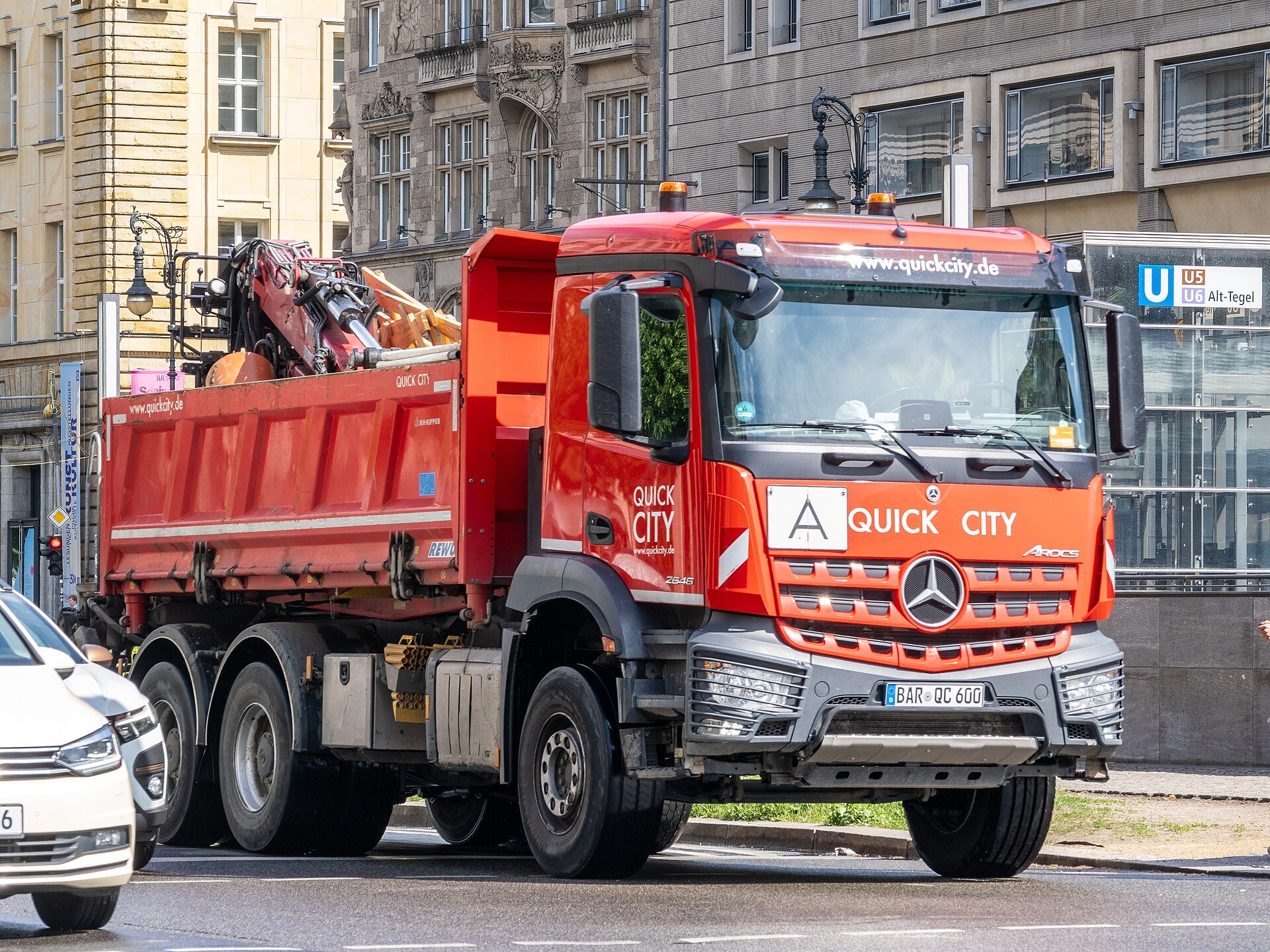
The Arocs is the construction range of Daimler Truck, and the company dates it in two steps rather than one: the Actros variant for construction, the Arocs, was introduced at bauma in 2013, and the current vehicle for the construction site at bauma in 2019. The September 2020 launch most people remember is neither — it is the update that brought MirrorCam, the Multimedia Cockpit and the advanced Predictive Powertrain Control. Three dates, three different things, and a used advertisement will quote whichever one flatters the vehicle.
It joins the Volvo FMX, the MAN TGS and the Iveco T-Way in the construction records here, and it is an instructive one, because Mercedes-Benz publishes an unusual amount about the engine and almost nothing about the weight. The T-Way is the closest parallel on the site: Iveco likewise gives permissible gross vehicle weight only as a span — 18 t to 41 t on the rigid, the same span Mercedes-Benz gives — and likewise publishes no European gross combination weight at all.
Four engine families, eighteen power steps in twenty-three rows
The model page carries a row for each: designation, cylinder count, displacement, rated engine speed, maximum torque and the speed at maximum torque. It prints twenty-three of them, which is not twenty-three engines — the OM 471’s five steps are printed twice, once as a second generation and once as a third, so ten of the rows are five steps counted again. The distinct outputs number eighteen, our count of the table and the same list the Great Britain product sheet prints under ENGINE OUTPUT. Read out of the international, German, Spanish and Turkish market pages, the table gives the same twenty-three rows with the same figures — the cross-check this site asks for and rarely gets.
The OM 936 is the 7.7-litre, five steps from 175 to 260 kW and 1,000 to 1,400 Nm. It is the only family rated at 2,200 rpm and the only one whose torque is quoted across a band, 1,200 to 1,600 rpm, rather than at a single speed. That describes its job: a light chassis, a skip or a small tipper, pulling away from rest rather than holding a gear.
The OM 470 is the 10.7-litre, listed in its second generation, rated at 1,800 rpm, 240 to 335 kW — the usual answer for a three-axle tipper or mixer doing real road mileage between sites. The OM 471 is the 12.8-litre, rated at 1,600 rpm, five steps from 310 to 390 kW and 2,100 to 2,600 Nm, and the volume engine of the heavy end. The OM 473 is the 15.6-litre at the same rated speed, in three steps of 380, 425 and 460 kW at 2,600, 2,800 and 3,000 Nm, and it exists for weight rather than speed.
Every one of the twenty-three rows carries Euro 6e as standard — the table’s statement about itself, worth keeping inside those bounds: the 2020 press captions and the heavy-haulage page call the same engines Euro VI. On a heavy goods vehicle the applicable series is Euro VI and 6e is the maker’s spelling of step E, as Euro 6 and Euro 7 sets out. Outputs appear in kW on the model page and in kW and hp on the product sheet, so nothing needs converting — why that matters is in how truck power figures are measured.
Two generations of the OM 471 that read almost identically
The OM 471 is listed twice, as a second and a third generation, and every figure is the same on both: five power steps, five torque figures, 1,600 rpm rated and 1,100 rpm at maximum torque.
Two things separate them in Mercedes-Benz’s own material, and only one is a figure. The stated difference is consumption, and the maker credits it to the engine by itself: in-engine improvements on the third-generation OM 471 lower fuel consumption by up to 4 % compared with the previous generation of engines. The model page and the product sheet say it in the same shape, an engine measured against an engine. The other difference is a table row the eye slides past. Below the torque figures the table carries “Torque increase by 200 Nm in 7th-11th gear”, and that row is the one place the two generations diverge: “Special equipment” against the 330 kW third-generation step, “As standard” against the 350 kW one, and a dash against every second-generation row, in all four markets.
Before reading that as an Arocs difference, read the footnote printed under the table. It scopes the torque-increase rows to model designation 963 4×2 and 6×2 platform and semi-trailer tractors. The product sheet gives the Arocs its own model designation, 964, and the Arocs wheel configurations run from 4×2 to 8×8/4. The rows sit in the Arocs table; the footnote points them at another vehicle, which is why the difference to quote a used buyer is still the consumption claim.
PowerShift Advanced stands beside that claim in both documents without sharing it: the model page pairs it with the third-generation engine for moving off dynamically and manoeuvring precisely, the product sheet with “unparalleled dynamism”. Neither credits it with the fuel figure, and the name is also the whole of what is published about the gearbox. It is a transmission management system, not a gearbox designation, and neither the model page nor the product sheet gives a speed count or a gearbox code for the civilian Arocs. What the control itself does is in automated manual transmissions.
What we could not confirm
A gross combination weight. There is none. No Mercedes-Benz page or product sheet that opens states one for the standard Arocs, so the row is blank rather than borrowed from a heavier vehicle.
A single gross vehicle weight. The product sheet gives permissible gross vehicle weight as a span, 18 t to 41 t, across the range. A span is not a plate for any one vehicle, and picking either end would invent a truck.
One torque cell in the OM 470 column. The model page gives 1,800 Nm for the 335 kW step, in all four markets — below the 2,100 Nm it gives for the 315 kW step on the same engine. Daimler Truck’s September 2020 caption for an Arocs 4146 K, an 8×4/4 with the OM 470 at 335 kW, reads 2,200 Nm instead. Two Mercedes-Benz documents disagree, so the OM 470 torque range here stops at the 315 kW step’s 2,100 Nm.
The 330 kW OM 471 torque, to a lesser degree. The table says 2,200 Nm in all four markets; the 2020 caption for an Arocs 3345 AK at the same output says 2,300 Nm. The table is followed, four markets stating it the same way, but the disagreement is on the record.
Vehicle dimensions. What Mercedes-Benz publishes is cab dimensions. A cab exterior length of 2,300 mm is not a vehicle length, and no wheelbase, height or turning circle is published for the range.
Anything from the defence-truck tables. Mercedes-Benz does publish a full per-configuration table of weights, wheelbases, turning circles and gearbox designations — for the defence-market Arocs, whose same columns list Euro III and Euro V and an engine not offered here. It opens and it is a manufacturer document, but it describes a different vehicle.
Twelve wheel configurations, and a shorter list beside them
The model page heads twelve sections: 4×2, 4×4, 6×2/4 NLA, 6×2 ENA, 6×2 DNA, 6×4, 6×6, 8×2/4 ENA, 8×4 ENA, 8×4/4, 8×6/4 and 8×8/4. The product sheet prints a shorter wheel formula without the suffixes, and it is the suffixes that carry the load: NLA is a steered trailing axle behind the drive axle, ENA a single-tyred rigid one, DNA a twin-tyred one — the notation itself is in axle configurations explained.
Traction bought hydraulically instead of mechanically
Hydraulic Auxiliary Drive is the Arocs answer to the problem the FMX solves with a driven front axle, and the model page marks it optionally available on five of the twelve configurations: 4×2, 6×2/4 NLA, 6×2 ENA, 6×2 DNA and 6×4. Every one of the five is a chassis with no driven front axle. None of the four-axle configurations carries the mark — the 8×4 tipper included — and neither does the 4×4 or the 6×6, so on the maker’s own page this is what a buyer orders instead of a driven front axle rather than alongside one. A high-pressure pump on the engine puts up to 450 bar on the front axle and generates up to 40 kW of additional drive energy per front wheel; it works up to a speed of 30 km/h, and the product sheet credits it with reducing vehicle weight by up to 575 kg. It is a switchable device for getting off a soft haul road, not a substitute for an 8×8.
The weight saving is the interesting half, and the product sheet draws the consequence itself: the 575 kg increases the payload. On a rigid tipper every kilogram of driveline is a kilogram of aggregate not carried — the relationship set out in gross vehicle and gross combination weight. Note what the sentence does not say: it names no baseline. Where Mercedes-Benz does name one, in the 2020 release, the figure is a different one — an advantage of 350 kg over an engageable all-wheel drive.
Braking, and the vehicle above the range
For loaded descents there is a turbo retarder clutch: a hydraulic starting element and retarder in one, which the bauma 2025 release also calls a fluid coupling, both names in consecutive sentences for the one device. Its 2025 figure is for a pair — together with the High Performance Engine Brake, the turbo retarder clutch delivers up to 750 kW of braking power and a braking torque of up to 3,000 Nm, wear-free. The 2020 release states the same pair as parts, and the parts do not fit the whole: 350 kW (476 hp) for the clutch as a primary retarder and up to 475 kW (646 hp) for the High Performance Engine Brake, which our own addition makes 825 kW against the 750 kW the later release gives for the two together. Two Mercedes-Benz documents, the same pair stated two ways, and neither is preferred here. Read against retarders and engine braking, the clutch is a primary retarder doing continuous work at walking pace — a different job from a driveline retarder holding a motorway gradient.
Above it sits the Arocs SLT, a separate vehicle kept off the table here. Daimler Truck put the three-, four- and five-axle SLT tractors at up to 250 tonnes gross combination mass in 2020; the heavy-haulage page and the bauma 2025 release both give up to 500 tonnes gross vehicle weight, optionally towing up to 1,000 tonnes. Two releases, two terms for the same kind of number.
Cabs
Eight variants are published with a dimension table each — ClassicSpace, CompactSpace, StreamSpace, BigSpace and Low Roof, in S, M and L lengths at 1,700 mm, 2,000 mm and 2,300 mm. The variable that matters on a construction chassis is the floor: an engine tunnel of 320 mm, one of 170 mm, or a flat floor. A BigSpace L-cab on a flat floor gives 1,990 mm of headroom; a CompactSpace M-cab over a 320 mm tunnel gives 1,065 mm above it. Same trade as in the cab article, sharper here, because a low cab on a tipper buys chassis height rather than comfort.
Who this truck is right for
Tipper, mixer, hook-loader and skip fleets, and buyers who want the engine narrowed by the job rather than the model: an OM 936 chassis is a genuinely different vehicle from an OM 473 one, under one nameplate.
It is the wrong truck for a buyer who needs a manufacturer combination-weight figure before ordering: that figure is not published. It is equally wrong for road haulage at standard weights, where the construction chassis and protective bodywork are carried every kilometre and an Actros L does the work for less.
Where it sits against its rivals
The FMX, the TGS and Scania’s XT range answer the same brief, each the construction derivative of a long-haul family. The FMX and the TGS have records here built on manufacturer documents; the XT has none, the Scania record on this site being the S-series tractor. No scored comparison is offered even against the two that do, because the three makers do not publish on a common basis — but the contrast is instructive. Volvo publishes an approved combination weight for every rear axle and Mercedes-Benz publishes none; Mercedes-Benz publishes eighteen power steps with a rated speed for each and Volvo publishes eight. Neither is hiding anything: they have decided that different halves of the specification are what a buyer chooses on, which is why these are compared through dealer quotations rather than web pages.
Buying used
Ask for the model designation and the build specification, not the badge. The product sheet gives the model as 964 in left- and right-hand drive and counts 42 different versions — fair warning that two Arocs of the same age can be very different vehicles.
Get the plated weights and the approved combination weight in writing. That is not boilerplate here: the manufacturer publishes a span for the range and nothing for the individual vehicle, so the plate is the only figure that exists. What an inspector reads from it is in roadworthiness and roadside checks.
Confirm which assistance systems are fitted. Daimler Truck’s September 2020 release announced Active Sideguard Assist — which can initiate automatic braking at a turning speed of 20 km/h until the vehicle comes to a standstill — as available for the Arocs model variants from June 2021, so a truck of roughly the right age may or may not have it. Announced availability is not fitment, and on a used vehicle only the build record settles it. What is mandatory on a new vehicle today is a different list, in mandatory driver assistance systems. Check Predictive Powertrain Control too, extended to heavy-duty trucks up to 120 tonnes, to all-wheel-drive vehicles and to vehicles with Hydraulic Auxiliary Drive, the mixer excepted.
Duty cycle beats mileage here, and the standard used-truck checks should be read against the work rather than the odometer. Where a component’s condition is in question, the diagnosis and replacement layer — the air dryer and compressor among them — belongs to a workshop publication rather than to this one.
Quick answers
- Which engines are available in the Mercedes-Benz Arocs?
- The record for the Mercedes-Benz Arocs covers these engine families: OM 936 (7.7 l), OM 470 (10.7 l), OM 471 (12.8 l), OM 473 (15.6 l). Output spans 175–460 kW and 1000–3000 Nm.
- What axle configurations does the Mercedes-Benz Arocs come in?
- 4×2, 4×4, 6×2/4 NLA, 6×2 ENA, 6×2 DNA, 6×4, 6×6, 8×2/4 ENA, 8×4 ENA, 8×4/4, 8×6/4, 8×8/4.
- What emission standard does the Mercedes-Benz Arocs meet?
- Euro 6e.
Compared with
- Volvo FMX
- MAN TGS
- Scania XT
Sources
- Arocs — model overview, engine performance data, cab variants and wheel configurations — Mercedes-Benz Trucks
- Arocs — Motorleistungsdaten (German market page, same engine table) — Mercedes-Benz Trucks
- Arocs — datos de potencia del motor (Spanish market page, same engine table) — Mercedes-Benz Trucks
- Arocs — motor performans verileri (Turkish market page, same engine table) — Mercedes-Benz Trucks
- The Arocs — product sheet (Daimler Truck UK Marketing, February 2025) — Mercedes-Benz Trucks
- Arocs up to 500 t — heavy haulage variant — Mercedes-Benz Trucks
- Innovating the construction industry with the new Mercedes-Benz Arocs — Daimler Truck Newsroom
- 125 years of experience in construction: from Daimler's vehicles to Arocs with MirrorCam — Daimler Truck Newsroom
- Mercedes-Benz Trucks at bauma 2025: solutions for construction transport — Daimler Truck Newsroom