Nooteboom
Nooteboom MCOS
Six named MCOS types with a published fifth-wheel load, rear-axle rating, gross weight and deadweight against each — what the four weights mean, and what Nooteboom does not publish.
.jpg)
Model overview
Axle variants: tri-axle · quad-axle
The weights above are the MCOS-48-03(EB), the three-axle fixed-floor type, at 80 km/h; Nooteboom repeats the identical row for the German §70 case and foots all six of its tables "Weights depending on version", so no deadweight here is a fixed property of the model. Nooteboom's own payload for this type is 38.5T. Across the range it publishes gross vehicle weights of 41.0T, 48.0T and 58.0T, a fifth-wheel load of 14.0T on the -41-03(EB) and 18.0T on every other type, and deadweights of 9.1T, 9.5T, 11.0T, 11.5T, 12.5T and 12.7T. The rear axle rating Nooteboom prints is per axle — "3x10.0T" on this type — so the 30 000 kg axle load above is our sum of it, not a maker-published bogie total. Nooteboom names no year of introduction for the MCOS anywhere, so the production row is blank. Load floor height is adjustable from 810 to 1030 mm, with a loaded floor height of approximately 860 mm in drive position; the floor is 2520 mm wide as standard and widens to 3020 mm on sliding outriggers. Hydraulic steering to a maximum 45 degrees, Weweler air suspension with 220 mm of total vertical travel, a Wabco EBS with ALR, ABS and RSS, SAF axles at a technical 9 t or 10 t per axle at 80 km/h, 1360 mm axle distance, tyres 235/75R17.5 or 245/70R17.5. The ramp programme runs a 3 m hydraulic ramp at approximately 15 degrees, 4 m and 5 m folding ramps at approximately 11 and 9 degrees, and 2400 mm aluminium hook-on ramps at approximately 18 degrees. Nooteboom publishes no loading-floor length, no coupling height and no overall vehicle dimensions for any MCOS type.
The MCOS is the hydraulically steered half of Nooteboom’s SMART programme. The other half is the OSDS, the same three- and four-axle semi low loader with self-tracking axles, and Nooteboom describes the MCOS as what happened when it added hydraulic steering to a programme it was already selling rather than as a new vehicle. That lineage is the commercial argument: the steering is the expensive part, and the SMART range puts it on a trailer built to a production method rather than to order.
What makes the MCOS worth a page is not the steering but the paperwork. Its brochure prints six named types with a complete weight table against each — fifth-wheel load, rear axle rating, gross vehicle weight, deadweight and payload — the full set a buyer needs to check a trailer against a tractor. The made-to-order MCO, whose page offers the same hydraulic steering across 2 to 8 axles rather than three or four, publishes an option list and no weight of any kind: no deadweight, no gross weight, no payload, no fifth-wheel load.
Six named types, and the weight belongs to the type
Three-axle first. The MCOS-41-03(EB) is published at a fifth-wheel load of 14.0T, rear axles of 3x9.0T, 41.0T gross, 9.1T deadweight and 31.9T payload. The MCOS-48-03(EB) — the type this page’s table is anchored on — reads 18.0T, 3x10.0T, 48.0T, 9.5T and 38.5T. The same chassis in Access Platform form carries the identical ratings against a 12.7T deadweight and a 35.3T payload, and the single-extendible MCOS-48-03V against 11.0T and 37.0T.
Four-axle next. The MCOS-58-04(EB) reads 18.0T at the fifth wheel, 4x10.0T on the rear axles, 58.0T gross, 11.5T deadweight and 46.5T payload; the extendible MCOS-58-04V, 12.5T and 45.5T against the same ratings.
Two qualifiers are Nooteboom’s own and both matter. Every table is headed 80km/h, with a second row for the German §70 case that repeats the figures unchanged. And every table is footed Weights depending on version. A deadweight on a low loader follows what was bolted to it — ramp programme, floor material, storage boxes — and the brochure says so rather than letting the reader assume otherwise.
Four weights, and they are four different questions
The deadweight is what the trailer weighs empty, and it is the only figure on the sheet a buyer cannot change after the vehicle is built. The gross vehicle weight is what it may weigh loaded. The rear axle rating is what each of the rear axles can take. The fifth-wheel load is what the trailer imposes on the tractor. Four numbers, four different questions, and reading any one of them as another is the error gross vehicle and gross combination weight exists to prevent.
On the MCOS-48-03(EB) they reconcile exactly, and the arithmetic is ours rather than a line in the brochure: 18.0 at the fifth wheel plus 3x10.0 on the rear axles is the 48.0T gross, and 48.0 less the 9.5T deadweight is the 38.5T payload Nooteboom prints. The spec table above shows the bogie as one figure, 30.0 t, and that is our addition too; Nooteboom publishes 3x10.0T and never a bogie total. The equivalent sums are 27.0 t on the -41-03(EB) and 40.0 t on the two four-axle types.
Then read the gross figure against the road rather than against the trailer. A 48.0T rating is what the structure and running gear will take, not what may be run: the road limit applies to a combination that also contains a tractor unit, and 48 tonnes on the trailer alone is already above the 40 tonnes Annex I point 2.2.2 of Council Directive 96/53/EC allows an articulated vehicle with five or six axles in international traffic. The axle count is part of that limit rather than decoration: a three-axle MCOS behind a two- or three-axle tractor is exactly the vehicle point 2.2.2 describes, while a four-axle MCOS-58-04 behind a three-axle tractor makes seven axles, which is not one of the cases that point lists. Whether such a movement can be made at all, and on what authorisation, is answered nationally.
The 18-tonne kingpin load is the tractor’s problem
18.0T through the fifth wheel is a heavy imposed load by general-haulage standards — the Krone curtainsider worked through in the kingpin and the fifth wheel imposes 12 tonnes — and it is the figure to carry into the coupling conversation rather than the gross weight. It has to clear two separate limits: the U value of the coupling itself, and the tractor’s own plating on the axle underneath it. Which binds first is settled by the tractor, not by anything written on the trailer, and the margin between an 18-tonne imposed load and the U values on the two coupling plates read in that article is narrow enough to be worth measuring rather than assuming.
Which tractor can absorb it is a question about axle configuration rather than about horsepower: the load lands on the tractor’s own plating, and which configurations have the room for it is what that article works through.
The deck is the specification
A low loader is bought for height, and the MCOS load floor is adjustable from 810 to 1030 mm, sitting at approximately 860 mm loaded in drive position. Width is 2520 mm as standard and widens to 3020 mm on sliding outriggers integrated into both side raves, with hardwood bolsters available between them. Axle distance is 1360 mm, on SAF axles at a technical 9 t or 10 t per axle at 80 km/h, on 235/75R17.5 or 245/70R17.5 tyres.
Read the 2520 mm as the load floor and nothing else. It is not the vehicle’s overall width, and the difference between a deck dimension and a vehicle dimension is the substance of semi-trailer dimensions. A curtainsider is bought on the deck length and the internal width that article works through; a low loader is bought on how low the floor sits and how far the outriggers travel.
Steering, suspension, brakes and ramps
The hydraulic steering runs to a maximum 45 degrees, which Nooteboom reached on this model without a steering quickener. Suspension is Weweler air with a raise and lower function and 220 mm of total vertical travel. Braking is a Wabco EBS with ALR, ABS and RSS, as Nooteboom lists it — electronic control on a vehicle whose centre of gravity moves with every load, and the kind of system trailer brakes and EBS traces through the regulation that governs it.
The ramp programme is where deadweight is won and lost. Nooteboom publishes a 3 m hydraulic ramp at approximately 15 degrees, automatic folding ramps in 4 m at approximately 11 degrees and 5 m at approximately 9 degrees, and 2400 mm aluminium hook-on ramps at approximately 18 degrees. The 5 m ramp is the easiest to drive a machine onto and the heaviest thing on the list; the aluminium hook-ons are the lightest, and Nooteboom notes that they reduce the dead weight. The lashing rings are TÜV-certified, and how a rated lashing point is used is the subject of load securing on trailers.
What we could not confirm
Nooteboom publishes no loading-floor length for any MCOS type, so that row is blank. It publishes one for the self-steering OSDS, and carrying an OSDS figure across to its hydraulically steered sibling is exactly what this site refuses: they are different vehicles in the same programme, and a number that belongs to one is not evidence about the other. The same applies to coupling height. No overall length, width or height is published for the model at all.
There is no launch year either, so the production row is blank. Nooteboom names no introduction date for the MCOS on any page that opens; the earliest dated maker evidence is a February 2015 news item, which calls these “the latest generation MCOS semi low-loaders” and says the market share has increased “since the successful introduction”. That places February 2015 after the introduction rather than at it, which makes it a floor rather than a start — so no year is entered. The MCOS was on sale by February 2015 and this site does not know when it went on sale.
Two Nooteboom documents give different deadweights for what appear to be the same five types, and neither refers to the other. The July 2017 SMART-programme page gives 8.6T, 9.0T, 9.8T, 10.2T and 11.2T and states that those are “the weights of the basic version without optional ramps”; the brochure gives 9.1T, 9.5T, 11.0T, 11.5T and 12.5T, footed only Weights depending on version, with no ramp basis declared at all. The 2017 page also names its types MCOS-41-03, -48-03, -48-03V, -58-04 and -58-04V where the brochure heads its tables MCOS-41-03(EB), -48-03(EB), -48-03V, -58-04(EB) and -58-04V, so pairing them one for one is our reading rather than either document’s. This page uses the brochure figures because the brochure is the current document.
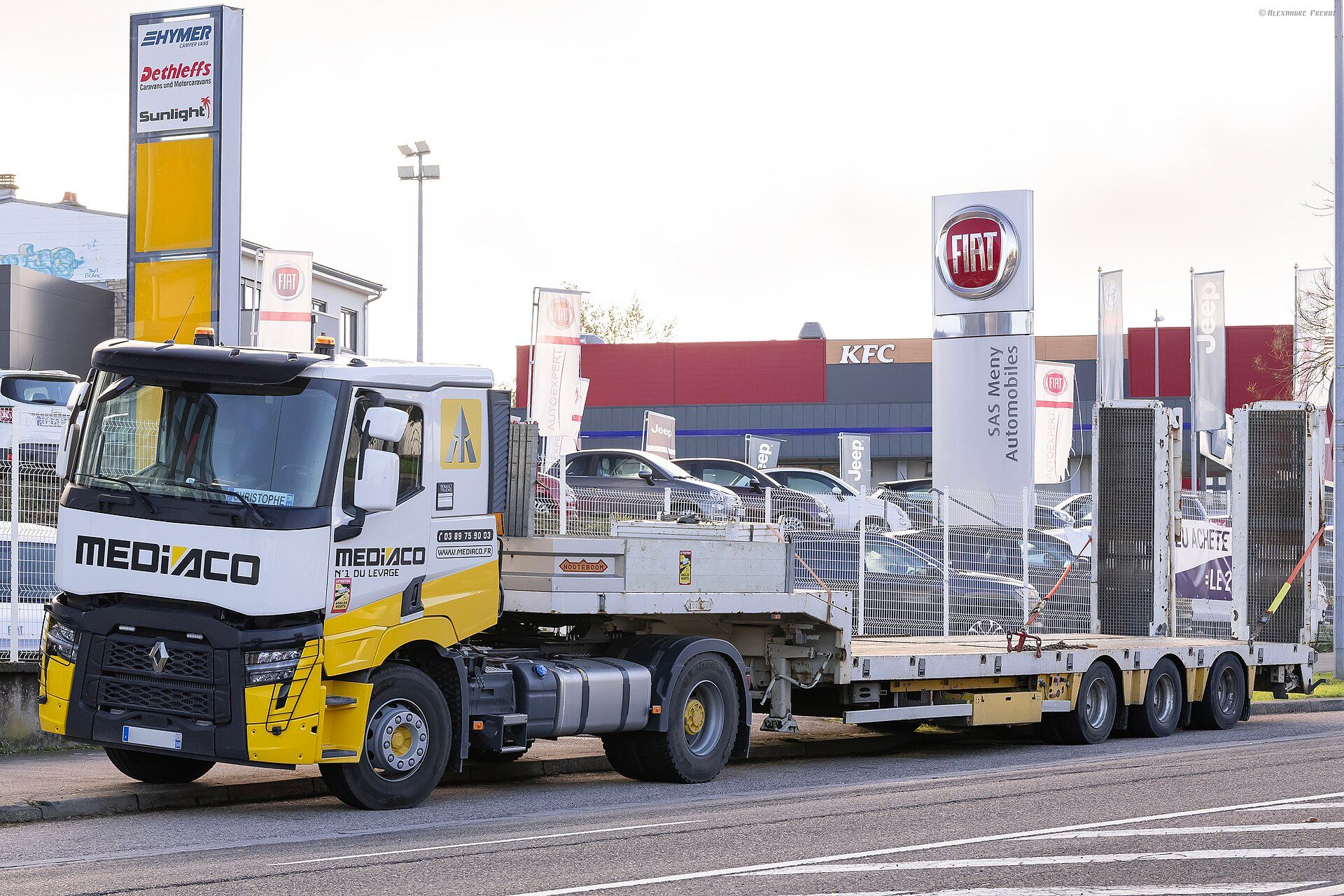
The lashing rings are described as TÜV-certified and no lashing capacity in daN is published for this model, so none is given. And the photograph at the top of this page shows a Nooteboom three-axle semi low loader carrying the maker’s badge on the gooseneck; no type designation is legible on it, and it is not claimed to be an MCOS.
Who this trailer is for
The buyer is an operator moving machinery inside the payloads tabulated above, repeatedly, into places that are difficult to reach — construction and rental plant, access platforms, road-building machinery, agricultural machines — and who has decided that tyre wear and manoeuvring time are worth more than the price gap to a self-steering trailer. Nooteboom’s own case is that it lowered that gap far enough for hydraulic steering to stop being a specialist purchase, so the vehicle to measure it against is its self-steering sibling.
It is the wrong trailer for two jobs. If the load is tall rather than heavy, the deck is not the constraint and a flat trailer does the work. If the machine is heavier than the 46.5T the range’s top type carries, the MCOS range ends there: the 58.0T against the MCOS-58-04(EB) is its gross weight and not its payload, and Nooteboom’s own description of the programme is the transport of medium-weight machinery up to 47 tonnes. The made-to-order MCO carries the same hydraulic steering over 2 to 8 axles at a technical 8, 10 or 12 t per axle at 80 km/h, but Nooteboom publishes no gross weight, no deadweight and no payload for any MCO type, so no capacity above 46.5T can be quoted here — and a buyer who moves to it loses the published weight tables that make the MCOS legible in the first place.
Where it sits against its rivals
Nooteboom, Faymonville, Goldhofer and Broshuis each publish this class differently, which makes a like-for-like comparison harder than it looks. Nooteboom’s position is a standardised programme with published tables, so the comparison to make is named type against named type, at the same speed qualifier, with the same ramp set specified. A payload quoted at 80 km/h and a payload quoted under a national exemption are not the same figure, and neither is a deadweight with aluminium ramps against one with hydraulic folding ramps.
Buying used
Start with the type designation and match it against the plate rather than against the seller’s advert. The extendible V types cost deadweight against their fixed-floor equivalents — 1.5 tonnes on the three-axle pair and 1.0 tonne on the four-axle pair, both subtractions ours from the figures above. Because every table is footed Weights depending on version, the number that matters is the one on the vehicle’s papers rather than the one in the brochure. Nooteboom makes a statement about papers in exactly one place and it is about a different table: its July 2017 SMART-programme page says the deadweights there are “the weights of the basic version without optional ramps” and that “these dead weights are also entered as such in the trailer’s papers”. It says nothing of the kind about the brochure’s tables, and a trailer built with ramps is not the basic version either way.
Then check what the trailer was built to carry. The Access Platform version of the MCOS-48-03(EB) carries a 12.7T deadweight against the standard type’s 9.5T on identical ratings. Nooteboom’s own example of a sector-specific build is one customer’s MCOS with a load floor specially strengthened for machines with a highly concentrated load, such as road planers; that is a construction decision taken at order rather than a fitting added afterwards. Confirm which axles are hydraulically steered as well — Nooteboom offers the rearmost two, three or four — because that is the difference between the vehicle in front of you and the one in the brochure photograph.
Finally, count the ramps and the boxes. Every storage box, boom carrier and bolster set came out of the payload when the trailer was built, which is what Weights depending on version means in practice. The rest are the ordinary checks for buying a used vehicle of this class.
Compared with
- Faymonville
- Goldhofer
- Broshuis
Sources
- MULTITRAILER MCOS semi lowloader — brochure — Nooteboom Trailers B.V.
- MCOS semi low-loader with hydraulic steering — product page — Nooteboom Trailers B.V.
- MCO semi low-loader with hydraulic steering — product page — Nooteboom Trailers B.V.
- Council Directive 96/53/EC — Annex I: maximum weights and dimensions — legislation.gov.uk (The National Archives)
- Nooteboom MCOS Semi Low-loader makes switching to hydraulic steering easier — Nooteboom Trailers B.V.
- Robust lightweight semi low-loaders — the Nooteboom SMART programme — Nooteboom Trailers B.V.
- Semi low-loaders with hydraulic steering — Multitrailer range — Nooteboom Trailers B.V.