operating
The smart tachograph: what version 2 records and when it is required
What the second-generation smart tachograph writes down under Regulation (EU) No 165/2014, how it decides a border has been crossed, and which vehicles had to carry one by which date.
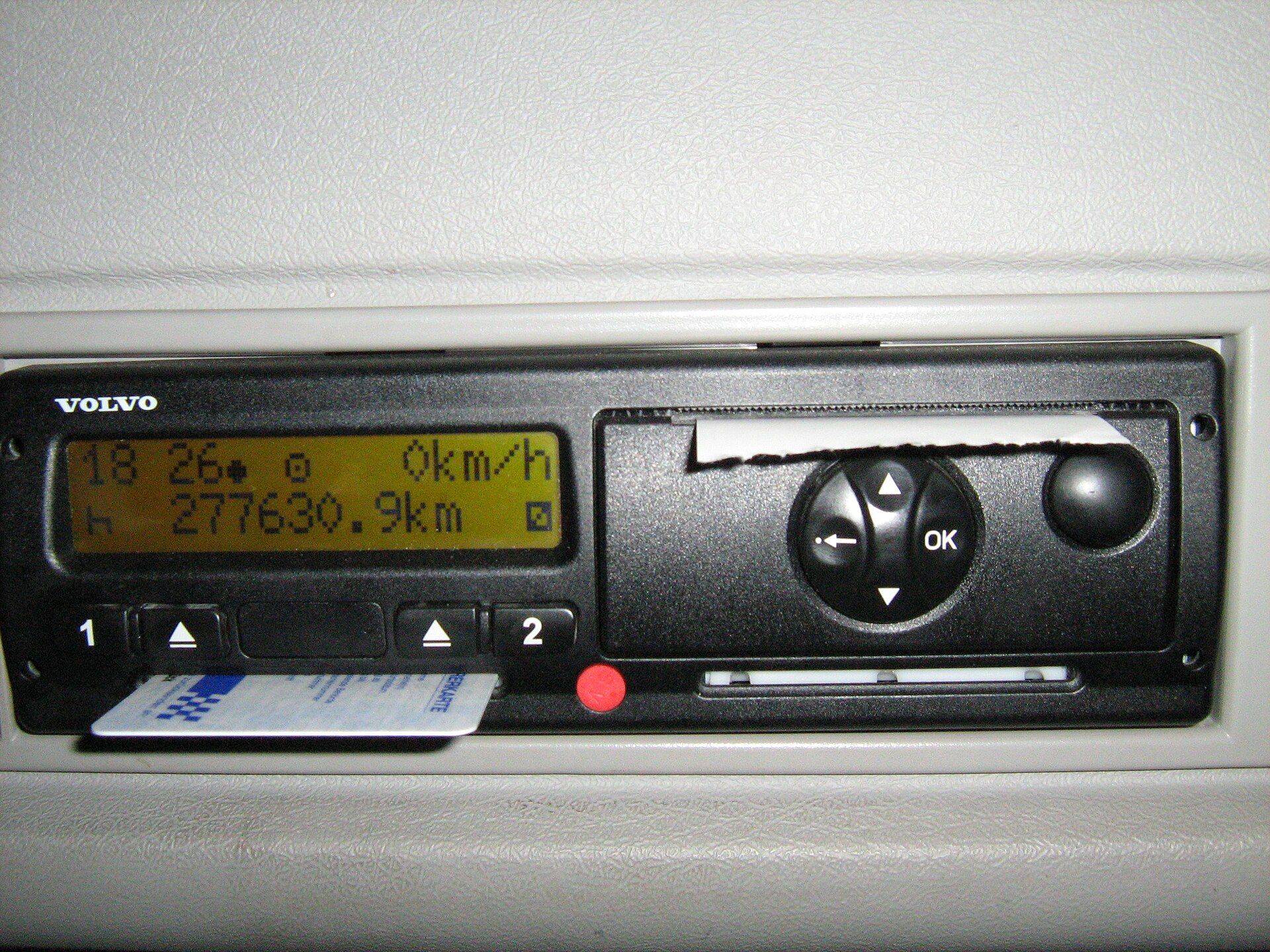
A tachograph used to be a device that argued with the driver about hours. The second-generation smart tachograph is a different instrument: it records where the vehicle was at five defined moments in the working day, decides for itself which country it is in, and can be interrogated from the roadside while still moving. Two questions follow for anyone running or buying a heavy vehicle in Europe — what the unit writes down, and which vehicles had to have one by which date. Neither answer is as wide as it is usually reported.
Five position points, and whether the load was goods or people
Article 8(1) of Regulation (EU) No 165/2014, as amended by Regulation (EU) 2020/1054, sets out what is recorded automatically: the position of the vehicle “at the following points, or at the closest point to such places where the satellite signal is available” — the starting place of the daily working period, every time the vehicle crosses the border of a Member State, every time it performs loading or unloading activities, every three hours of accumulated driving time, and the ending place of the daily working period.
The second subparagraph adds something that is not a position at all: the unit must also record “whether the vehicle has been employed for the carriage of goods or passengers, as required by Regulation (EC) No 561/2006”. A vehicle that does both says which it was doing.
Not all of that binds every vehicle, and the fourth subparagraph is the part summaries drop. Two of the five position points — the border crossing and the loading or unloading, being the second and third indents — together with the goods-or-passengers flag “shall apply to vehicles that were registered in a Member State for the first time more than two years after the entry into force of the detailed provisions referred to in the second paragraph of Article 11, without prejudice to the obligation to retrofit certain vehicles later in accordance with Article 3(4)”. That sentence is the hinge of the whole regime. It measures from the same entry into force as the retrofit deadlines below, and it is the one place where the Regulation ties what the unit records to the timetable on which units had to be replaced.
Article 8(2) is the limit on all of this, and it is tighter than the popular description of the device as a tracker. Only a positioning service free of charge may be used, and no position data other than those expressed, “wherever possible”, in geographical coordinates for determining those points may be permanently stored. Data held temporarily to work out when a point has been reached, or to corroborate the motion sensor, “shall not be accessible to any user” and is deleted automatically. What is authorised is five stamps, not a continuous track.
How the unit decides that a border has been crossed
The technical detail lives in Annex IC to Implementing Regulation (EU) 2016/799, which Implementing Regulation (EU) 2021/1228 rewrote, inserting a border-crossing monitoring function at point 3.27. Requirement 226a makes it “detect when the vehicle has crossed the border of a country, which country has been left and which country has been entered”; 226b bases that on the measured position and a stored digital map; 226c adds the qualifier that a crossing is not recorded where the vehicle was in the country for less than 120 seconds.
The map is not the manufacturer’s choice. Under requirements 133j to 133m the unit stores a digital map made available by the European Commission from a dedicated secured website, with a version identifier and a hash value the manufacturer must verify before use, at a definition corresponding to NUTS level 0 and a scale of 1:1 million.
What is stored is more than two country codes. Requirement 133a records the country left, the country entered and the position of the crossing; 133b adds the driver and/or co-driver card number and card issuing Member State, the card generation — the field that tells an officer whether a version 1 or a version 2 card was in the slot — the GNSS accuracy with date and time, a flag saying whether the position was authenticated, and the odometer reading at detection. Requirement 133c gives the memory a floor of 365 days; 133d overwrites the oldest first.
Load and unload are a driver entry, not an automatic one
The loading and unloading point in Article 8(1) is often read as though the vehicle detects it. It does not. Requirement 62a lets the driver “enter and confirm, in real time” that the vehicle is being loaded, unloaded, or both at once; 62b records each type as a separate event; 62c fixes when — “before the vehicle leaves the place where the load/unload operation is carried out”. Where no satellite position is available then, 133f uses the latest position held; 133h keeps the entries for at least 365 calendar days.
A position that may only be assumed to be authentic
Implementing Regulation (EU) 2021/1228 made the Galileo Open Service Navigation Message Authentication service mandatory, so a recorded position can be shown to have come from a genuine satellite signal. Requirement 88a adds a “GNSS anomaly” event, triggered when the receiver detects an attack or when authentication fails, then suppressed for ten minutes so a jammed vehicle does not fill its memory with one entry.
That created a problem, which Implementing Regulation (EU) 2023/980 records plainly: the service was then “currently in a public testing phase, with a service declaration expected only after the introduction date of the second version of the smart tachograph in newly-registered vehicles”. The answer was a transitional vehicle unit, type-approved against the test-phase signal, which ignores authentication until a software update is applied and until then assumes the positions its receiver supplies “are always authenticated”. Requirement TRA_022 allowed type approval of such units to be requested only until 31 December 2023 or the service declaration date, whichever is the later; TRA_023 allowed them to be fitted to newly registered vehicles only until 31 May 2024 or five months after that declaration. TRA_020 makes manufacturers tell the Commission which software versions are affected, and the Commission publish them. On an early version 2 vehicle, whether the unit is a transitional one and whether it has been updated belongs on the same list as the emissions and toll checks in buying a used truck.
What a control officer can pull out of a moving vehicle
Article 9 governs remote early detection. The communication happens only when the control authority’s equipment asks for it, and the data is limited to what a targeted check of a possibly manipulated tachograph needs. Article 9(4) runs to twelve indents by our count: latest security breach attempt, longest power supply interruption, sensor fault, motion data error, vehicle motion conflict, driving without a valid card, card insertion while driving, time adjustment data, calibration data including the dates of the two latest calibrations, vehicle registration number, speed recorded by the tachograph, and — added by Regulation (EU) 2020/1054 — exceeding maximum driving time.
None of that is a record of hours. Article 9(6) has the data deleted at the latest three hours after communication unless it indicates possible manipulation, and Article 9(8) states that such a communication shall in no case lead to automatic fines or penalties. It selects vehicles to stop; it decides nothing.
The manual entry the driver stops making
Article 34(7) opens with the country symbols the driver enters for the places where the daily working period started and finished. Its second subparagraph added, from 2 February 2022, the symbol of the country the driver enters after crossing a border of a Member State, at the first stop in that Member State, made “at the nearest possible stopping place at or after the border”.
The relief on version 2 is narrower in the Regulation than it is usually quoted. The fourth subparagraph removes only “the information referred to in the first subparagraph” — the two country symbols at the start and end of the working period — “if the tachograph is automatically recording location data in accordance with Article 8”. The border-crossing symbol sits in the second subparagraph and is not covered by those words. That the driver stops entering it too is the Commission’s position rather than the Regulation’s wording: its guidance states that where a driver is driving a vehicle equipped with smart tachograph version 2, there is no requirement to manually record border crossings, regardless of the card version. Until the vehicle carries one, the same guidance says, the driver records every crossing by hand.
Article 36 separately requires records for the current day and the preceding 56 days. That period is not part of the version 2 package: Article 3 of Regulation (EU) 2020/1054 applied it from 31 December 2024, a different provision landing on the same day as the first retrofit deadline.
Which vehicle, by which date
Implementing Regulation (EU) 2021/1228 was published in OJ L 273 of 30 July 2021 and enters into force on the twentieth day following publication, which puts that at 19 August 2021 — the count is ours, the regulation states only the rule. Its Article 2 applies it from 21 August 2023, and Implementing Regulation (EU) 2023/980 confirms the consequence: from that date, vehicles registered for the first time in a Member State are to be equipped with the new version.
The retrofit deadlines in Article 3(4) and 3(4a) are periods measured from that entry into force, and both datings below are our arithmetic from the wording. Article 3(4) runs “no later than three years from the end of the year of entry into force”, which puts it at 31 December 2024 — the date the Commission gives directly, as the day by which an analogue or non-smart digital unit had to be retrofitted “at the latest”.
Article 3(4a) runs “no later than four years after the entry into force”, which by the same arithmetic lands on 19 August 2025. The Commission does not put the deadline there. Its guidance says a vehicle already carrying a smart tachograph had “until 18 August 2025 at the latest to retrofit”, and separately that from 19 August 2025 vehicles registered in the Union and operating in Member States other than their Member State of registration “are all to be equipped with a smart tachograph version 2”. The two dates are the deadline and the day after it, and they are worth keeping apart: a fleet reading 19 August 2025 as the date to book the workshop for is, on the Commission’s reading, a day late. The table takes the Commission’s date.
| Vehicle | Obligation | Date |
|---|---|---|
| Registered for the first time from the application date | Version 2 fitted from new | From 21 August 2023 |
| Analogue, or digital to any of the three Annex IB specifications in Article 3(4) | Retrofit to version 2 — only where the vehicle operates outside its Member State of registration | By 31 December 2024 |
| Smart tachograph version 1 to Annex IC | Retrofit to version 2 — same condition | By 18 August 2025 |
| Goods vehicles over 2.5 t including any trailer or semi-trailer, in international transport or cabotage | Into the scope of 561/2006, and so of Article 3(1) | From 1 July 2026 |
| Drivers | All to hold a version 2 driver card | By August 2028 |
The wording of Article 3(4) and 3(4a) is the part most often widened in summaries. Both bind only “vehicles operating in a Member State other than their Member State of registration”. The Commission’s guidance works the boundary case: a vehicle in exclusively domestic transport that transits another Member State because it is the shortest route is not carrying out international carriage, “therefore, this obligation does not apply”. A domestic fleet is outside the retrofit duty; the moment one of its vehicles takes work in another Member State it is inside, and the guidance says the tachograph must be replaced before that journey starts.
The 2028 date comes from the card, not the vehicle. Version 2 cards have been issued since August 2023, and Article 26(6) says a driver card “shall not be valid for more than five years”, from which the Commission concludes that all drivers will hold one by August 2028.
What this means when the vehicle changes hands
Two duties survive the sale. Article 23(1) requires inspection by an approved workshop at least every two years, and Article 23(2) sets a minimum floor of seven checks — seven by our count of the indents, which the Regulation leaves unnumbered: correct fitting for the vehicle, proper working, the type-approval mark, the installation plaque, intact and effective seals, the absence of manipulation devices or traces of their use, and the tyre size and actual circumference. Commission Regulation (EU) No 581/2010, still in force, caps downloading at 90 days for data from the vehicle unit and 28 days for data from the driver card.
The generation fitted is now a commercial fact rather than a technical one. A vehicle still on version 1 can work at home indefinitely but cannot be put to work in a Member State other than the one it is registered in — the test is the operation, not the border, and on the Commission’s own example crossing another Member State by the shortest route does not by itself trigger the duty. That still narrows both the work the vehicle can take and the buyers it will attract. The same logic reaches a used coach, because Article 3(1) borrows its scope from Regulation (EC) No 561/2006, whose Article 2(1)(b) covers the carriage of passengers by vehicles “constructed or permanently adapted for carrying more than nine persons including the driver, and are intended for that purpose” — the driver counts towards the nine. The retrofit is a workshop-capacity problem rather than a hardware one, and belongs beside tyres and inspections in running costs.
Quick answers
- When does a vehicle have to have a smart tachograph version 2?
- A vehicle registered for the first time from 21 August 2023 carries one from new, because Implementing Regulation (EU) 2021/1228 applies from that date. Older vehicles were retrofitted on the schedule in Article 3(4) and 3(4a) of Regulation (EU) No 165/2014, but only where they operate in a Member State other than the one they are registered in.
- Does the smart tachograph record border crossings automatically?
- Yes. Article 8(1) of Regulation (EU) No 165/2014 lists border crossing as one of five position points recorded automatically, and requirement 226a of Annex IC makes the unit detect which country was left and which entered. Requirement 226c excludes crossings where the vehicle was in a country for less than 120 seconds.
- Does the retrofit deadline apply to a truck that never leaves its own country?
- No. Article 3(4) and 3(4a) bind only vehicles "operating in a Member State other than their Member State of registration", and the Commission's own guidance says a vehicle that works domestically but transits another Member State is not caught either.
- Can the tachograph be read from the roadside without stopping the vehicle?
- Article 9 allows it, but the exchange is limited to twelve items by our count of the indents in Article 9(4), covering manipulation indicators rather than the driver's hours. Article 9(6) requires the data to be deleted at the latest three hours after communication unless the data indicate a possible manipulation or misuse of the tachograph, and Article 9(8) forbids any automatic fine on the strength of it.
- How often must a tachograph be inspected?
- At least every two years, by an approved workshop, under Article 23(1) of Regulation (EU) No 165/2014. Article 23(2) lists what the inspection must check as a minimum — seven items by our count of the indents, among them the tyre size and actual circumference and any traces of a manipulation device.
Sources
- Regulation (EU) No 165/2014 on tachographs in road transport — consolidated text of 31 December 2024 — EUR-Lex, European Union
- Commission Implementing Regulation (EU) 2021/1228 amending Implementing Regulation (EU) 2016/799 as regards smart tachographs — EUR-Lex, European Union
- Commission Implementing Regulation (EU) 2023/980 as regards a transitional smart tachograph and its use of Galileo OSNMA — EUR-Lex, European Union
- Regulation (EU) 2020/1054 amending Regulation (EC) No 561/2006 and Regulation (EU) No 165/2014 as regards positioning by means of tachographs — EUR-Lex, European Union
- Regulation (EC) No 561/2006 on driving times and rest periods — consolidated text of 31 December 2024 — EUR-Lex, European Union
- Questions and answers on tachograph provisions of Mobility Package 1 — European Commission, DG Mobility and Transport
- Commission Regulation (EU) No 581/2010 on maximum periods for downloading data from vehicle units and driver cards — EUR-Lex, European Union