segments
Bus Seat Belts: Which Classes Must Have Them, and Who Must Wear Them
UN Regulation No 16 requires safety belts only in Class III and Class B buses; Class I and A may be fitted, Class II where a Contracting Party demands it. Wearing them is a separate directive.
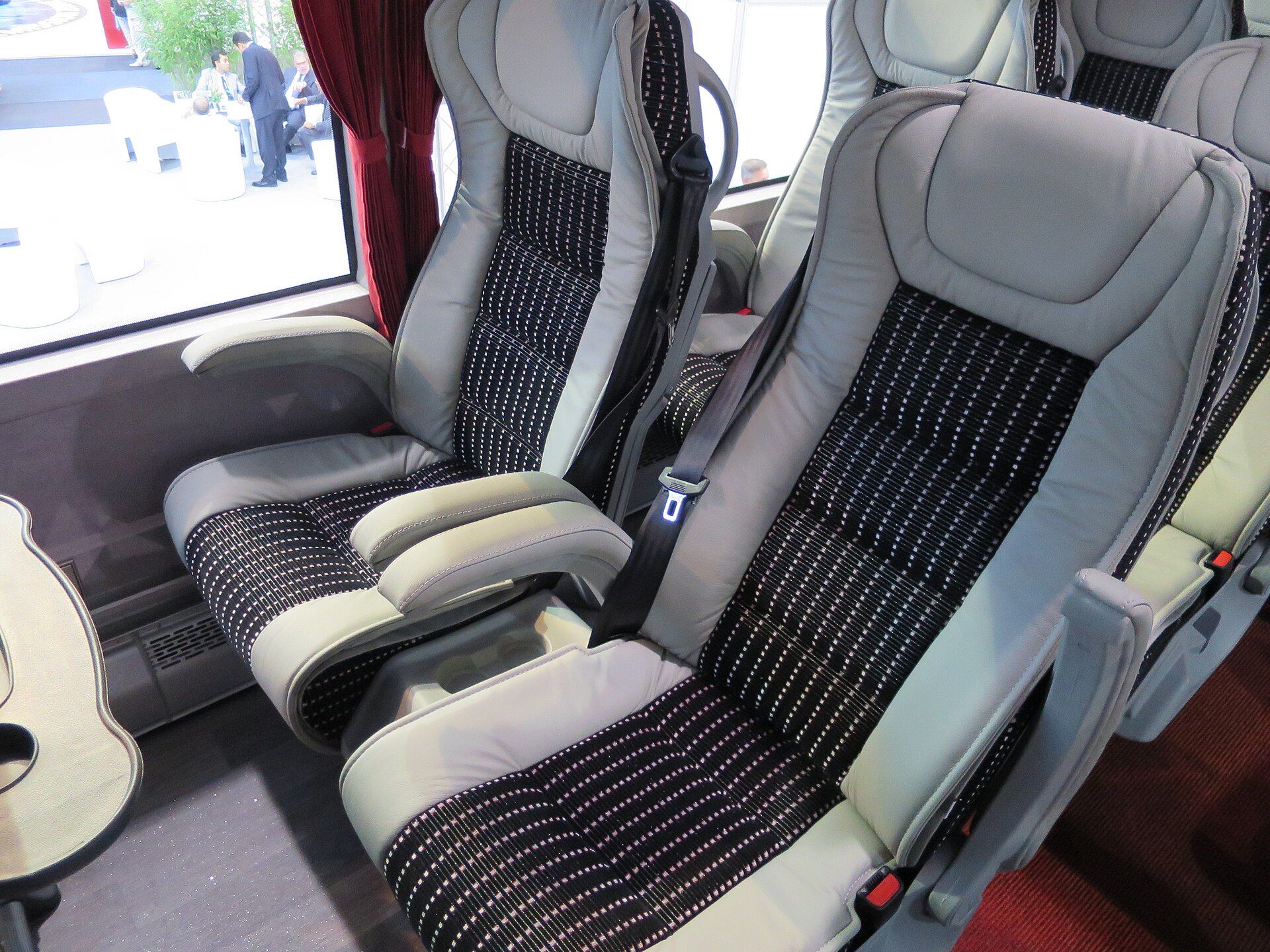
Two questions hide behind one phrase. Whether a bus must be built with safety belts is a type-approval question, answered by UN Regulation No 16 and made compulsory in the Union by Regulation (EU) 2019/2144. Whether the people sitting in them must fasten them is a traffic-law question, answered by Directive 91/671/EEC. The two have different scopes and different exemptions.
The paragraph that draws the line
Paragraph 8.1.1 of UN Regulation No 16 is the whole answer to why a touring coach has belts and an urban bus does not. With the exception of seating intended solely for use when the vehicle is stationary, the seats of vehicles of categories M1, M2 (of Class III or B), M3 (of Class III or B) and N shall be equipped with safety-belts or restraint systems satisfying the Regulation. The paragraph handles the remaining classes in three separate sentences, and the separation matters. Class I or A vehicles of category M2 or M3 may be fitted with safety belts and/or restraint systems conforming to the Regulation — a permission, and one that names those two classes only. Class II is not in that sentence. What the Regulation offers over Class II is a power: a Contracting Party applying the Regulation may demand the installation of safety belts on M2 and M3 vehicles belonging to that class, which is the Contracting Party’s to exercise and not a requirement the Regulation imposes itself. And where safety belts and/or restraint systems are fitted in Class I, II or A vehicles of category M2 or M3 — by the manufacturer’s choice or on a Contracting Party’s demand — they have to be in compliance with the Regulation.
The classes come from UN Regulation No 107, republished in the Official Journal on 29 January 2026 and set out in full in bus classes under UN R107. Paragraph 2.1.1.3 makes Class III, in the band above 22 passengers in addition to the driver, the vehicles “constructed exclusively for the carriage of seated passengers”; 2.1.2.2 makes Class B, at 22 passengers or fewer in addition to the driver, those “not designed to carry standing passengers”. Against them, 2.1.1.1 defines Class I by its areas for standing passengers, to allow frequent passenger movement, and 2.1.2.1 defines Class A as designed to carry them.
The criterion is standing capacity, not size, speed or road type. The three classes that admit standing passengers — I, II and A — are the three the equipping duty leaves out; the two that do not are the two it binds. Within that group the Regulation divides again: Class I and A carry the express permission to fit, Class II the Contracting Party’s power to demand. It is not the line every bus rule draws. UN Regulation No 66 on rollover strength reaches single-deck Classes II, III and B above 16 passengers, so it binds the intercity bus where the fitting duty does not.
The rule’s first European home no longer exists
That rule entered European law through Directive 2005/40/EC, and its status has to be stated exactly: EUR-Lex records the directive as no longer in force, date of end of validity 31 October 2014, implicitly repealed by Regulation (EC) No 661/2009.
Article 1(3)(b) replaced point 3.1.1 of Annex I to Directive 77/541/EEC with the ancestor of the text in UN R16 today, and Article 1(2) tied the classes to section 2 of Annex I to Directive 2001/85/EC. One difference between the two is worth holding on to, because the repealed wording is the one still quoted at second hand. The old point 3.1.1 put all three of the remaining classes into a single permissive sentence: Class I, II or A vehicles belonging to category M2 or M3 may be fitted with safety belts and/or restraint systems, provided they conform to the requirements of the Directive. That sentence died with the Directive. R16 does not say it: the permission it grants names Class I and A, and Class II reaches the Regulation by the Contracting Party’s demand and by the compliance-when-fitted sentence instead. Recital 3 says why a line was drawn at all: Parliament’s Resolution of 18 February 1986 had pressed for compulsory belt wearing for all passengers except in public service vehicles, so a distinction had to be made between public service buses and other vehicles. Article 3 staged the change over three dates — 20 April 2006, 20 October 2006 and 20 October 2007, the last being when certificates of conformity for non-compliant new vehicles ceased to be valid and registration, sale and entry into service had to be refused.
Then the parent act went. Article 19(1) of Regulation (EC) No 661/2009 repealed a long list of directives including both 77/541/EEC and 2001/85/EC with effect from 1 November 2014, which is why the amending directive’s validity ends the day before. Regulation 661/2009 has since followed: EUR-Lex records it as no longer in force from 5 July 2022, repealed by Regulation (EU) 2019/2144, whose Article 18(1) repeals it from that Regulation’s date of application and whose Article 19 fixes that date at 6 July 2022.
The third layer is the one in force. Article 4(2) of Regulation (EU) 2019/2144 makes type-approval to the UN Regulations in its Annex I count as EU type-approval, and that Annex names UN Regulation No 16, 07 series of amendments, at Official Journal L 109 of 27 April 2018, across categories M and N. Annex II entry A5, “Safety-belts and restraint systems”, points at the same Regulation from M1 to N3 under note A: registration of a non-compliant vehicle prohibited from 6 July 2022. The wording changed on the way from the Directive to R16, as set out above, and so did the anchor for the class definitions: R16 footnotes its class terms to the Consolidated Resolution on the Construction of Vehicles (R.E.3), document ECE/TRANS/WP.29/78/Rev.3, paragraph 2, so they are UN definitions now, not the ones in section 2 of Annex I to Directive 2001/85/EC that 2005/40/EC pointed at.
Anchorages reach one class further than belts
Fitting a belt and providing somewhere to bolt it are separate approvals with different scopes. UN Regulation No 14 covers the anchorages, and paragraph 5.3.1 of its 09 series draws the line one class wider: any vehicle in categories M and N, except those of categories M2 or M3 belonging to Classes I or A, shall be equipped with safety-belt anchorages satisfying the Regulation — and where such a vehicle is fitted with anchorages anyway, they too must comply. A Class II intercity bus therefore carries compliant anchorages whether or not a belt is ever bolted to them. Annex 6 sets the minimum count per seating position.
| Seating position | M2 over 3.5 t | M3 |
|---|---|---|
| Forward-facing, outboard, front | 3 | 3 |
| Forward-facing, outboard, other than front | 3 or 2 | 3 or 2 |
| Forward-facing, centre, front | 3 or 2 | 3 or 2 |
| Forward-facing, centre, other than front | 3 or 2 | 3 or 2 |
| Rearward-facing | 2 | 2 |
| Side-facing | — | 2 |
Where the table offers three or two, paragraph 5.3.5 allows two only if one of three conditions holds: a seat or other vehicle part conforming to paragraph 3.5 of Appendix 1 to UN Regulation No 80 sits directly in front; no part of the vehicle is in the reference zone or capable of being there while the vehicle is in motion; or the parts within that zone meet the energy-absorbing requirements of Appendix 6 to R80.
Three points or two
The belt itself follows the same logic. Annex 16 to UN R16 lists, for M2 vehicles over 3.5 tonnes and for M3, the types Br3, Br4m, Br4Nm, Ar4m and Ar4Nm at every forward-facing position, and paragraph 8.1.7 settles which applies: a three-point belt shall be provided unless one of the three conditions above is met, in which case a two-point belt may be. For M3 the same annex allows types B, Br3, Br4m and Br4Nm at side-facing positions and shows a dash for rearward-facing ones. A coach seat and the seat in front of it are therefore one engineering problem rather than two. But the three conditions are alternatives, and they do not all point the same way. Two of them are satisfied by what stands ahead of the passenger — a conforming seat or vehicle part directly in front, or parts inside the reference zone that meet the R80 energy-absorbing requirements. The third is satisfied by the opposite case, no part of the vehicle being in that zone or capable of being there while the vehicle is in motion. What paragraph 8.1.7 tests is the reference zone, not the presence of something in it. Makers price the difference rather than argue it: Irizar’s equipment matrix for the i6S marks two-point belts on seats as standard on every column and three-point belts as an option on every column, so on that coach the belt type is an order line.
The seat is a third approval
UN Regulation No 80 covers passenger seats for forward-facing installation in M2 and M3 vehicles of Classes II, III and B, and those vehicles in respect of their seat anchorages and seat installation; paragraph 1.1(c) excludes rearward-facing seats and any head restraint fitted to them. Annex II to Regulation (EU) 2019/2144 lists it at entry A3, “Bus seats”, against M2 and M3. Its scope matches R14’s on the bus side and runs one class wider than R16’s fitting duty: in Class II the seat and its anchorage must be approved even though the belt itself need not be fitted. Paragraph 1.4 goes further and prohibits side-facing seats in M2 and M3 vehicles of those three classes, except in M3 vehicles of them above 10 tonnes technically permissible maximum laden mass where paragraph 7.4 is satisfied; paragraph 1.5 lifts that prohibition for ambulances and for vehicles intended for use by the armed services, civil defence, fire services and forces responsible for maintaining public order.
Wearing is a different instrument entirely
None of the above obliges anyone to fasten anything. That duty sits in Council Directive 91/671/EEC, which EUR-Lex records as in force with a current consolidated version of 20 March 2014. Its title now reads “relating to the compulsory use of safety belts and child-restraint systems in vehicles” — the words “in vehicles of less than 3,5 tonnes” fell away when Directive 2003/20/EC extended it, and Article 2 of that amending directive required transposition before 9 May 2006. Article 1(1) sets the scope at all motor vehicles in categories M1, M2, M3, N1, N2 and N3 intended for use on the road, having at least four wheels and a maximum design speed exceeding 25 km/h.
Article 2(2)(a) is the operative sentence for buses: Member States shall require that all occupants aged three and over of M2 and M3 vehicles in use shall use the safety systems provided while they are seated. The duty is to use what is provided, so on a vehicle with no belts there is nothing to fasten; and it binds only while the passenger is seated, so the standing passenger of a Class I bus falls outside it in terms. Article 2(2)(b) adds an information duty dischargeable in four ways: by the driver; by the conductor, courier or official designated as group leader; by audio-visual means; or by signs and/or the pictogram established by the Member States in accordance with the Community design in the Annex — a white figure on a blue background — prominently displayed at every seating position.
The exemptions are where the city bus reappears. Article 5 exempts holders of a medical exemption certificate, valid in every Member State and required to state its period of validity. Article 6 lets a Member State grant further exemptions for transport in its own territory with the Commission’s agreement, and its last indent is the urban case in terms: to take account of the specific conditions of use of M2 and M3 vehicles for local transport in urban and built-up areas, or in which standing is allowed.
Article 6a needs its status put exactly, because it is the one easily written off as spent: the Article is still in the Directive, but nothing can still be running under it. The consolidated text carries the Article in full and unmarked — where the deleted Article 4 appears only as a row of dashes — and it lets Member States, with the Commission’s agreement, grant temporary exemptions so that, for local transport operations and particularly for school buses, a greater number of seated children may be carried in M2 and M3 vehicles than there are seats fitted with belts. What the Article caps is the exemption, not itself: the period of validity of such exemptions, set by the Member State, may not be more than five years from 9 May 2003, which puts the last day any of them could run at 9 May 2008 — that date is our arithmetic from the Article’s two components and is printed nowhere in it. School transport is where that exemption mattered.
The reminder, and what it does not cover
Recital 12 of Regulation (EU) 2019/2144 records the shift: under Regulation 661/2009 the belt reminder was compulsory only for the driver’s seat of new passenger cars from 2014, and amendment of UN R16 made it obligatory to fit all front and rear seats of M1 and N1 vehicles, as well as all front seats of N2, N3, M2 and M3 vehicles, with reminders from 1 September 2019 for new types and 1 September 2021 for all new motor vehicles. The Regulation’s own text is narrower than that summary suggests.
Paragraph 8.4.1.1 requires a reminder at the driver’s seating position of M and N vehicles and at the seating positions in the same row as the driver’s seat; 8.4.1.2 extends it to all rear rows only in M1 and N1. Paragraph 8.4.1.3 exempts folding seats — the text names foldable crew seats in buses and coaches — and any seating position fitted with an S-type belt. On an M3 coach the reminder therefore covers the driver’s row and nothing behind it.
Both alert levels are specified. Under 8.4.2.3.1 the first level is at least a visual warning lasting 30 seconds or longer at the driver-row positions and 60 seconds or longer at the M1 and N1 rear positions; under 8.4.2.4.1 the second is a visual and audible signal activated for at least 30 seconds when at least one — or any combination, at the manufacturer’s choice — of three conditions is fulfilled. Each condition is a measured quantity exceeding a threshold the manufacturer sets, and it is the threshold the Regulation caps, not the quantity: distance driven greater than a distance threshold that shall not exceed 500 m, vehicle speed greater than a speed threshold that shall not exceed 25 km/h, or duration time greater than a duration threshold that shall not exceed 60 seconds.
What to check on a particular vehicle
Class first, and with it the date; everything else follows from the pair. A vehicle approved as Class III or Class B had to leave the factory with belts once the duty bit — in the Union from 20 October 2007, the date Article 3(3) of Directive 2005/40/EC set for treating the certificates of conformity of non-compliant new vehicles as invalid and refusing their registration, sale and entry into service, and now for registrations from 6 July 2022 under Annex II entry A5 note A to Regulation (EU) 2019/2144. On anything approved before that first date the class tells you what the vehicle had to have at its date of approval, not what is on board. One approved as Class I or Class A did not have to carry belts under either regime, and its seats need carry no anchorages either. Class II is the ambiguous middle: anchorages and R80 seats yes, belts only where the Contracting Party demanded them. Because a vehicle may be approved for more than one class under paragraph 2.1.1.4 of R107, the approval documents rather than the body shape settle it — the same reading habit that governs a coach specification sheet and the certificate fields set out under buying a used coach, and the same Annex II date regimes that decide the driver assistance systems a given registration had to carry.
Quick answers
- Do coaches have to have seat belts?
- Paragraph 8.1.1 of UN Regulation No 16 requires the seats of M2 and M3 vehicles of Class III or Class B to be equipped with safety-belts or restraint systems. Class III is the class constructed exclusively for the carriage of seated passengers, which is how a touring coach is normally approved.
- Why do city buses not have seat belts?
- Because paragraph 8.1.1 of UN Regulation No 16 names only Class III and Class B among M2 and M3 vehicles. A Class I city bus and a Class A minibus are built with areas for standing passengers, and for them the same paragraph says belts may be fitted, not shall.
- Is it compulsory to wear a seat belt on a bus?
- Article 2(2)(a) of Directive 91/671/EEC requires Member States to make all occupants aged three and over of M2 and M3 vehicles in use wear the safety systems provided while they are seated. The duty attaches to what is fitted, and only while the passenger is seated.
- Do buses have two-point or three-point seat belts?
- Annex 16 to UN Regulation No 16 lists both for M2 vehicles over 3.5 tonnes and for M3. At the forward-facing positions the annex marks with a symbol, paragraph 8.1.7 makes the three-point belt the default and allows a two-point lap belt only where one of three conditions about the structure in front of the seat and the reference zone is met. At M3 side-facing positions the annex lists the two-point type B among the permitted types, with no such condition.
- Does a bus have to warn the driver about an unfastened belt?
- Paragraph 8.4.1.1 of UN Regulation No 16 requires a safety-belt reminder at the driver's seating position of M and N vehicles and at the seats in the same row as the driver. Paragraph 8.4.1.2 extends the duty to rear rows only in M1 and N1 vehicles.
Sources
- UN Regulation No 16 — Safety-belts, restraint systems, child restraint systems and ISOFIX child restraint systems; and vehicles equipped with safety-belts and safety-belt reminders (OJ L 109, 27.4.2018), paragraphs 8.1.1, 8.1.7, 8.4.1 and 8.4.2, and Annex 16 — UNECE / EUR-Lex, Publications Office of the European Union
- UN Regulation No 14 — Approval of vehicles with regard to safety-belt anchorages, 09 series of amendments (OJ L 324, 13.12.2019), paragraphs 5.3.1 and 5.3.5, and Annex 6 — UNECE / EUR-Lex, Publications Office of the European Union
- UN Regulation No 80 — Approval of seats of large passenger vehicles and of these vehicles with regard to the strength of the seats and their anchorages, 03 series of amendments (OJ L 266, 18.10.2019), paragraphs 1.1-1.5 — UNECE / EUR-Lex, Publications Office of the European Union
- Regulation (EU) 2019/2144 on type-approval requirements for the general safety of motor vehicles — Article 4(2), Article 18(1), Article 19, recital 12, Annex I and Annex II entries A3, A4, A5 and A6 — EUR-Lex, Publications Office of the European Union
- Regulation (EU) 2019/2144, consolidated text 02019R2144-20260802 — Annex I rows for UN Regulations Nos 14, 16 and 80 — EUR-Lex, Publications Office of the European Union
- Regulation (EC) No 661/2009 — Article 19(1); EUR-Lex record: 'No longer in force, Date of end of validity: 05/07/2022; Repealed by 32019R2144' — EUR-Lex, Publications Office of the European Union
- Directive 2005/40/EC amending Council Directive 77/541/EEC — recital 3, Articles 1 and 3; EUR-Lex record: 'No longer in force, Date of end of validity: 31/10/2014; Implicitly repealed by 32009R0661' — EUR-Lex, Publications Office of the European Union
- Council Directive 91/671/EEC relating to the compulsory use of safety belts and child-restraint systems in vehicles, consolidated text 01991L0671-20140320 — Articles 1(1), 2(2), 5, 6 and 6a, the deleted Article 4, and the Annex — EUR-Lex, Publications Office of the European Union
- Directive 2003/20/EC amending Council Directive 91/671/EEC — Article 1(4), 'Article 4 shall be deleted'; Article 2, transposition before 9 May 2006 — EUR-Lex, Publications Office of the European Union
- UN Regulation No 107 — General construction of category M2 or M3 vehicles (OJ L, 2026/139, 29.1.2026), paragraphs 2.1.1 and 2.1.2 — UNECE / EUR-Lex, Publications Office of the European Union
- UN Regulation No 66 — Strength of the superstructure of large passenger vehicles, 02 series of amendments (OJ L 84, 30.3.2011), paragraph 1.1 — UNECE / EUR-Lex, Publications Office of the European Union