Irizar
Irizar i6S
Ten configurations from 10,780 to 14,980 mm on five engine steps, a weight Irizar publishes as a range rather than a plate, and the figures its own two documents contradict.

Model overview
Axle configurations: Two-axle (10.8 m, 12 m, 13 m) · Three-axle with steered third axle (13.2 m, 14 m, 15 m)
Engine families
- Power
- 271–320 kW
- Power
- 340–375 kW
- Torque
- 2300–2500 Nm
The grid above describes the 12 m x 3.5 m two-axle integral coach. Irizar's model page offers six lengths; the catalogue prints ten configurations of them, on a 3.5 m or a 3.7 m body, and every one is 2,550 mm wide. The 3.7 m body stands 3,931 mm high against 3,731 mm. Maximum authorised weight is published as a range and not as a plated figure: 18,000-19,000 kg on the two-axle coaches and 25,000-26,000 kg on the three-axle ones, on the maker's web pages alone — the technical catalogue has no weight row anywhere in its eleven pages. The 12 m coach holds 9.1 m3 of luggage on the 3.5 m body, less 1 m3 with a WC and 1.8 m3 with a driver's bunk, and 12.59 m3 on the 3.7 m body, less 1.2 m3 and 2.1 m3 for the same two. Torque is recorded for the MX13 alone: the catalogue gives the 271 kW MX11 step 1,580 Nm and the model page gives it 1,600 Nm, and neither document resolves the other. Axles are ZF throughout — RL82EC front, A132 rear, and RL82EC again where a steered third axle is fitted — on electronically controlled air suspension, with disc brakes on all wheels under EBS.
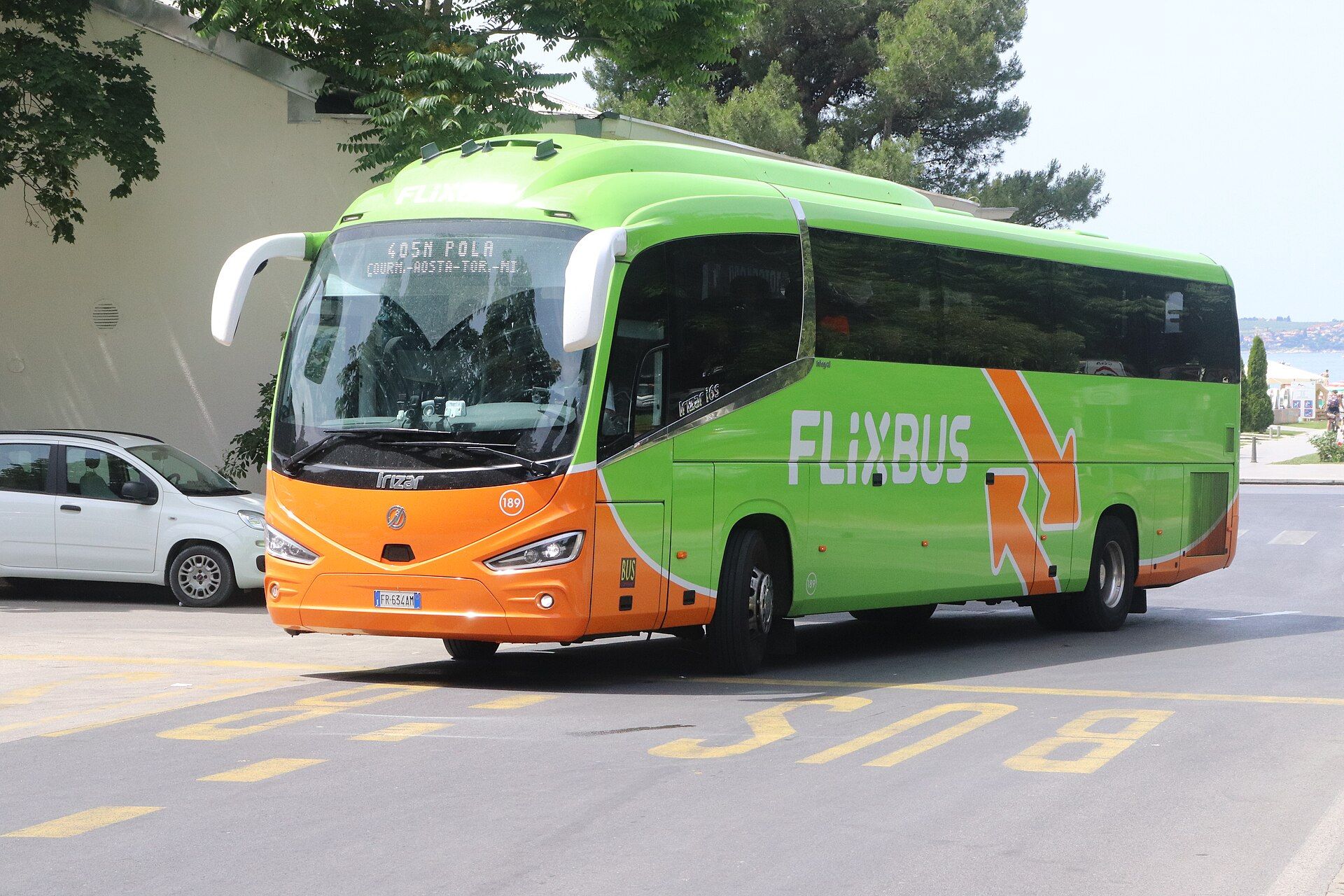
The i6S is the touring coach Irizar launched in October 2016. The maker’s own news archive puts it plainly: “A year on from unveiling the Irizar i8, Irizar is launching the new Irizar i6S, a high-tech coach that replaces the Irizar pb.” Irizar builds it as an integral vehicle — body and running gear as one product from one company — and separately sells coach bodywork onto chassis built by others. The two are different purchases, and every figure here belongs to the integral vehicle: both of the maker’s technical tables are headed that way. Irizar’s i6S on-chassis page publishes body dimensions, turning circles, luggage volumes, seat layouts and the same maximum authorised weight band as the integral coach; what it does not publish is an engine, a wheelbase or an overhang.
What this record is, and what it is not
This page describes the 2016-generation i6S as Irizar’s legacy site and its technical catalogue document it, not the coach Irizar sells today. The current corporate site returns a genuine 404 for the plain i6S — the company’s own “page not found” template rather than a block on automated readers — and its model list runs i3, i4, i6, i6S Efficient, i8 and the electric range. Irizar’s launch item of May 2022 says the i6S Efficient cut consumption and emissions by up to 13 per cent, took up to 950 kg out of the vehicle and improved the aerodynamic coefficient by 30 per cent. A 2025 technical catalogue for that coach exists and is linked from the maker’s page; it sits on a third-party reader that could not be opened here, and nothing below is cited to it. Two documents carry the figures instead — the technical catalogue Irizar hosts and still links from its datasheet index, and the i6S model page on the same host. Where they disagree, the text says so.
Ten configurations, nine equipment columns
The catalogue’s contents page names ten builds: 10.8, 12 and 13 m on two axles, 13.2, 14 and 15 m on three, each on a 3.5 m or a 3.7 m body except the shortest and the 13.2 m. All ten are 2,550 mm wide; the 3.5 m body stands 3,731 mm high and the 3.7 m body 3,931 mm. The two-axle coaches measure 10,780, 12,200 and 12,920 mm, the three-axle ones 13,220, 14,070 and 14,980 mm with a steered third axle 1,500 mm behind the drive axle. Wheelbases run 5,280, 6,100 and 6,820 mm on two axles against 6,135, 6,370 and 7,280 mm on three, turning circles 21,174, 23,200 and 24,290 mm against 23,340, 23,396 and 24,680 mm — so the 13,220 mm three-axle coach turns in less road than the 12,920 mm two-axle one, the inversion the Mercedes-Benz Tourismo also shows between its M/2 and M/3. The axle configuration is what the extra length is spent on.
Those figures reproduce themselves, which is the reason to trust the catalogue over the website: adding front overhang, wheelbase, any third-axle spacing and rear overhang gives the printed length exactly on all ten builds — 2,690 plus 6,100 plus 3,410 makes the 12,200 mm coach, 2,690 plus 6,135 plus 1,500 plus 2,895 the 13,220 mm one. That arithmetic is ours; the catalogue prints the sums and never checks them. It matters because the model page gives the same coach as 13,200 mm, and 13,200 is the figure of the two that the maker’s own overhangs and wheelbase do not add up to.
Front and rear doors are 900 mm wide on every configuration, with an 800 mm rear door offered in the two columns that also offer a rear floor-mounted toilet; the free-standing aisle is 2,060 mm and the first step 360 mm throughout. The equipment matrix that follows has nine columns for those ten builds: the 13.2 m coach has a dimension column and a seat table, and no equipment column at all.
Five engine steps in two families
The powertrain table carries five columns, all six-cylinder in-line, 24-valve common-rail units with a variable-geometry turbine, all declared EURO 6 with no letter sub-step. Three are the 10.8-litre MX11 at 271, 291 and 320 kW; two are the 12.9-litre MX13 at 340 and 375 kW. Irizar names no engine manufacturer anywhere on its own domain, so neither does this page.
Torque is recorded here for the MX13 alone, at 2,300 and 2,500 Nm — not for want of a figure but because of a live disagreement. The catalogue gives the 271 kW step 1,580 Nm and the model page gives the same step 1,600 Nm, and no Irizar document settles it; opening the MX11 range at either end would mean choosing a side. The catalogue’s other MX11 figures are 1,900 Nm at 291 kW and 2,100 Nm at 320 kW.
No rated speed is published either. Maximum power is quoted against a band — 1,650 rpm for the smallest step, 1,450 to 1,700 rpm for the larger MX11 steps, 1,425 to 1,750 rpm for both MX13 steps — and peak torque against a second band from 1,000 rpm. A band is not a rated speed, so the field is blank; what a power figure does and does not tell a buyer is set out in reading truck power figures.
Gearbox, retarder and axles
Two transmissions are offered: a ZF Ecolife six-speed automatic with torque converter, rated to 2,300 Nm and carrying an inbuilt ZF Power Retarder, and a fully automated twelve-speed ZF AS Tronic rated to 2,700 Nm carrying an inbuilt ZF Power Intarder. Both retarders are quoted with three brake points. Irizar publishes no engine-and-gearbox matrix, so reading those ceilings against the engine table is ours rather than the maker’s: the Ecolife’s 2,300 Nm is exactly the torque of the 340 kW engine and is under the 2,500 Nm of the 375 kW one, while the AS Tronic’s 2,700 Nm is above every step. The only availability statement Irizar prints anywhere is the seat tables’ note that “Some of the distribution options shown may not be available depending on the selected powertrain”. What each device does on a descent is in retarders and engine braking. Axles are ZF throughout — RL82EC front, A132 drive, RL82EC again for the steered third — on electronically controlled air suspension with kneeling, and disc brakes on all wheels under EBS.
The weight is a range, not a plate
Irizar publishes maximum authorised weight as 18,000 to 19,000 kg on the two-axle coaches and 25,000 to 26,000 kg on the three-axle ones. That is a band, and it appears on the maker’s web pages alone: the technical catalogue has no weight row in its eleven pages. This record therefore carries no gross vehicle weight, because writing 19,000 kg into a single-value field would publish the top of a maker’s range as the vehicle’s weight. A coach stating a band where a rival states one plated figure is a good illustration of why the plate and the brochure are different documents, which is the subject of how to read a coach data sheet.
Seating at 12 m runs 55+1+1, 53+1+1 and 51+1+1 with a low toilet or none, at 710 to 750 mm minimum pitch, and 51+1+1, 49+1+1 or 45+1+1 with a high toilet and a kitchen, at 710 to 800 mm; the two extra places are the driver and the courier. Luggage is 9.1 m³ on the 3.5 m body, less 1 m³ with a toilet and 1.8 m³ with a driver’s bunk, and 12.59 m³ on the 3.7 m one, less 1.2 m³ and 2.1 m³ for the same two. The deduction row is headed only “with WC” and never says which of the low, high and rear toilets it costs.
What the safety tables declare
The model page states the i6S “complies with the R/66.02 safety regulation”. Irizar’s corporate passenger-safety page states that “Irizar coaches comply with R66/01 regulations on the roll-over resistance of the structure (effective in 2017)”. Both are Irizar’s, both were read for this page, neither refers to the other, and the disagreement is left standing. On a body builder’s product the series is not a detail: R107 paragraph 3.2 makes the assembler the manufacturer where a chassis is assembled with type-approved bodywork, and the first two digits of the approval number are the series, as rollover strength under UN R66 sets out.
Two-point belts on seats are standard on all nine columns of the equipment matrix and three-point belts optional on all nine, matching the safety page’s wording that customers “may opt for” three-point belts and Isofix. Irizar states its seats comply with R.14 in Europe, 20G in the USA and ADR80 in Australia; which belts a given coach owed depends on its class and its date rather than on the options list, as bus seat belts works through. A fire detection system in the engine compartment is standard on all nine columns and a suppression system optional on all nine, while the toilet and the driver’s bunk are options each listed as including a smoke detector — so the detector count follows the interior order, which is the practical end of bus fire safety.
What we could not confirm
Irizar states no vehicle class. The catalogue publishes seat distributions and no standing places, which reads against bus classes as a coach built exclusively for seated passengers — but that reading is ours rather than the maker’s, and no Irizar document opened here uses a class number.
Above 12 m the two documents cannot both be right, so nothing above 12 m is taken from the model page. Its nine variant tabs do not address its nine panels: two tabs serve the same three-axle panel, the 12,920 mm two-axle coach appears under a 14 m label, and one of the two 15 m builds has no panel at all. Where panels can be matched they still disagree, on the turning circle at 14,070 mm and on luggage volume at 13.2 m, at 14 m and at 15 m; the one length past 12 m where the two documents agree on length, turning circle and luggage volume is 12,920 mm. The disputed figures are the model page’s, so they are not repeated here, and no luggage volume above 12 m is published at all.
No axle load split is published for any configuration, and no fuel tank capacity: the equipment table offers additional tanks as an option and prints no litre figure anywhere. The catalogue’s closing panel defines adaptive cruise control, autonomous emergency braking and lane departure warning without marking which build carries them, so no fitment is claimed for those three. Irizar publishes no end year for this generation, so none is recorded.
Who this coach is right for
The i6S suits an operator who wants one coach family stretched across very different work and who orders on interior fit rather than on driveline. Ten builds share a width, two roof heights and one five-step engine programme, so a mixed fleet keeps its parts, its training and its driver familiarity while covering a 10,780 mm shuttle and a 14,980 mm three-axle tour coach. The 12 m two-axle build is the volume choice: 55 seats at 710 mm pitch, or 51 at the same pitch with a kitchen and a high toilet, falling to 45 if the pitch goes out to 800 mm. That comparison is ours, read off the catalogue’s 12 m seat table. The three-axle builds exist for seats and hold rather than for manoeuvring, and carry the heavier weight band. The 10.8 m coach is the one for constrained access, turning in 21,174 mm.
It suits an operator less well who needs a firm plated weight before ordering, or who is buying to a current specification: this vehicle has been superseded by the i6S Efficient, whose figures are not the ones on this page.
Where it sits against its rivals
The Mercedes-Benz Tourismo, the MAN Lion’s Coach and the VDL Futura are what a European touring operator cross-shops against an i6S. This site holds verified records for the Tourismo and the Lion’s Coach and none for the Futura, so no figure-by-figure comparison is offered against the third.
Against the Tourismo, whose data sheet was read for this comparison, the contrast is structural rather than numerical. Daimler publishes a fixed set of models on one engine family with a single plated weight per axle count; Irizar publishes ten configurations across two engine families and a weight band. The Tourismo buyer chooses a length and gets a specification; the i6S buyer chooses a length, a roof height, an engine family and a gearbox, with two published torque ceilings to read against five engine steps.
What to check on a used one
Start with the plate and the registration document, because the maker’s own literature will not settle the weight for you: an 18,000 kg two-axle i6S and a 19,000 kg one are both inside Irizar’s published band. Read them alongside the document checks in buying a used coach. Then read the approval mark rather than the brochure, since Irizar’s two pages name two different rollover series and only the digits on the vehicle in front of you count.
Establish the engine step and the gearbox together. Five steps look identical from the kerb, and the two gearbox ceilings are worth reading against them: the converter automatic is rated to 2,300 Nm and the 375 kW engine is quoted at 2,500 Nm. Irizar publishes no engine-and-gearbox matrix, so that reading is ours rather than a pairing the maker rules out. Confirm whether the coach is an integral i6S or Irizar bodywork on someone else’s chassis, because no powertrain and no wheelbase figure on this page belongs to the second kind — though the weight band and the body dimensions do. And measure the hold against the seat count for the actual duty: at 12 m the taller body carries 12.59 m³ against 9.1 m³, and a driver’s bunk takes 2.1 m³ of that away.
Quick answers
- Which engines are available in the Irizar i6S?
- The record for the Irizar i6S covers these engine families: MX11 (10.8 l), MX13 (12.9 l). Output spans 271–375 kW.
- What axle configurations does the Irizar i6S come in?
- Two-axle (10.8 m, 12 m, 13 m), Three-axle with steered third axle (13.2 m, 14 m, 15 m).
- What emission standard does the Irizar i6S meet?
- Euro 6.
Compared with
- Mercedes-Benz Tourismo
- MAN Lion's Coach
- VDL Futura
Sources
- Irizar i6S — Technical specifications (technical catalogue, 11 pages) — Irizar
- Irizar i6S — model page with variant dimensions, weights and powertrain — Irizar
- Irizar i6S integral — model page — Irizar
- Irizar i6S on chassis — model page — Irizar
- Technical data sheets — download index — Irizar
- Passenger safety — the values of an Irizar — Irizar
- Irizar launches the new Irizar i6S (news archive, October 2016) — Irizar
- Irizar i6S Efficient Launch; the most efficient coach in the history of Irizar — Irizar