MAN
MAN Lion's Coach
Four bodies from 12,101 to 13,901 mm on one 12.4-litre engine, why the shortest coach turns tightest, and the Euro step MAN prints on no data sheet.
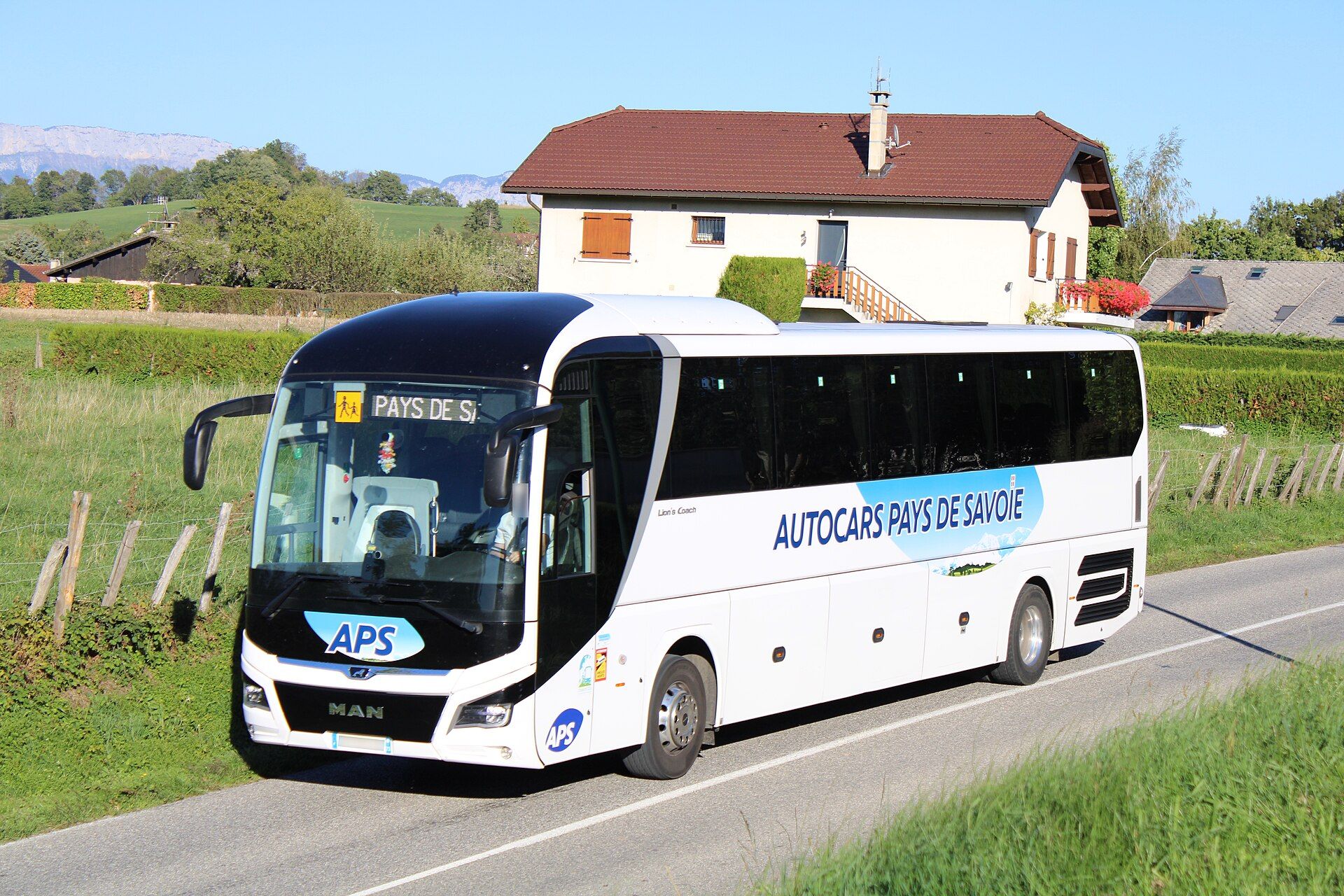

Model overview
Axle configurations: Two-axle (Lion's Coach, Lion's Coach C two axles) · Three-axle (Lion's Coach C three axles, Lion's Coach L)
Engine families
- Power
- 324–353 kW
- Torque
- 2250–2450 Nm
The figures above are the base MAN Lion's Coach, the 12,101 mm two-axle model. Three more bodies share the driveline: the C (two axles) at 13,091 mm, the C (three axles) at 13,361 mm and the L at 13,901 mm, all 2,550 mm wide and 3,870 mm high. Permissible total weight is 19,700 kg on the base coach, 20,600 kg on the two-axle C and 25,530 kg on both three-axle models. Maximum seats run 53, 59, 57 and 61 and luggage space up to 11.7, 14.3, 11.8 and 13.2 m³ — every sheet prints that row "max.", so they are ceilings per body rather than the hold of a particular coach — and the model with the most seats is not the model with the largest luggage maximum. Turning circles are 20,880 mm, 23,400 mm, 20,960 mm and 22,256 mm: the two-axle C needs the most room of the four although the L is 810 mm longer again — that subtraction is ours and MAN prints it nowhere. The engine card above carries the base coach's own two steps. The D 2676 LOH is offered at 324 kW with 2,250 Nm and 353 kW with 2,450 Nm on the two shorter models, and at 353 kW with 2,450 Nm and 382 kW with 2,650 Nm on the two longer ones, so 382 kW and 2,650 Nm belong to the 13,361 mm and 13,901 mm bodies plated 25,530 kg and to no 12,101 mm coach; the 01/2023 brochure marks the six-speed automatic gearbox "(only at 480 hp)" on the C (three axles) and the L, a restriction it puts on neither shorter model. A wheelchair lift is "Optionally available" on all four sheets and the fuel row reads "Diesel, HVO" on all four. The battery-electric MAN Lion's Coach 14 E is a separate driveline and is not in the grid above; its figures come from MAN's Lion's Coach E brochure footed 09/2025 and the Lion's Coach E technical-data page, not from the diesel documents. A three-axle body of 13,968 mm on 2,550 mm and 3,885 mm, a technically permissible gross weight of 27,300 kg, an electric central motor of 330 kW continuous with an automated 4-speed MAN TipMatic, NMC packs and CCS charging at up to 375 kW. Usable capacity is two figures per pack count and not one, because MAN sells two depth-of-discharge strategies: the 09/2025 brochure gives four, five and six packs 231, 289 and 347 kWh usable at 65 per cent depth of discharge and 320, 400 and 480 kWh at 90 per cent, and only the 90 per cent set reaches either technical-data table. The range belongs to that same set — "up to 650 km (Maximum range battery usage strategy)", footed "under optimal conditions" in the brochure and carrying MAN's own "[in-development]" marker on the page. The Lion's Coach E technical-data page carries the 14 E under the disclaimer "Vehicle is in prototype or development status", and MAN's release of 13 May 2025 puts series production in 2026 at Ankara, so the 14 E is not presented here as a vehicle on sale. Its published seat count is unresolved: 61 in the 09/2025 brochure and in the release of 13 May 2025, 63 in the release of 1 October 2025, and "max. 63+1+1" on the E technical-data page. No MAN Lion's Coach document opened states a Euro step, a kerb weight, a permitted axle load, a tyre size, a tank volume, a door arrangement, a wheel formula, a UN Regulation No 107 class or a UN Regulation No 66 declaration: the "Euro 6" above is MAN's own newsroom wording of 2021, from the releases of 16 February and 10 December that year, and no later MAN document restates it.
The Lion’s Coach is MAN’s touring coach, launched at Busworld in Kortrijk in autumn 2017 and sold since across four body lengths on one engine. MAN said in February 2021 that over 2,500 had been sold in Europe since the launch, over 500 of them in Germany alone over the preceding three years. Every diesel figure below is read from MAN’s own four per-variant data sheets, cross-read against their German twins, the brochure footed 01/2023 and MAN’s Lion’s Coach technical-data page. The battery-electric 14 E has documents of its own — the Lion’s Coach E brochure footed 09/2025 and the Lion’s Coach E technical-data page — and where a claim comes from those, from a press release or from Council Directive 96/53/EC instead, the text says which.
Four bodies, one driveline
The four are the Lion’s Coach at 12,101 mm, the C (two axles) at 13,091 mm, the C (three axles) at 13,361 mm and the L at 13,901 mm. All are 2,550 mm wide and 3,870 mm high, all carry the same engine and all take the same two gearboxes.
Maximum seats run 53, 59, 57 and 61 in that order, and luggage space up to 11.7, 14.3, 11.8 and 13.2 m³ — the sheets print that row “max.” and the brochure prints “max.” against each of its four columns too, so these are ceilings for each body and not the hold a particular coach has. The two do not move together: the C (two axles) seats fewer than the L and carries the largest luggage maximum of the four, while the C (three axles), 270 mm longer, is quoted 2.5 m³ below it. That 2.5 m³ is the gap between two maxima and it is our subtraction, not a figure MAN prints.
Turning circles show what the third axle buys: 20,880 mm for the base coach, 23,400 mm for the C (two axles), 20,960 mm for the C (three axles) and 22,256 mm for the L. The two-axle C needs the most room of the four, though the L is 810 mm longer again and turns in 1,144 mm less. All four subtractions here are ours and MAN prints none of them. On a hotel forecourt that inversion decides which model takes the work, and the axle configuration is the whole reason for it.
One engine, three power steps, two gearboxes
Every sheet carries the same block: the MAN D 2676 LOH Common Rail, a 6-cylinder unit of 12,419 cm³. The power steps split by body length rather than by choice. The base coach and the C (two axles) are offered at 324 kW (440 hp) with 2,250 Nm and at 353 kW (480 hp) with 2,450 Nm; the two long models start where the short ones stop, at 353 kW with 2,450 Nm and 382 kW (520 hp) with 2,650 Nm. Three outputs in all, two per body, with 353 kW the overlap. MAN’s technical-data page states the span as 440 to 520 hp and 2,250–2,650 Nm, so both ends of the programme are the maker’s own statement rather than an assembly of ours.
Two gearboxes run across all four models, and MAN names them three ways. The technical-data page has the MAN TipMatic Coach, a 12-speed automated manually operated gearbox, and the EcoLife, a six-speed automatic. The English sheets translate the first as a “12-speed semi-automatic manual gearbox”, where the German sheets print Automatisiertes 12-Gang-Schaltgetriebe — automated, not semi-automatic, a difference set out in automated manual transmissions.
One restriction belongs on an order form. In the brochure’s technical spread the six-speed automatic is marked “(only at 480 hp)” on the C (three axles) and the L, with no such note on either shorter model: on the two long coaches, the torque-converter box means the middle power step.
Weights, and what they are not
The base coach is plated at 19,700 kg, the C (two axles) at 20,600 kg and both three-axle models at 25,530 kg. Those are manufacturer’s permissible total weights, and not the same kind of number as the ceilings in Council Directive 96/53/EC, whose consolidated text of 14 August 2019 is in force. Article 1(2) makes the Annex I weights “valid as circulation standards and thus refer to loading conditions, not production standards”, and Article 4(2)(b) lets a Member State authorise national passenger transport that does not conform to them at all. Point 2.3.1 allows a two-axle bus 19,5 tonnes and point 2.3.2 a three-axle motor vehicle 25 tonnes, or 26 tonnes on either of two tyre-and-suspension conditions it sets out in full. Setting MAN’s plate beside those figures is our comparison, and it puts two different quantities side by side rather than stating compliance — a distinction read out in how to read a coach data sheet.
Length binds more directly, national traffic included: Article 4(1)(b) forbids a Member State to authorise normal circulation of national passenger transport vehicles not conforming to point 1.1, which caps a bus with two axles at 13,50 m and one with more than two at 15,00 m. The C (three axles) at 13,361 mm would fit the two-axle ceiling as well, so there the third axle is bought for weight rather than length.
The Euro step MAN does not print
Not one of the four data sheets states an emission class, in English or in German, and neither does the 01/2023 brochure or the Lion’s Coach technical-data page. The step recorded here is plain Euro 6, and it comes from MAN’s newsroom of 2021 rather than from any specification document: “a perfectly tuned Euro 6 driveline” on 16 February 2021 and “the optimised Euro 6 driveline” on 10 December 2021.
A sub-step exists in MAN’s material, and this page does not carry it. Inside the December 2021 release, the Sustainable Bus jury’s verdict is quoted on a D26 that “meets the Euro 6e standard” and makes up to 510 hp (375 kW). The other figure often read alongside it is not the jury’s: “a maximum overall permitted weight of up to 19.5 tonnes” is MAN’s own body text in that release, in the same run of prose that gives the “optimised Euro 6 driveline” this page does carry.
Both figures have been overtaken. The current sheets top out at 520 hp, and every one of the four models is plated above 19.5 tonnes: the base coach at 19,700 kg, the C (two axles) at 20,600 kg and both three-axle models at 25,530 kg. Setting those plates against MAN’s own 19.5-tonne sentence is our comparison and MAN makes none. “Euro 6e” is left off this page for a narrower reason than an unreliable release: it is a third party’s wording quoted in a newsroom item, and no MAN specification document for this model states any Euro step at all. Why a maker declining to name a step is not evidence of an early one is in Euro 6 and Euro 7 explained.
What we could not confirm
MAN’s English sheet for the C (three axles) prints “Permissible total weight 2,530 kg”. That is a typo in MAN’s document, not a reading error: it survives a table extraction, the German twin sheet prints 25.530 kg for the identical model and the brochure prints 25,530 kg. This page carries 25,530 kg and records the error rather than smoothing it away.
Rows a coach buyer expects are absent. No sheet carries a rated speed, a kerb weight, a permitted axle load, a tyre size, a tank volume or a floor height, and there is no door row at all. Four of those the comparable Mercedes-Benz facts sheet does print: permitted axle loads front, drive and trailing, a tyre size, fuel and AdBlue tank volumes, and a floor height over the roadway. The other two it does not. That sheet has no kerb-weight row either, and its only engine-speed row is headed “At speed [1/min]” without saying whether it qualifies rated power or peak torque — which is why the Tourismo page here leaves its own rated-speed row blank rather than reading it as one.
No MAN document states a vehicle class. Read against UN Regulation No 107 paragraph 2.1.1.3 as published at OJ L 52 of 23 February 2018 — vehicles constructed exclusively for the carriage of seated passengers, within the group above 22 passengers besides the driver — the Lion’s Coach answers to Class III, and that reading is ours rather than MAN’s; the bus class definitions set out what turns on it. Nor is there a rollover declaration anywhere, where the Tourismo facts sheet declares ECE-R 66.02 as standard: the only regulation MAN names is front impact protection to ECE-R 29, and what UN R66 requires is in bus rollover strength. Nor a retarder — constant speed downhill is credited to the EBS brake system with MAN BrakeMatic, a function rather than the hardware behind it, which is what retarders and engine braking covers.
The electric 14 E is not yet a coach you can buy
MAN showed a battery-electric Lion’s Coach 14 E at Busworld in October 2025. Its figures are not on the diesel documents at all; they come from the Lion’s Coach E brochure footed 09/2025 and the Lion’s Coach E technical-data page. A three-axle body of 13,968 mm, 27,300 kg technically permissible, an electric central motor of 330 kW continuous through an automated 4-speed MAN TipMatic, NMC packs and CCS charging at up to 375 kW.
Usable capacity has two figures per pack count, not one, because MAN sells two depth-of-discharge strategies. The 09/2025 brochure’s battery table gives four, five and six packs 231, 289 and 347 kWh usable on the reliable-range strategy at 65 per cent depth of discharge, and 320, 400 and 480 kWh on the maximum-range strategy at 90 per cent. Only the second set reaches either technical-data table: the brochure’s own, on page 22, prints “480 kWh (6 packs), 400 kWh (5 packs), 320 kWh (4 packs)”, and the E technical-data page gives the same set as “320 kWh to 480 kWh”. It is that set the range belongs to as well — the brochure prints “Up to 650 km” against “Maximum range battery usage strategy” and foots it “under optimal conditions”.
All of it sits under MAN’s own disclaimer on the E technical-data page: “Vehicle is in prototype or development status. Information derived from related products and projections. Information may change depending on the series status.” The range carries MAN’s “[in-development]” marker there as well, and MAN’s release of 13 May 2025 puts series production in 2026 at Ankara. Two figures disagree across MAN’s own documents: charging time is about 60 minutes minimum in the 09/2025 E brochure and about 1.5 hours on the E technical-data page, and the seat count is 61 in that brochure, 63 in the October 2025 release and “max. 63+1+1” on that page. MAN also states that “future integration of the MCS (Megawatt Charging System) standard will enable up to 750 kW” — announced, not delivered, which is the distinction megawatt charging turns on.
Who this coach is right for
One driveline across a mixed fleet is the argument: the same engine, gearboxes, width, height and assistance programme run through all four models, so parts, training and driver familiarity are shared while four lengths cover four kinds of work. The base coach is the access choice, for narrow depots and hill roads; the C (two axles) is the touring model, with the largest luggage maximum on the cheaper plate; the C (three axles) suits an operator who needs the heavier plate but not the two-axle C’s turning circle; the L is the seating model. Light or urban duty is the poor fit: a 12.4-litre coach with nothing smaller beneath it, whose wheelchair lift is optional on all four sheets rather than standard — the gap between an option and a genuinely accessible vehicle being the subject of bus accessibility.
Where it sits against its rivals
The Mercedes-Benz Tourismo, the Setra ComfortClass and the VDL Futura are what a European touring operator cross-shops. Only the Tourismo has a verified record here, and the two are unusually comparable: four lengths each, one engine family each, two axles or three. What differs is what the maker will put on paper. Mercedes publishes axle loads, tyre size, tank volumes, floor heights, a drag coefficient and a rollover declaration, and no MAN document opened for the diesel Lion’s Coach carries any of them; MAN publishes a turning circle and a permissible weight for every model, and a torque figure against every power step. Neither sheet prints a kerb weight.
What to check on a used one
Establish which body you are looking at, then read the plate: the model name does not settle the weight, both three-axle models being plated at 25,530 kg and both two-axle models below it, and the axle count is visible from the kerb — a check that belongs alongside the document work in buying a used coach.
Establish the power step next: three exist across the range but only two on any body, and within one body the two are invisible — a 324 kW base coach and a 353 kW base coach look identical from outside. Across bodies the step gives itself away, since 324 kW is offered only on the two-axle pair and 382 kW only on the three-axle pair, so the number on the paperwork should agree with the axles you counted at the kerb. On the two long models the gearbox narrows it, since the brochure offers the six-speed automatic there at 480 hp and no other output; on the shorter pair it says nothing.
Then read the equipment against the year. MAN’s list here runs to OptiView camera mirrors, Turn Assist, Lane Return Assist, Traffic Jam Assist, a Driver Monitoring System, Emergency Brake Assist and adaptive cruise among others, and what a given coach carries depends on when it was ordered. Which became compulsory, and when, is in mandatory driver assistance systems. Finally ask for the emission paperwork rather than the brochure: MAN prints no Euro step on this model’s data sheets, so the registration document is the only place the answer exists.
Quick answers
- Which engines are available in the MAN Lion's Coach?
- The record for the MAN Lion's Coach covers these engine families: MAN D 2676 LOH Common Rail (12.419 l). Output spans 324–353 kW and 2250–2450 Nm.
- What axle configurations does the MAN Lion's Coach come in?
- Two-axle (Lion's Coach, Lion's Coach C two axles), Three-axle (Lion's Coach C three axles, Lion's Coach L).
- What emission standard does the MAN Lion's Coach meet?
- Euro 6.
Compared with
- Mercedes-Benz Tourismo
- Setra ComfortClass 500
- VDL Futura
Sources
- MAN Lion's Coach — data sheet (man-bus-datenblatt-lions-coach-en.pdf) — MAN Truck & Bus
- MAN Lion's Coach C (three axles) — data sheet, the sheet printing 2,530 kg — MAN Truck & Bus
- MAN Lion's Coach C (Dreiachser) — German data sheet, printing 25.530 kg — MAN Truck & Bus
- MAN Lion's Coach brochure (footer D112.597 · pe01/2023), technical data spread — MAN Truck & Bus
- MAN Lion's Coach — technical data — MAN Truck & Bus
- MAN Lion's Coach E — technical data, with the prototype/development disclaimer — MAN Truck & Bus
- International success: MAN Lion's Coach proves a hit despite the pandemic (16 February 2021) — MAN Truck & Bus Press
- Council Directive 96/53/EC, consolidated text of 14 August 2019 — Article 1(2), Article 4(1)(b) and 4(2)(b), Annex I points 1.1 and 2.3 — EUR-Lex, Publications Office of the European Union
- The Tourismo — technical data and equipment at a glance (facts sheet, footer 03/2026), the comparison document for the rows MAN does not print — Daimler Buses / Mercedes-Benz Buses
- MAN Lion's Coach C (two axles) — data sheet (man-bus-datenblatt-lions-coach-c2-en.pdf) — MAN Truck & Bus
- MAN Lion's Coach L — data sheet (man-bus-datenblatt-lions-coach-l-en.pdf) — MAN Truck & Bus
- MAN Lion's Coach E brochure (footer D111.3679/e · 09/2025), technical data page 22 — MAN Truck & Bus
- Award-winning model: MAN Lion's Coach is the Sustainable Bus of the Year 2022 (10 December 2021) — MAN Truck & Bus Press
- Sustainable travel: Europe's first eCoach is made by MAN (13 May 2025) — MAN Truck & Bus Press
- MAN's first fully electric coach (1 October 2025) — MAN Truck & Bus Press
- Successful World Premiere: MAN Lion's Coach E Awarded Sustainable Bus of the Year 2026 (4 October 2025) — MAN Truck & Bus Press
- UN Regulation No 107 (OJ L 52, 23.2.2018) — paragraphs 2.1.1 and 2.1.1.3 — UNECE / EUR-Lex