Mercedes-Benz
Mercedes-Benz Tourismo
Four lengths from 12,295 to 13,935 mm on a single 10.7-litre engine, what separates the M/2 from the M/3, and the figures the current data sheet does not print.
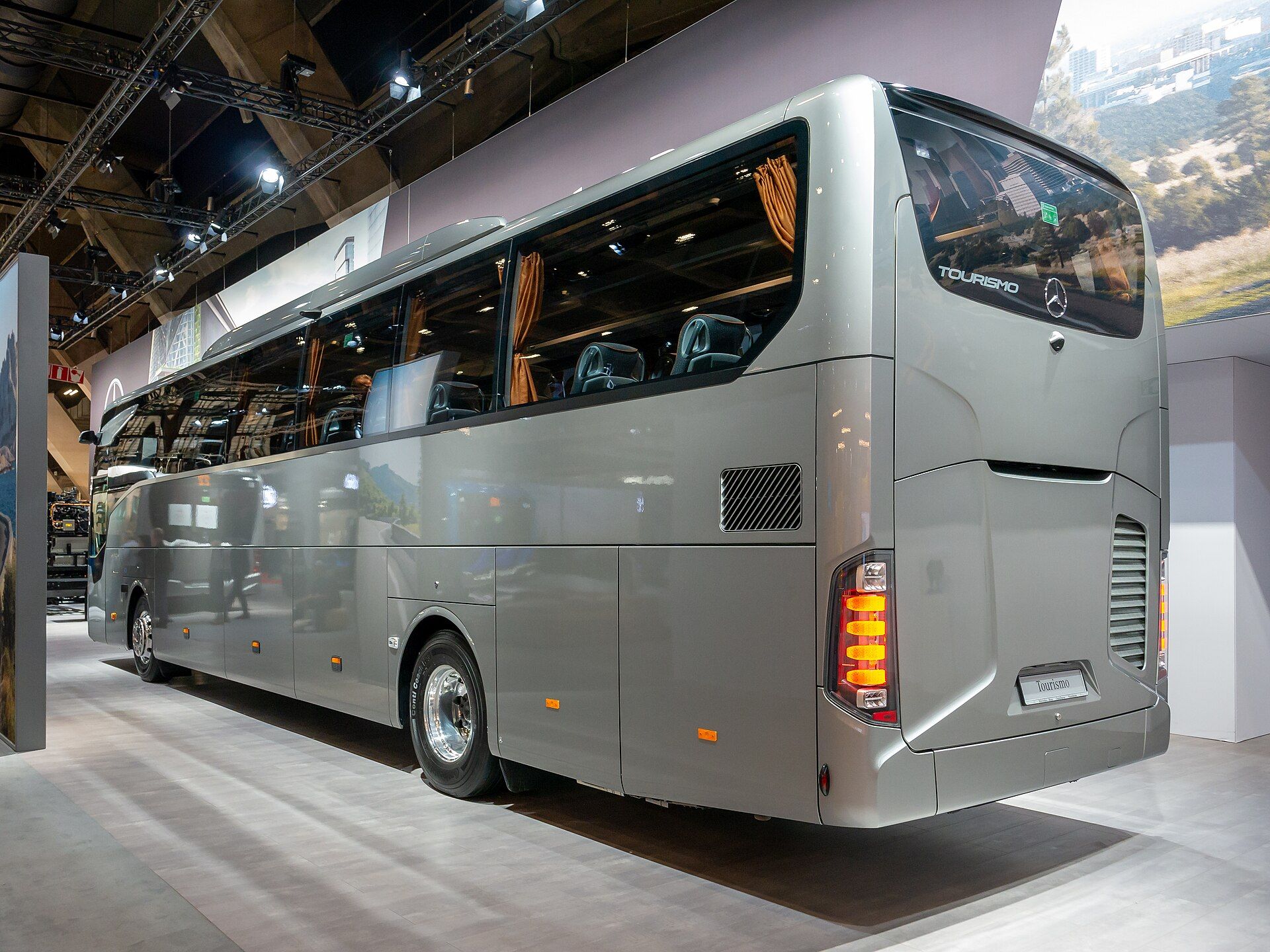
.jpg)
Model overview
Axle configurations: 4x2 · 6x2
Engine families
- Power
- 265–335 kW
- Torque
- 1700–2200 Nm
The grid above describes the base 12,295 mm two-axle Tourismo. Three longer models share the same body width, the same height and the same engine: the M/2 at 13,115 mm on two axles, the M/3 at 13,115 mm on three, and the L at 13,935 mm on three. The two-axle models are plated at 19,500 kg and the three-axle models at 24,750 kg. Standard seating is 1/51 on the Tourismo, 1/55 on both M models and 1/59 on the L, with passenger capacity between 44 and 65 depending on model and seat type. Turning circles are 21,634 mm on the Tourismo, 23,774 mm on the M/2, 21,428 mm on the M/3 and 23,327 mm on the L: the two-axle M/2 needs more room than the longer three-axle M/3, which steers its trailing axle. The L is offered with three power steps and the other three models with four. Gearbox offerings vary the same way, so the transmission row above is the base Tourismo's own: a fifth unit, the GO 230-6, is listed against the M/3 and against no other model.
The Tourismo is the high-deck touring coach Daimler Buses sells in volume. Daimler Truck says the 40,000th of them left the line at the beginning of 2026, and that the third generation has been available since autumn 2017 after more than 26,000 units. The release attaches neither figure to a particular generation, so this page does not either. A coach this common sets the second-hand market it trades in.
The specification tables below come from the facts sheet Mercedes-Benz hosts itself, dated 03/2026 in its footer, which covers four models. Where a claim comes from a Daimler Truck press release or from the maker’s marketing page instead, the text says which.
Four models, and what actually separates them
The four are the Tourismo at 12,295 mm, the M/2 and the M/3 at 13,115 mm, and the L at 13,935 mm. All four are 2,550 mm wide and 3,680 mm high. With mirrors the lengths become 14,296 mm, 13,476 mm and 12,656 mm, which matters at a depot gate more than the bare figure does.
The M/2 and M/3 share a length to the millimetre and differ in axle count. The M/2 is a two-axle coach; the M/3 puts a third, actively steered trailing axle under the same body. The axle configuration is the whole difference, and it shows up in two places on the data sheet.
The first is the turning circle. The M/2 needs 23,774 mm; the M/3, which is the same length, needs 21,428 mm, because it steers the trailing axle. The base Tourismo turns in 21,634 mm and the longest model, the L, in 23,327 mm — so the 13,935 mm three-axle coach manoeuvres in less space than the 13,115 mm two-axle one. On a hotel forecourt that inversion decides which model can take the work.
The second is where the length went. Front overhang is 2,890 mm on all four. Wheelbase is 6,090 mm on the Tourismo and the M/3 and 6,910 mm on the M/2 and the L, with a further 1,350 mm from drive axle to trailing axle where one is fitted, and a rear overhang of 2,785 mm on the three-axle models against 3,315 mm on the two-axle ones. Adding those together reproduces every printed length exactly on all four models — a check we ran, and one the facts sheet does not print.
One engine, four power steps
Every engine row of all four columns of the facts sheet reads the same block: the Mercedes-Benz OM 470, a 6-cylinder in-line unit of 10.7 litres, declared Euro VI E. What changes from column to column is the power step. The maker’s own marketing page for these same four models names a second, smaller engine that no row of the facts sheet carries; that conflict is set out at the end of this page.
The document lists 265, 290, 315 and 335 kW, and torque figures of 1,700, 1,900, 2,100 and 2,200 Nm. The L is the exception: it is offered with three steps rather than four, and 265 kW is not among them. Sub-step E is the one that added cold-start emissions to the on-road evaluation, which is set out in Euro 6 and Euro 7 explained; on a coach that spends winter mornings on short airport runs, that is not an academic distinction.
Five gearboxes appear across the four columns: Mercedes-Benz GO 190-6, GO 210-6, GO 230-6 and GO 250-8, plus a ZF Ecolife unit. No single column carries all five. The base Tourismo is listed with the GO 190-6, the GO 210-6, the GO 250-8 and the ZF; the GO 230-6 shows up on the M/3 and nowhere else; neither the M/3 nor the L is offered a GO 190-6; and the L is the one model with three gearbox rows rather than four. Daimler Truck describes the programme as a Mercedes-Benz manual, the fully automated Mercedes-Benz PowerShift and a ZF automatic with torque converter, and says the torque-converter box is available for all Tourismo models in conjunction with the 315 kW output. That is an availability pairing; the release does not say the box is offered with no other output.
Aerodynamics are quoted as an air resistance of 0.33 on all four models; Daimler Truck’s release names the same figure a drag coefficient.
Weights: what the third axle buys
The two-axle models are plated at 19,500 kg and the three-axle models at 24,750 kg. Permitted axle loads are identical across the range — 7,500 kg on the front axle and 12,600 kg on the drive axle — with 5,750 kg on the trailing axle where one exists.
Those axle figures do not add up to the plated weight, and are not meant to. Two axles at their individual maxima come to 20,100 kg against a 19,500 kg plate; three come to 25,850 kg against 24,750 kg. Both sums are ours. Each axle has a ceiling and the vehicle has a lower one that cannot be reached by loading every axle to its own.
The plated 19,500 kg is the same number as the 19.5 tonnes Annex I point 2.3.1 of Directive 96/53/EC allows a two-axle bus. That comparison is ours, and the two are not the same kind of number. Article 1(2) makes the Annex I weights circulation standards, referring to loading conditions rather than production standards, and Article 4(2)(b) lets a Member State authorise national passenger transport that does not meet them; the sheet’s figure is what the vehicle is plated at. The difference between the two kinds of number is read out in how to read a coach data sheet.
Luggage is the other reason for the third axle
Luggage volume is 12.1 m³ on the L and the M/2 and 9.9 m³ on the M/3 and the Tourismo. The two coaches of 13,115 mm carry different volumes because the third axle sits in the locker. An operator choosing between the M/2 and the M/3 is trading 2.2 m³ of hold — our subtraction — against a tighter turning circle and a heavier plate.
Seating runs the other way. Standard seating is 1/51 on the Tourismo, 1/55 on both M models and 1/59 on the L, with passenger capacity between 44 and 65 across the range depending on model and seat type. The model with the most seats is not the model with the most hold.
Two doors are fitted throughout, both in what the sheet calls position A. The central aisle floor sits 1,370 mm above the road on all four. A wheelchair space is optional on all four models. The lift is optional on the Tourismo, the M/3 and the L, and marked standard on the M/2 alone — an anomaly the sheet states without explaining, and exactly the kind of per-model detail that decides a tender, because the gap between an optional lift and a genuinely accessible vehicle is the subject of bus accessibility.
What the safety table declares
Active Brake Assist 6 Plus, Sideguard Assist 2, Frontguard Assist, Front Collision Guard, Traffic Sign Assist, Lane Assist, Attention Assist 2 and an extinguishing system are all marked standard on all four models, alongside disc brakes on every axle and a water retarder. Adaptive cruise control, MirrorCam and kneeling are options. Tyre pressure monitoring is marked both ways in the same document and is dealt with below. The regulatory backdrop to most of that list is in mandatory driver assistance systems.
The sheet also declares rollover strength to ECE-R 66.02 as standard on all four. No document cited here states a vehicle class. Read against the bus class definitions — constructed exclusively for the carriage of seated passengers, in the group above 22 passengers besides the driver — the Tourismo answers to Class III, and that reading is ours rather than the maker’s. Either way it is inside the regulation’s scope, which reaches single-deck Class II, Class III and class B vehicles above 16 passengers. What the 02 series requires, and the five ways it may be proved, is in rollover strength.
What we could not confirm
Three items that circulate widely about the Tourismo are not in the current facts sheet, and this page records none of them as a specification: the OM 936 engine, the C 410 type codes, and seat counts for kitchen and toilet variants. The type codes and the variant seating belong to an earlier edition of the data sheet. The OM 936 is a live disagreement rather than an old one. The Mercedes-Benz model overview page, cited here as well and describing the same four models on two or three axles, calls the OM 936 of 7.7 litres the entry-level engine and gives it a maintenance interval of its own, while every engine row of the facts sheet reads OM 470 in all four columns. The sheet offers no row the smaller engine could occupy, so no OM 936 figure appears here and the disagreement is left standing rather than settled in either direction.
The engine table carries a row headed “At speed [1/min]” reading 1.100 against every engine, and never says whether that qualifies rated power or peak torque, so the rated-speed row on this page is blank rather than guessed. The same table pairs 290 kW with 1,700 Nm and 265 kW with 1,900 Nm in the M/3 column, which reverses the ordering in the other three columns; no power-to-torque pairing is published here for that reason.
Three smaller inconsistencies are worth naming. The safety section carries a row reading “Rollover strength compliant with in ECE R29” one page before the ECE-R 66.02 row, both marked standard on all four models, and the document gives no way to reconcile them. Tyre pressure monitoring is printed twice under exactly the same name: standard on all four models in the safety and driver assistance table, and optional on all four in the profitability table one page later. The document offers nothing to choose between the two readings, so this page records no marking for it rather than taking the maker’s more flattering row. And the base Tourismo’s “Track circle minimal” cell reads 17,45 where its three siblings read 19,190, 17,252 and 19,589 mm — a decimal in a column of millimetres.
Who this coach is right for
The Tourismo suits an operator who wants one coach family to cover several kinds of work. The same 10.7-litre engine, the same body width and height and the same assistance package run through all four models, so a mixed fleet shares parts, training and driver familiarity while still offering four lengths.
The base 12,295 mm model is the one to choose where access is the constraint — narrow depots, hill villages, school and shuttle contracts — because it turns in 21,634 mm. The M/2 is the volume choice for touring: the longest two-axle model, and at 12.1 m³ the one with the largest hold. The M/3 is for operators who need 13,115 mm of body but cannot live with a 23,774 mm turning circle, and who can use the 24,750 kg plate. The L exists for maximum seating, at 1/59 standard.
It suits an operator less well where the work is genuinely light. Four power steps from 265 kW upwards and a 10.7-litre engine are a lot of coach for short regional runs, and a smaller vehicle will usually cost less to run for the same duty.
Where it sits against its rivals
The MAN Lion’s Coach, the VDL Futura and Daimler Buses’ own Setra ComfortClass are the vehicles a European touring operator actually cross-shops. This site holds no verified specification record for the three, so no figure-by-figure comparison is offered rather than one assembled from dealer listings.
What the documents do show is where the Tourismo positions itself: one engine block through every column of the data sheet, four lengths inside a single body, and a safety package the maker moved from the options list to standard. Against the Setra sold by the same company, an operator is comparing price positions inside one group rather than two engineering philosophies.
What to check on a used one
Start with the plate and the registration document, because on this range the model name does not settle the weight. A 13,115 mm coach may be plated at 19,500 kg or at 24,750 kg depending on whether it is an M/2 or an M/3, and the axle count is visible from the kerb. Check it alongside the wider document checks in buying a used coach.
Establish the power step. The sheet lists four, and a 265 kW coach and a 335 kW coach look identical from outside. Ask which gearbox is fitted as well: Daimler Truck pairs the ZF torque-converter automatic with the 315 kW output across all models, so that box is a reason to expect the 315 kW step rather than proof of it. The release states an availability pairing, not an exclusive one, and the paperwork is what settles the question.
Then check the equipment against the year. Daimler Truck’s 2024 release announced MirrorCam, LED headlamps as an option in the identical housing, and the Coach Infotainment Series. What that update lengthened was the options list rather than the standard one: MirrorCam is still marked optional on all four models in the current sheet, whose only row headed as headlamps offers Bi-Xenon with a cleaning system and offers it as an option, and whose LED row covers daytime running lights rather than headlamps. An earlier third-generation Tourismo is the same vehicle underneath, ordered from a shorter list. Tyres are 295/80 R 22.5 across the range. Finally, read the luggage volume against the seat count for the actual duty: both M models seat 1/55 as standard, and the M/3 gives 9.9 m³ of hold where the M/2 gives 12.1 m³.
Quick answers
- Which engines are available in the Mercedes-Benz Tourismo?
- The record for the Mercedes-Benz Tourismo covers these engine families: Mercedes-Benz OM 470 (10.7 l). Output spans 265–335 kW and 1700–2200 Nm.
- What axle configurations does the Mercedes-Benz Tourismo come in?
- 4x2, 6x2.
- What emission standard does the Mercedes-Benz Tourismo meet?
- Euro VI E.
Compared with
- MAN Lion's Coach
- VDL Futura
- Setra ComfortClass 500
Sources
- The Tourismo — technical data and equipment at a glance (facts sheet, footer 03/2026) — Daimler Buses / Mercedes-Benz Buses
- Tourismo — model overview — Mercedes-Benz Buses
- Successfully on the road: 40,000th Mercedes-Benz Tourismo rolls off the production line — Daimler Truck
- Mercedes-Benz Tourismo — the even safer, more comfortable, more economical and more user-friendly high-decker — Daimler Truck
- Mercedes-Benz Tourismo Safety Coaches — Safety Coaches from Daimler Buses define the state of the art — Daimler Truck