Mercedes-Benz
Mercedes-Benz Citaro
Four bodies on one floor plan — 12 m, short K, articulated G and low-entry LE. The lengths, engines, weights and turning circles Mercedes publishes, and what is missing.
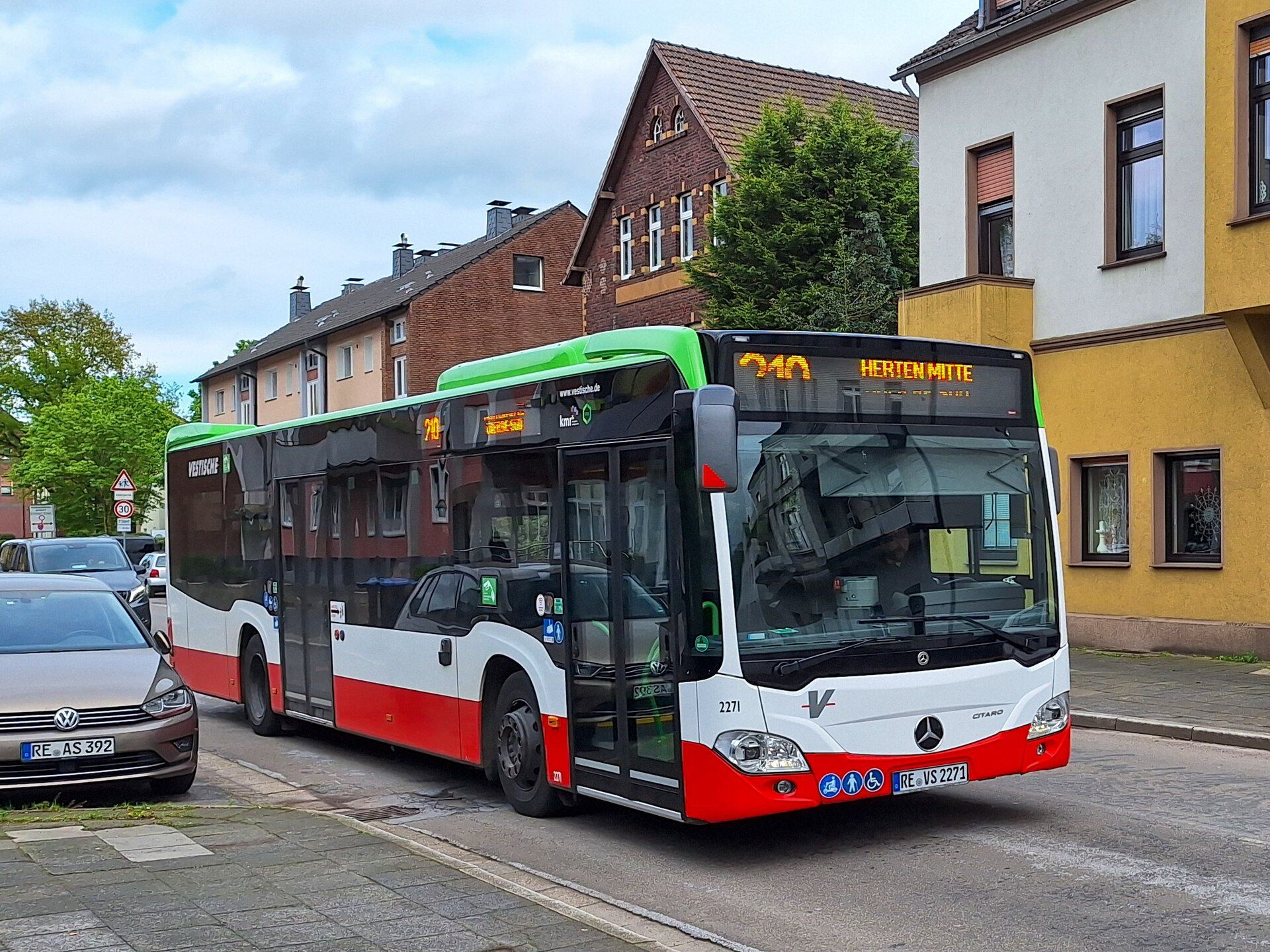

Model overview
Axle configurations: Two-axle · Three-axle articulated (Citaro G)
Engine families
- Power
- 220–260 kW
- Torque
- 1200–1400 Nm
- Power
- 265 kW
- Torque
- 1700 Nm
The figures above are the 12 m Citaro. The same data sheet covers three more bodies on one floor plan: Citaro K at 10,633 mm, articulated Citaro G at 18,125 mm and low-entry Citaro LE at 12,170 mm, all 2,550 mm wide and 3,095 mm tall bare — 3,120/3,130 mm with air conditioning, and 3,315/3,500 mm on the LE. Turning circles are 17,284 mm for the K, 22,970 mm for the G and 21,568 mm for the LE. Gross vehicle weight is 18,000 kg for the K and 28,000 kg for the G; maximum axle loads are 7,500 kg front and 13,000 kg drive on the Citaro, 7,245 kg and 11,500 kg on the K, 7,500 kg front, 10,000 kg centre and 13,000 kg drive on the G, and 7,500 kg and 12,600 kg on the LE. Directive 96/53/EC Annex I point 2.3.1 caps a two-axle bus at 19.5 t and point 2.4 a three-axle articulated bus at 28 t — maximum authorised weights for international traffic, which Article 4 leaves Member States free to disapply to national passenger transport — so the Citaro, the LE and the G sit exactly on the international ceiling. The 10.7-litre OM 470 is offered on the G alone, which is also listed with the OM 936; the Citaro and the K are listed with the 7.7-litre OM 936 h and OM 936 and the LE with the OM 936, at 220 kW, or 260 kW as an option. Maximum passenger capacity is printed as 1/106 for the Citaro and the LE, 86 for the K and 163 for the G.
The Citaro is the low-floor city bus Mercedes-Benz builds for scheduled urban and interurban service, and Daimler Buses calls it its best-selling city bus. Its world premiere was at the 1997 UITP Congress in Stuttgart; the second generation, which this page describes, followed in 2011 after more than 32,000 first-generation units, and Daimler Buses recorded the 70,000th Citaro in November 2024. Those are cumulative build figures across both generations, not a share of any national or European fleet, and no such share is claimed here.
Everything below comes from facts-citaro.pdf, the 04/2026 data sheet
Mercedes-Benz Buses publishes on its own site. Where it and the HTML model page
disagree, this page follows the PDF.
Four bodies on one floor plan
“Citaro” is four vehicles, and the data sheet is four columns. The Citaro is 12,135 mm long, the short Citaro K 10,633 mm, the articulated Citaro G 18,125 mm and the low-entry Citaro LE 12,170 mm — all 2,550 mm wide, the maximum Annex I point 1.2(a) of Directive 96/53/EC allows, and 2,950 mm across the mirrors.
The modularity is visible in the numbers rather than merely claimed. Front overhang is 2,805 mm on every body and rear overhang 3,430 mm on three of them, 3,330 mm on the LE. Length is carried by the wheelbase: 5,900 mm on the Citaro, 4,398 mm on the K, 6,035 mm on the LE, and on the G a 5,900 mm front axle to centre axle plus 5,990 mm centre axle to drive axle. Add overhangs back to wheelbases and every published length returns exactly — our addition, not the maker’s, but it shows the table is internally consistent.
Against Annex I point 1.1 of the same Directive, in force in its consolidated version of 14 August 2019, the 12 m car and the LE sit inside the 13.50 m allowed for a bus with two axles and the G inside the 18.75 m allowed for an articulated bus. None is dimensioned to the length ceiling. The class framework beside those limits is set out under bus classes under UN R107.
The height is two different numbers and only one is the vehicle
Bare height is 3,095 mm on all four bodies. Height including the air-conditioning system is a separate row — 3,120/3,130 mm on the Citaro, K and G, 3,315/3,500 mm on the LE — and a third row, for optional equipment, reaches 3,300 mm, 3,350 mm and 3,500 mm.
These are not interchangeable. The vehicle height is 3,095 mm; the figure a depot needs for door, washer and pit clearance is whichever of the other rows matches the specification ordered, because the roof pack is what meets the lintel. Inside, stand height is 2,313 mm, falling to 2,116 mm on the LE where the rear floor rises over the driveline.
Two engine families, one of them for the G alone
The Citaro and the K are listed with the OM 936 h and the OM 936, the LE with the OM 936 alone. The data sheet gives one set of figures for all of them: 7.7 litres, six cylinders in line, 220 kW with 1,200 Nm as standard or 260 kW with 1,400 Nm as the optional engine, maximum torque between 1,200 and 1,600 rpm. What separates the h from the plain OM 936 it does not say, and neither does this page.
The articulated Citaro G is the only body offered with the OM 470 at 10.7 litres: 265 kW and 1,700 Nm, maximum torque at 1,100 rpm. It can also be had with the OM 936, so the larger block is a choice about gradient and loading rather than a requirement of the articulated body.
Every column of the emissions row reads Euro VI and the data sheet names no step within it, so neither does this page — the difference between what Euro VI and Euro 7 require and what a brochure implies. The transmission is a Voith Diwa.6 four-speed automatic across the range and both engine choices. A hybrid system and a recuperation module appear as equipment rows with no figures attached, so none is claimed here, and where these drivelines sit against the alternatives is covered in city bus propulsion.
What the turning-circle rows are measuring
Turning circle is 22,970 mm for the Citaro, 17,284 mm for the K, 22,970 mm for the G and 21,568 mm for the LE. The articulated bus matching the 12 m car is the whole argument for articulation: half as much length again, and the joint gives the circle back.
Below those sit rows most readers skip. The data sheet repeats the turning circle on a circle labelled BOKraft — the Verordnung über den Betrieb von Kraftfahrunternehmen im Personenverkehr, a German federal ordinance made under the Personenbeförderungsgesetz, not a European instrument — printing 25,000 mm for the Citaro, the K and the LE, giving the ring the Citaro and G sweep on it as 6,791 mm, and stating a maximum permissible ring width, according to BOKraft, of 7,200 mm. Annex I point 1.5 of Directive 96/53/EC requires a vehicle in motion to turn within a swept circle of 12.50 m outer and 5.30 m inner radius, and the German figures and the European ones coincide: twice the outer radius is 25,000 mm, and the difference between the radii is 7,200 mm. Both figures are printed in the data sheet; what is ours is the observation that they are the Directive’s radii doubled and differenced, which neither document makes.
Weights and axle loads
Gross vehicle weight is 19,500 kg for the Citaro and the LE, 18,000 kg for the K and 28,000 kg for the G. Annex I point 2.3.1 of Directive 96/53/EC sets 19.5 t for a two-axle bus and point 2.4 sets 28 t for a three-axle articulated bus, and the Citaro, the LE and the G sit exactly on those figures, the K deliberately below.
Those two weight figures carry a narrower frame than the length and width limits used above. The Directive’s own title reserves weights to international traffic, and Article 2 defines a maximum authorised weight as the maximum weight for use of a laden vehicle in international traffic. Article 4 then makes only the dimension points — 1.1, 1.2, 1.4a, 1.5 and 1.5a — binding on vehicles in national passenger transport, and expressly permits a Member State to authorise national passenger vehicles that do not conform to point 2. A scheduled urban bus works almost entirely in national traffic, where the plated figure is set by national law. Sitting on 19,500 kg is therefore a design decision taken against the international ceiling, not compliance with a rule that binds the bus’s daily work.
Maximum permissible axle loads are 7,500 kg front and 13,000 kg drive on the Citaro; 7,245 kg and 11,500 kg on the K; 7,500 kg front, 10,000 kg centre and 13,000 kg drive on the G; and 7,500 kg with 12,600 kg on the LE. They add to more than the plated weight on every body, which is normal: it is the plated figure that binds.
Mercedes publishes no wheel formula for the Citaro anywhere in the document, so this page publishes none — only the hardware: a ZF RL 82 EC front axle on all four bodies, a ZF AV 133 drive axle on the Citaro and K, a ZF AV 130 with a ZF AVN 133 centre axle on the G, and a Mercedes-Benz RO 440 on the LE. The notation itself is explained under axle configurations.
Floor, doors and access
Floor height over the roadway is 370 mm, entry height 320 mm at every door the sheet lists — doors one and two on the Citaro, K and LE, all four on the G — door opening width 1,250 mm throughout, and tyres 275/70 R 22.5 on every body. Door count is 2 on the Citaro and K, 3 or 4 on the G, 2 or 3 on the LE; how those counts interact with exit requirements is set out under bus doors and emergency exits.
The 320 mm needs care. It is a manufacturer’s entry height, not the first-step height UN Regulation No 107 measures, and that test binds a door rather than the vehicle and has two limbs. Annex 8, paragraph 3.1, requires the first step from the ground of at least one service door not to exceed 250 mm on a vehicle of Class I or A — or, as an express alternative, not to exceed 270 mm in two door openings, one an entrance and one an exit. The same sentence sets 320 mm for Classes II, III and B, which is the sheet’s figure by coincidence and nothing more.
The condition under which a first step is measured is in Annex 3, paragraph 7.7.7.3: level ground, mass in running order, tyre equipment and pressure as the manufacturer specifies for the technically permissible maximum laden mass. Annex 8 then adds that on a low-floor vehicle a kneeling system, though not a retractable step, may be engaged for that measurement — so an optional kneeling row, which is how the Citaro carries it, is something the test may count rather than something shut out of it. Annex 8 states its own scope as vehicles permitting easier access for persons with reduced mobility, and paragraph 5.2 of the Regulation makes its technical provisions compulsory for vehicles of Class I, a class the data sheet never states for the Citaro. Why tyre choice alone can move a published entry height is worked through in bus accessibility.
Paragraph 2.1.4 defines a low-floor vehicle as one of Class I, II or A in which at least 35 per cent of the area available for standing passengers — on an articulated vehicle, of its forward section — is step-free and includes access to at least one service door. That qualifier is load-bearing for the G, where the 35 per cent is taken in the front section rather than across the whole bus. Mercedes calls the Citaro low-floor; of the LE it says only that the body combines the advantages of low-floor and high-floor buses, with a low-floor front section and a raised rear reached by two steps. “Low entry” is this page’s shorthand for that arrangement, and the Regulation defines no such term.
What we could not confirm
The HTML model page says the Citaro is available with outputs ranging from 220 to 290 kW. No 290 kW step appears in the data sheet, whose highest figure is 265 kW, so this page carries 265 kW and leaves the 290 kW claim where it was found. The data sheet also contradicts itself on AdBlue: one table gives usable volume as 27 l in all four columns, another 27, 27, 32 and 27 l. Both readings are in the spec file and neither is presented as settled. A second row does not reconcile at all: the BOKraft turning circle reads 25,000 mm for the Citaro, the K and the LE but 2,500 mm for the G, which cannot be a turning circle for an 18,125 mm vehicle. It is recorded as printed and nothing here is built on it.
Standard seating is printed as 1/31, 1/25, 42 and 1/34, and maximum passenger capacity as 1/106, 86, 163 and 1/106. The document never says what the figure before the slash counts, and it is missing from three of the eight cells — the G’s standard seating, and the K’s and the G’s maximum capacity — so the notation is reproduced rather than resolved.
Three things are absent altogether — a kerb weight, an approval class and a rated engine speed. Paragraph 2.1.1.1 of UN Regulation No 107, read with the paragraph 2.1.1 it sits under, calls a vehicle carrying more than 22 passengers in addition to the driver and constructed with areas for standing passengers, to allow frequent passenger movement, Class I; below that capacity paragraph 2.1.2.1 makes the same construction Class A. The data sheet states no class for the Citaro and neither does this page. The “at speed” rows follow the torque rows and give the speed of maximum torque, not a rated speed, so that field is blank.
Who this bus is right for
The 12 m Citaro is the default for dense urban stopping work: kerbside boarding, standing passengers, high door throughput, a plated weight that uses the whole two-axle allowance. The K exists for streets the 12 m car cannot use, and its 17,284 mm turning circle is what it buys with the seats and plated weight it gives up. The G answers a frequency limit rather than a geometry one: once headways cannot be cut further, capacity has to come from the vehicle, and here it does so without costing turning circle. The LE suits interurban work where a raised rear floor buys seats and volume. None is a coach — for longer-distance work read coach specifications instead.
Where it sits against its rivals
Against the MAN Lion’s City the comparison is closest, and in most tenders it turns on depot commonality and dealer coverage rather than the data sheets. The Solaris Urbino 12 has been the more aggressive competitor on battery-electric variants, which matters where a fleet is buying into a clean vehicle obligation; the Iveco Urbanway competes hardest on price and on gas. For a transport authority the decision is usually made on whole-life cost and service network, the ground covered in bus fleet operating costs.
What to check on a used one
Identify the body from the vehicle documents rather than by eye: a K and a 12 m car look alike in a photograph and differ in length, plated weight and drive axle rating. The engine follows from that — an OM 470 belongs only in a G, and an OM 936 in a G is a legitimate specification, not a downgrade. Take the air-conditioned height from the vehicle rather than the model: a bus bought against 3,095 mm and delivered at 3,130 mm is a building problem.
Ask for the complete emission-system record. On any Euro VI vehicle the aftertreatment is the expensive part to put right, and how the SCR system and AdBlue have been maintained is a fair proxy for the rest of the bus. On an articulated bus, ask about the turntable and its anti-jackknife controller, which Daimler Buses introduced in 2014 and lists as standard on the Citaro G. The sheet also marks rollover strength to ECE-R 66.02 as standard on all four bodies, and that is a declaration rather than a requirement discharged: UN Regulation No 66 applies by its paragraph 1.1 to single-deck rigid or articulated M2 or M3 vehicles of Classes II or III or Class B having more than 16 passengers, which leaves a bus built with areas for standing passengers outside it, while paragraph 1.2 lets a manufacturer ask for the approval anyway. Ask which of the two the approval paperwork records. The discipline that applies to buying a used coach applies here: the document trail is the vehicle.
Quick answers
- Which engines are available in the Mercedes-Benz Citaro?
- The record for the Mercedes-Benz Citaro covers these engine families: Mercedes-Benz OM 936 / OM 936 h (7.7 l), Mercedes-Benz OM 470 (10.7 l). Output spans 220–265 kW and 1200–1700 Nm.
- What axle configurations does the Mercedes-Benz Citaro come in?
- Two-axle, Three-axle articulated (Citaro G).
- What emission standard does the Mercedes-Benz Citaro meet?
- Euro VI.
Compared with
- MAN Lion's City
- Solaris Urbino 12
- Iveco Urbanway
Sources
- The Citaro — technical data and equipment at a glance (facts-citaro.pdf, 04/2026) — Daimler Buses / Mercedes-Benz Buses
- Citaro — model overview — Mercedes-Benz Buses
- 25 years of the Mercedes-Benz Citaro: stops along the route of Daimler Buses' best-selling city bus — Daimler Truck
- 70,000 Citaro buses from Mercedes-Benz — the all-electric eCitaro anniversary bus is on the road in the Netherlands — Daimler Truck
- Council Directive 96/53/EC laying down maximum authorised dimensions and weights for road vehicles, consolidated to 14.8.2019 — Annex I points 1.1, 1.2, 1.5, 2.3.1 and 2.4 — Official Journal of the European Union
- UN Regulation No 107 — uniform provisions concerning the approval of category M2 or M3 vehicles with regard to their general construction (OJ L 52, 23.2.2018) — paragraphs 2.1.1, 2.1.1.1, 2.1.2.1, 2.1.4 and 5.2, Annex 3 paragraph 7.7.7.3 and Annex 8 paragraph 3.1 — Official Journal of the European Union / UNECE
- UN Regulation No 66 — uniform provisions concerning the approval of large passenger vehicles with regard to the strength of their superstructure, 02 series of amendments (OJ L 84, 30.3.2011) — paragraphs 1.1 and 1.2 — Official Journal of the European Union / UNECE
- Verordnung über den Betrieb von Kraftfahrunternehmen im Personenverkehr (BOKraft) — Eingangsformel and § 16 — Bundesministerium der Justiz / Bundesamt für Justiz