Otokar
Otokar Kent
One name across five propulsions and four bodies — what Otokar publishes for the 12-metre Kent, where its own documents disagree, and which rows stay blank.

Model overview
Axle configurations: Two-axle · Three-axle articulated (Kent LF Körüklü) · Four-axle (Kent XL)
Engine families
- Power
- 220 kW
- Torque
- 1182 Nm
- Rated speed
- 2100 rpm
The figures above are the 12 m diesel — Kent LF in Turkey, KENT C 12 in Europe. Otokar sells the same name in four more bodies and five propulsions. The battery-electric e-Kent is 12,130 mm long and 3,220 mm tall on a 5,900 mm wheelbase, plated at 18,000 kg, with a Voith motor of 410 kW and 3,100 Nm, LFP packs of 497 kWh or 331 kWh, CCS2 DC charging in under 2.5 hours on the 497 kWh Option-1 pack with no time published for Option-2, a 22 per cent gradeability and a wall-to-wall turning radius of 10.8 m. The articulated Kent LF Körüklü is 18,750 mm on three axles rated 6.5, 10 and 12.5 tonnes, with a DAF engine of 10,837 cc at 270 kW and 1,900 Nm and four double-leaf inward doors. The 21 m Kent XL is a four-axle BRT bus plated at 34,000 kg, its axles rated individually at 7.5, 10, 11.5 and 6 tonnes, with three wheelbases of 5,900, 7,385 and 1,600 mm, one inward-opening front door and three side-sliding doors the KENT XL page calls outward-opening, and an Intarder in the gearbox. Its engine is the only Kent diesel Otokar names in full — a DAF MX 11, named on Otokar Europe's KENT C 21 page, of 10.8 litres and six cylinders at 270 kW and 1,900 Nm on KS90TA-21 — and it is offered on no 12 m Kent, which is why it is not a second entry in the engine block above. The Kent CNG runs a Cummins gas engine of 235 kW and 1,357 Nm; the Europe brochure adds a hybrid at 220 kW and a hydrogen fuel-cell bus 3,390 mm tall. Otokar's second engine step for the 12 m diesel, 204 kW with 1,082 Nm, appears on the superseded KS70TM-20 sheet and not on the current one, which also raised the front axle from 6.5 to 8 tonnes and the width from 2,540 to 2,550 mm. The only gross weights on an Otokar data sheet are the e-Kent's 18,000 kg and the Kent XL's 34,000 kg; the 2024 range brochure adds a third in a footnote, 28,000 kg for the articulated e-Kent. Passenger capacity is stated three different ways for almost every variant and the disagreements are recorded above rather than resolved. Otokar prints no wheel formula, no UN Regulation No 107 class and no UN Regulation No 66 declaration on any document opened.
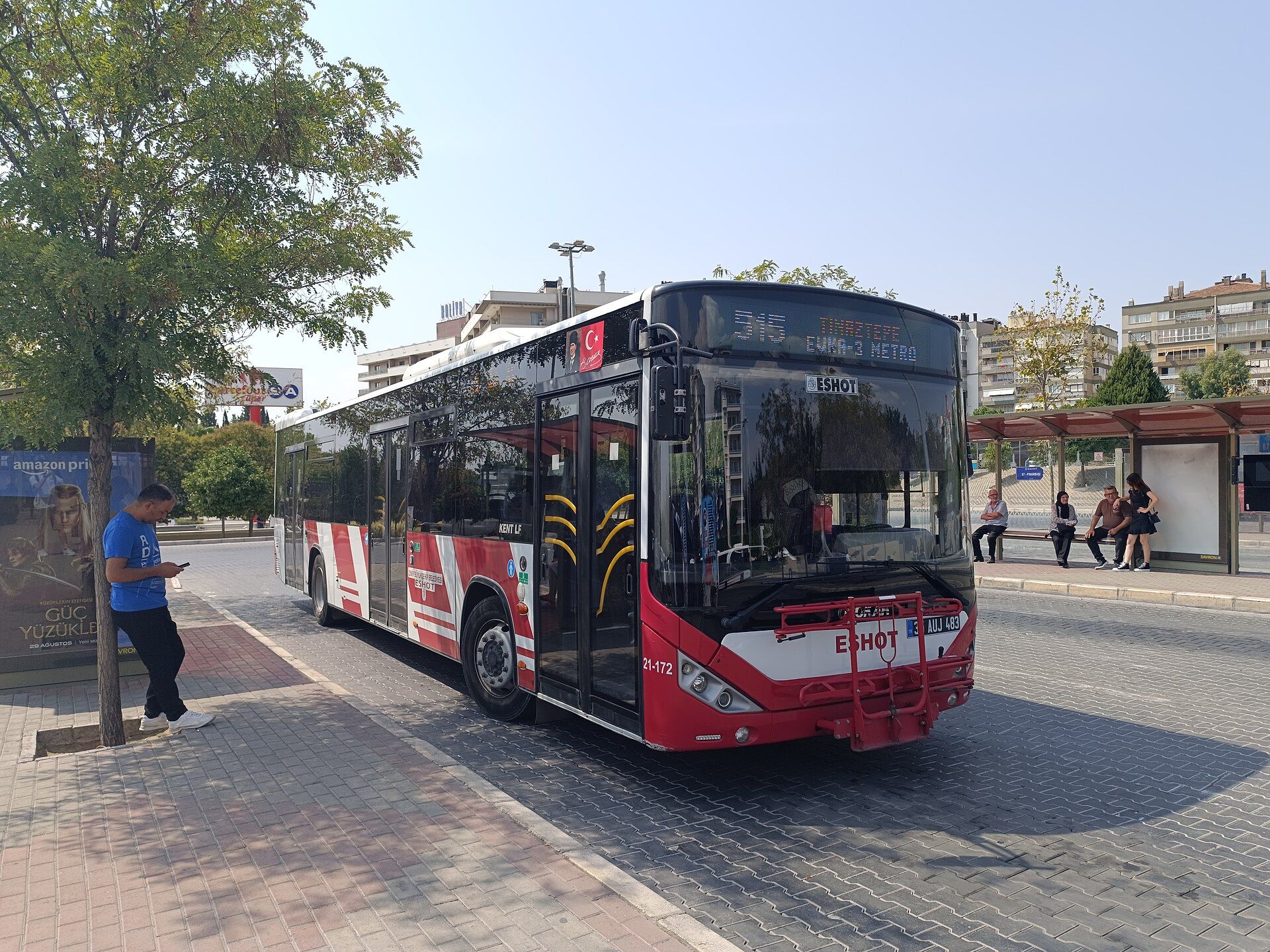
The Kent is Otokar’s city bus, and it is not one vehicle. The company’s own corporate timeline dates it to 2009 — the entry reads “KENT 12 metre şehiriçi otobüsleri” — and the name now covers lengths from 10.8 to 21 metres in diesel, natural gas, hybrid, hydrogen fuel cell and battery-electric form. The overview above is the 12-metre diesel alone — Kent LF on Otokar’s Turkish sheets, KENT C 12 in the European catalogue — except for its axle row, which names all three configurations the family is sold in. The rest of the family sits in the notes rather than the grid, because folding four bodies into one table would state figures belonging to different buses.
Otokar builds at Sakarya, and the history its timeline records is municipal: 400 Kent buses to the Municipality of Bucharest in 2019, the İzmir ESHOT tender in 2020, the İETT metrobüs tender in 2021. It is the first Turkish manufacturer here, a gap worth noting beside who builds trucks in Europe.
The name is a catalogue, not a model
Otokar’s Turkish range brochure lists Kent LF, Kent CNG, e-Kent, Kent LF Körüklü, Kent CNG Körüklü and Kent XL. The Otokar Europe brochure imprinted December 2024 lists KENT C 10, 12, 18 and 21, KENT C CNG, HYBRID and HYDROGEN, e-KENT C 10, 12 and 18, and KENT U LE 12. Neither list maps cleanly onto the other, and the timeline adds a sixth name, KENT Electra, for the 12-metre electric bus of 2019.
The consequence is not cosmetic. Ask how many people a 12-metre Kent carries and Otokar answers three ways: 26 seated and 76 standing on the Turkish data sheet; 102 in the Turkish range brochure and in the headline of its own English KENT C page; up to 108 in the European brochure and on Otokar Europe’s KENT C 12 page. The English KENT C page manages two figures by itself, 102 in its headline strip and 101 in its Performance text. The articulated bus is 155, 152 or up to 164 depending which page is open. None of it is reconciled here, only recorded: a tender has to quote one figure, and the buyer should know which document it came from.
The 12-metre diesel
The current sheet, document code KS70TP-26, gives a Cummins Intercooler turbo diesel of 6.7 litres, six cylinders in line, 220 kW at 2,100 rpm and 1,182 Nm between 1,150 and 1,400 rpm, declared to Euro 6. The gearbox is automatic, six forward and one reverse, with retarder function among the standard equipment; Otokar names no transmission maker. The front axle is independent and rated 8 tonnes, the rear rigid at 11.5 tonnes, on 275/70 R22.5 tyres. Top speed is limited to 80 km/h. The tanks hold 280 litres of fuel and 31 litres of AdBlue, a small reagent tank by SCR standards and the right size for a bus that sees a depot nightly.
The superseded revision, KS70TM-20, belongs beside it, because Otokar changed the bus without changing the name: width 2,540 mm rather than 2,550, height 3,145 rather than 3,165, a front axle of 6.5 rather than 8 tonnes, a four-speed automatic as standard with the six-speed optional, a 300-litre tank, and a second engine step of 204 kW with 1,082 Nm the current sheet has dropped. A used Kent LF is one document or the other and the badge does not say which. What the emission step fixed is in Euro 6 and Euro 7.
Five propulsions under one badge
No other model here is sold with five drives. The Kent CNG runs a Cummins gas engine of 235 kW and 1,357 Nm; the Europe brochure adds a hybrid at the diesel’s 220 kW and a hydrogen fuel-cell bus 3,390 mm tall against the diesel’s 3,165. Otokar’s hydrogen page puts a 410 kW motor behind a roof-mounted fuel cell with a battery of up to 140 kWh and claims 500 km of range; the European brochure gives the same bus 400 km. Which drive suits which line profile, and which counts as zero-emission in EU law, is in city bus propulsion.
The battery-electric e-Kent is the best-documented vehicle in the family and the worst-reconciled. Its 2026 sheet gives LFP packs of 497 kWh or 331 kWh, a Voith motor at a maximum 410 kW and 3,100 Nm, CCS2 DC charging in under 2.5 hours on the 497 kWh Option-1 pack — no time is published for Option-2 — and a wall-to-wall turning radius of 10.8 m. The 2024 Turkish brochure gives the same bus Li-ion of 300 kWh or 450 kWh charged at 150 kW. Otokar’s own e-KENT C page gives Li-ion NMC of 210, 280 or 350 kWh and a maximum power of 250 kW. Otokar Europe gives a “450 kW” battery — kilowatts printed where kilowatt-hours are meant, an error it repeats at 600 kW on the articulated. Four live Otokar pages, four answers. Charging overnight is the opposite case to the freight-side argument in megawatt charging.
What we could not confirm
Three fields a bus specification normally opens with are absent from every Otokar document for the diesel: wheelbase, gross vehicle weight and turning circle. Otokar publishes a wheelbase of 5,900 mm and a gross weight of 18,000 kg for the e-Kent, but that is a different vehicle on a different sheet — 12,130 mm long against the diesel’s 12,000 — and borrowing them would invent rather than report. A 2015 sheet carrying all three for the diesel exists on a distributor’s website; it is not Otokar’s and is not used here. On turning, Otokar publishes a wall-to-wall radius and never a circle, and doubling one would be this site’s arithmetic dressed as the maker’s figure.
Kerb weight is published nowhere, so payload cannot be derived. The Cummins carries no type number on any Otokar document, so the engine block above reads as a make. The one Kent engine Otokar does name in full is the Kent XL’s DAF MX 11, on Otokar Europe’s KENT C 21 page, and that belongs to a 21-metre bus rather than to the one in the grid, so it stays in the notes. No wheel formula appears anywhere, so the axle row counts axles rather than asserting a 4x2. Those rows are blank because Otokar does not fill them.
Axles, lengths and weights
The two gross weights Otokar prints on a data sheet belong to the extremes of the family. The e-Kent is plated at 18,000 kg; the 21-metre Kent XL at 34,000 kg on four axles rated individually at 7.5, 10, 11.5 and 6 tonnes — a sum of 35 tonnes against the plate, which is our addition and not Otokar’s. A third figure exists outside the sheets: the 2024 Turkish range brochure footnotes the articulated e-Kent’s capacity at a maximum laden weight of 28,000 kg. The XL is the only four-axle bus here, and its fourth axle is independent and rated 6 tonnes on the sheet, with Otokar’s KENT XL page adding that the axle steers — which is what lets a 20,995 mm vehicle work a BRT corridor; axle configurations covers what a fourth axle buys and costs.
Length is where European law bites. Annex I point 1.1 of Directive 96/53/EC sets maximum length at 13.50 m for a bus with two axles, 15.00 m for a bus with more than two and 18.75 m for an articulated bus, and Article 4(1)(b) requires Member States not to authorise the normal circulation of vehicles for national passenger transport that do not conform to it. The Kent LF Körüklü is 18,750 mm, sitting exactly on the articulated figure. The 20,995 mm Kent XL cannot be measured against either row from what Otokar publishes: Article 1(3) puts articulated buses with more than one articulated section outside the Directive altogether, Article 2 defines an articulated bus as one having two rigid sections and a single articulated section, and no Otokar document opened says how many articulations the XL has. Otokar sells it for the segregated BRT lines its own timeline records. How a plated weight differs from an authorised one is in gross vehicle and combination weights.
Doors, accessibility and a class nobody states
The Kent LF and e-Kent carry three double-leaf, inward-opening, air-actuated doors front, middle and rear; the articulated bus has four of the same type. The Kent XL is different: its sheet gives one double-leaf electric inward-opening door at the front and three double-leaf electric side-sliding doors behind it, which Otokar’s KENT XL page calls outward-opening — a station-platform decision rather than a styling one, as bus doors and emergency exits sets out.
What Otokar never states is the vehicle’s class under UN Regulation No 107. The Citaro and Solaris records here carry an explicit manufacturer declaration; no Otokar document opened carries an equivalent line for that Regulation or for UN Regulation No 66, whose paragraph 1.1 reaches Classes II and III and class B. With no class stated, neither can be settled from outside. What the classes decide is in bus classes, and what a rollover declaration means in UN R66. The accessibility hardware Otokar does publish — wheelchair layouts as alternative seating rows, kneeling, manual and electric ramps, Braille stop buttons — belongs with bus accessibility.
The 2026 sheets list the driver assistance systems by name and supplier: MOIS, BSIS and ISA from Knorr, plus DDAW, ESS, alcohol interlock preparation, reversing information and tyre pressure monitoring. No regulation is named beside them, so no compliance claim is made here; the timetables that bind are in mandatory driver assistance systems.
Who this bus is right for
A municipality buying on capital and running cost, with its own workshop, is the operator Otokar builds for: a full low floor, three wide doors and a passenger figure in the low hundreds on bought-in parts. It fits less well where a fleet engineer needs a complete specification before signing, since the gaps above have to be closed by asking. It is the wrong bus for interurban work, where Otokar’s own answer is the low-entry KENT U LE at 12,200 mm with seating for 49. The fleet running-cost case is in bus fleet operating costs.
Where it sits against its rivals
Against the Citaro, the Lion’s City and the Urbanway, the Kent competes on price and on the breadth of one platform: Otokar’s own brochures document diesel, gas, hybrid, fuel cell and battery under the Kent name, which no other record in this library can say. Whether a rival maker offers the same five drives under one of its own model names is not something the documents opened for this page can settle. Where it loses is documentation. Mercedes publishes a four-column data sheet with overhangs, turning circles and plated weights for every body; Otokar publishes an excellent sheet for the electric bus, a good one for the diesel with three fields missing, and marketing pages contradicting both. Otokar Europe holds more than 6,500 parts in a central European warehouse. How a newer entrant establishes itself is in new truck brands entering Europe.
Buying used
Start with the sheet, not the badge. Establish whether the bus is to KS70TM-20 or to the current KS70TP-26: the width, the height, the front axle rating, the gearbox and the engine step all changed between them. Then establish the auxiliary brake — an Intarder in the gearbox on the Kent XL, a retarder function in the gearbox on the Kent LF and the articulated bus, regeneration alone on the e-Kent. Three different maintenance stories, laid out in retarders and engine braking.
Ask for the plate rather than a brochure capacity, since Otokar’s own passenger figures differ by document, and ask for the wheelbase and gross weight in writing on a diesel. On an e-Kent the battery is the purchase: 497 kWh and 331 kWh are two different buses, and the brochure’s 300 and 450 kWh a third configuration again. The rest is the discipline of any secondhand passenger vehicle, set out in buying a used coach.
Quick answers
- Which engines are available in the Otokar Kent?
- The record for the Otokar Kent covers these engine families: Cummins (6.7 l). Output spans 220 kW and 1182 Nm.
- What axle configurations does the Otokar Kent come in?
- Two-axle, Three-axle articulated (Kent LF Körüklü), Four-axle (Kent XL).
- What emission standard does the Otokar Kent meet?
- Euro 6.
Compared with
- Mercedes-Benz Citaro
- MAN Lion's City 12
- Iveco Urbanway 12
Sources
- Kent LF — teknik özellikler (technical data sheet, document code KS70TP-26) — Otokar Otomotiv ve Savunma Sanayi A.Ş.
- e-Kent — teknik özellikler (technical data sheet, document code KS98TA-26) — Otokar Otomotiv ve Savunma Sanayi A.Ş.
- Kent XL — teknik özellikler (technical data sheet, document code KS90TA-21) — Otokar Otomotiv ve Savunma Sanayi A.Ş.
- Kent LF Körüklü — teknik özellikler (technical data sheet, document code KS82TD-20) — Otokar Otomotiv ve Savunma Sanayi A.Ş.
- KENT — urban and intercity bus range brochure (imprint OEU-24 EN, December 2024) — Otokar Europe SAS
- KENT C 21 — model page naming the DAF MX 11 — Otokar Europe SAS
- KENT C 12 — model page giving 12,000 x 2,550 x 3,165 mm and a maximum capacity of 108 — Otokar Europe SAS
- KENT C — model page (English) giving 102 in its headline strip and 101 in its Performance text — Otokar Otomotiv ve Savunma Sanayi A.Ş.
- KENT XL — model page (English) describing the steered fourth axle and outward-opening doors — Otokar Otomotiv ve Savunma Sanayi A.Ş.
- KENT C HYDROGEN — model page (English), Otokar commercial vehicles — Otokar Otomotiv ve Savunma Sanayi A.Ş.
- Tarihçe — Otokar corporate timeline — Otokar Otomotiv ve Savunma Sanayi A.Ş.
- Council Directive 96/53/EC on maximum authorised dimensions and weights, consolidated to 14.8.2019 — Articles 1(3), 2 and 4, Annex I points 1.1, 1.2, 1.5 and 1.5a — Official Journal of the European Union
- UN Regulation No 107 on the general construction of M2 and M3 vehicles (OJ L 52, 23.2.2018) — paragraphs 2.1.1, 2.1.1.1, 2.1.3 and 2.1.4, Annex 3 paragraphs 7.6.1.1, 7.6.1.2 and 7.6.1.6 — Official Journal of the European Union / UNECE
- UN Regulation No 66 on the strength of the superstructure of large passenger vehicles, 02 series (OJ L 84, 30.3.2011) — paragraphs 1.1 and 1.2 — Official Journal of the European Union / UNECE
- Kent LF — teknik özellikler, superseded revision (document code KS70TM-20) — Otokar Otomotiv ve Savunma Sanayi A.Ş.
- Şehir içi otobüsler — city bus range brochure (document code KS87TE-24) — Otokar Otomotiv ve Savunma Sanayi A.Ş.
- e-KENT C 12 — model page — Otokar Europe SAS
- KENT C 18 — model page — Otokar Europe SAS
- KENT C CNG — model page (English), Otokar commercial vehicles — Otokar Otomotiv ve Savunma Sanayi A.Ş.
- e-KENT ARTICULATED — model page (English), Otokar commercial vehicles — Otokar Otomotiv ve Savunma Sanayi A.Ş.
- e-KENT C — model page (English), Otokar commercial vehicles — Otokar Otomotiv ve Savunma Sanayi A.Ş.
- KENT C ARTICULATED — model page (English), Otokar commercial vehicles — Otokar Otomotiv ve Savunma Sanayi A.Ş.